Improved Method of Rice Cultivation / 4
April 27, 2026 | by anisurrahaman235f@gmail.com
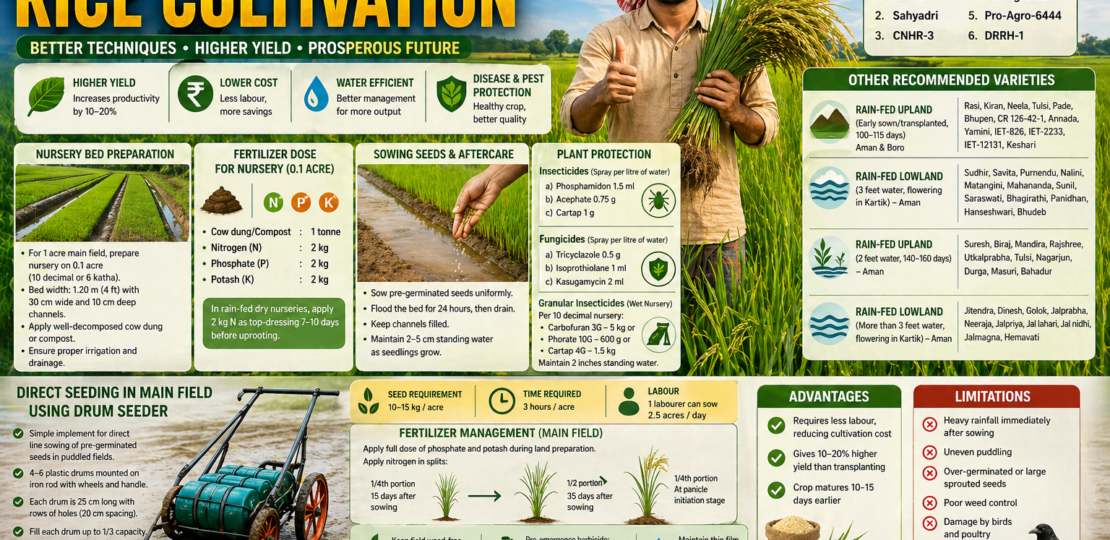
Hybrid Rice Varieties
(Medium duration: 120–140 days, suitable for Aman and Boro seasons)
- KRH-2
- Sahyadri
- CNHR-3
- Pro-Agro-6201
- Pro-Agro-6444
- DRRH-1
Rain-fed Upland (Early sown/transplanted, 100–115 days) – Aman & Boro
- Rasi
- Kiran
- Neela
- Tulsi
- Pade
- Bhupen
- CR 126-42-1
- Annada
- Yamini
- IET-826
- IET-2233
- IET-12131
- Keshari
Rain-fed Lowland (3 feet water, flowering in Kartik) – Aman
- Sudhir
- Savita
- Purnendu
- Nalini
- Matangini
- Mahananda
- Sunil
- Saraswati
- Bhagirathi
- Panidhan
- Hanseshwari
- Bhudeb
Rain-fed Upland (2 feet water, 140–160 days) – Aman
- Suresh
- Biraj
- Mandira
- Rajshree
- Utkalprabha
- Tulsi
- Nagarjun
- Durga
- Masuri
- Bahadur
Rain-fed Lowland (More than 3 feet water, flowering in Kartik) – Aman
- Jitendra
- Dinesh
- Golok
- Jalprabha
- Neeraja
- Jalpriya
- Jal lahari
- Jal nidhi
- Jalmagna
- Hemavati
Nursery Bed Preparation
To raise seedlings for transplanting in 1 acre of main field, prepare a nursery bed on 0.1 acre (10 decimal or 6 katha) of land. After ploughing and laddering the nursery area for easy weeding, spraying, irrigation, and top-dressing, divide the entire nursery into several broad strips. Each strip should be 1.20 metres (4 feet) wide. Around each strip, dig a channel 30 cm (1 foot) wide and 10 cm (4 inches) deep for proper drainage and irrigation.
Highly saline soils are not suitable for nursery beds. In mildly saline soils, ensure proper irrigation and never allow the bed to dry out. Well-decomposed cow dung or compost manure must be applied during nursery bed preparation.
Fertilizer Dose for Nursery
For 0.1 acre (10 decimal or 6 katha) nursery bed, apply the following basal dose:
- Cow dung or compost: 1 tonne
- Nitrogen: 2 kg
- Phosphate: 2 kg
- Potash: 2 kg
In rain-fed dry nurseries, do not apply nitrogen as basal dose. Instead, apply 2 kg nitrogen as top-dressing 7–10 days before uprooting seedlings, taking advantage of rainfall when the soil has moisture.
Sowing Seeds in Nursery and Aftercare
In dry nurseries, ensure that sprouted seeds are sown uniformly at the recommended rate. After sowing, flood the nursery bed with water and keep it submerged for 24 hours. Later, drain the excess water, keeping only the channels filled.
If pre-germinated (sprouted) seeds are used, light irrigation one day after sowing is sufficient. As the seedlings grow, gradually increase the water level in the nursery, but never allow more than 2–5 cm of standing water.
Plant Protection in Nursery
To protect rice seedlings from diseases and insect pests, timely application of pesticides in the nursery is essential. This builds early resistance in the plants and reduces problems after transplanting.
For Dry Nursery (7–10 days before uprooting seedlings):
For Wet Nursery (18–25 days after sowing):
Spray any one of the following insecticides per litre of water:
(a) Phosphamidon 1.5 ml
(b) Acephate 0.75 g
(c) Cartap 1 g
In wet nurseries, granular insecticides can also be applied. In Tungro-prone areas, granular insecticides are particularly effective. For every 10 decimal nursery, apply 5 kg Carbofuran 3G or 600 g Phorate 10G or 1.5 kg Cartap 4G and maintain 2 inches of standing water.
If blast or brown spot appears, spray any one of the following fungicides per litre of water:
(a) Tricyclazole 0.5 g
(b) Isoprothiolane 1 ml
(c) Kasugamycin 2 ml
Direct Seeding in Main Field using Drum Seeder
Drum seeder is a simple implement used for direct line sowing of pre-germinated rice seeds in puddled main fields. The machine consists of 4–6 plastic drums (6–20 cm diameter) mounted on an iron rod. Plastic wheels are fitted at both ends, and a handle is provided for pulling. The normal weight of the seeder is about 6 kg. Each drum is 25 cm long with rows of holes at both ends. The distance between two rows of holes on one drum is 20 cm.
Fill each drum up to one-third capacity with pre-germinated seeds. Pull the seeder on a well-puddled, levelled field with no standing water. Do not irrigate for 3–5 days after sowing. Gradually introduce water afterwards.
Seed requirement: 10–15 kg per acre.
Time required: 3 hours per acre. One labourer can sow 2.5 acres in a day.
Apply the full dose of phosphate and potash during land preparation. Apply nitrogen in splits:
- 1/4th portion 15 days after sowing
- 1/2 portion 35 days after sowing
- 1/4th portion at panicle initiation stage
Nitrogen can also be applied through LCC (Leaf Colour Chart). Keep the field weed-free for 40–50 days after sowing. A paddy weeder can be used for intercultural operations.
As a pre-emergence herbicide, spray 1200 ml Oxadiazon or 1500 ml Pendimethalin in 200 litres of water per acre within 3–6 days after sowing. Maintain thin film of water for 3–5 days after herbicide application.
Advantages of Drum Seeder Method
- Requires less labour, reducing cultivation cost
- Gives 10–20% higher yield than transplanting
- Crop matures 10–15 days earlier
Limitations
- Heavy rainfall immediately after sowing
- Uneven puddling
- Over-germinated or large sprouted seeds
- Poor weed control
- Damage by birds and poultry
Proper land preparation, timely weed management, and bird protection are essential for success in this method.
RELATED POSTS
View all

Nitrogen Fixation by Different Leguminous Crops in Soil
April 25, 2026 | by anisurrahaman235f@gmail.com