(c) In Enhancing the Effectiveness of Organic Manure:
April 25, 2026 | by anisurrahaman235f@gmail.com
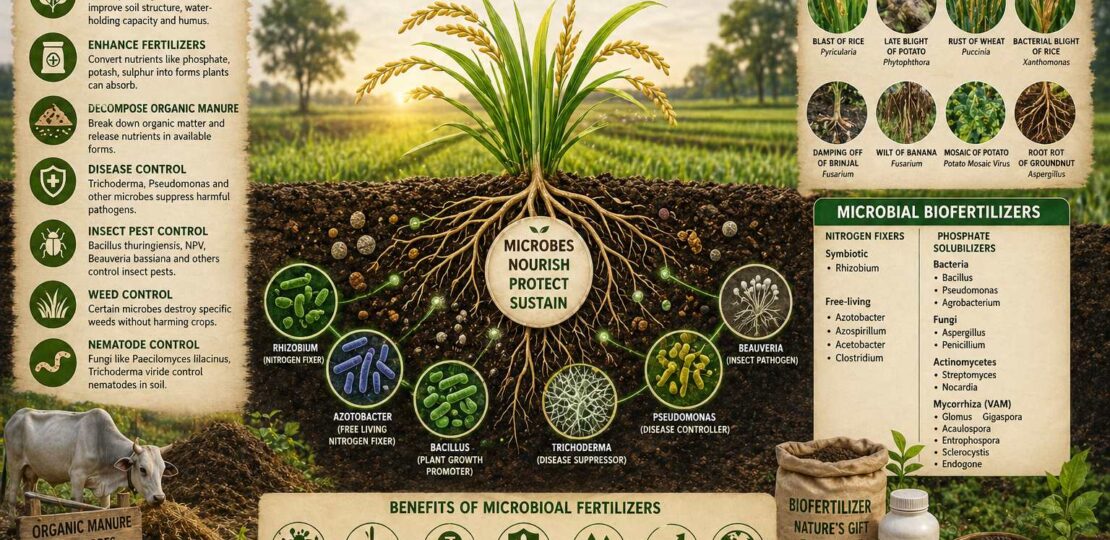
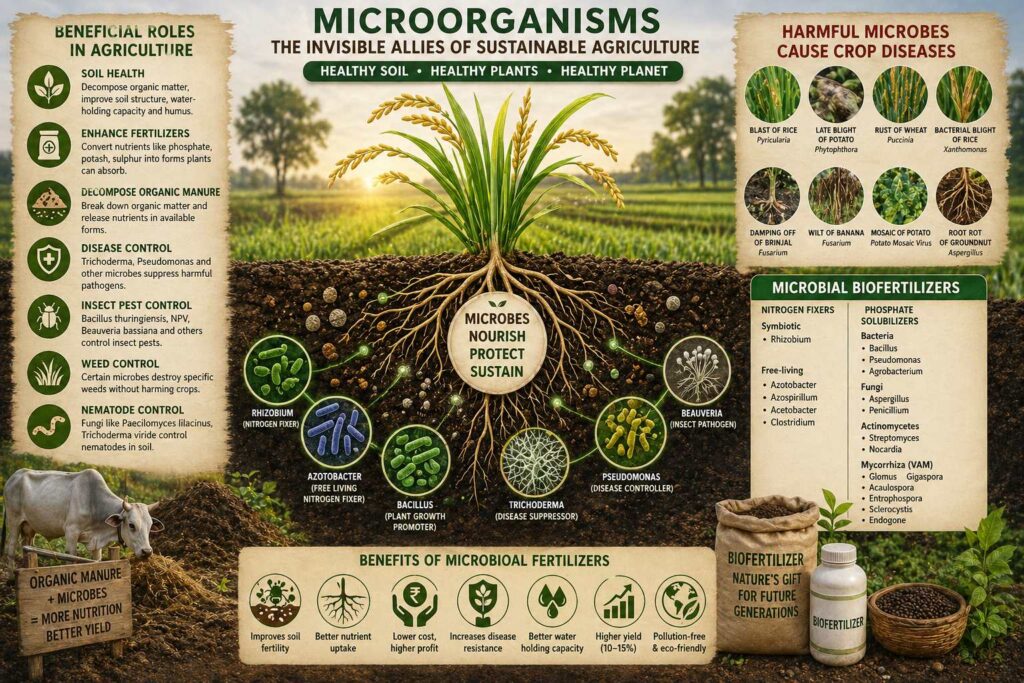
The organic manure applied to the soil decomposes in two ways: natural decay and decomposition through the action of microorganisms. Decomposition caused by microorganisms results in the breakdown of organic matter at a balanced rate. As a result, nutrients such as nitrogen, phosphate, potash, and various other food elements become available to plants in much larger quantities and in easily absorbable forms. The microorganisms directly and indirectly involved in this process include Serratia, Micrococcus, Pseudomonas, Bacillus, Clostridium, Corynebacterium, Azotobacter, and several species of fungi and actinomycetes.
Farmyard manure, cow dung manure, vermicompost, oilcake manure, Azolla, and blue-green algae—all forms of organic matter—undergo decomposition through the action of various microorganisms. In every gram of vermicompost, 2.5 × 10⁸ nitrogen-fixing microorganisms and a sufficient quantity of phosphate-solubilizing microorganisms can be found.
(d) In Disease Control:
Fungi and bacteria such as Trichoderma and Pseudomonas destroy various types of disease-causing pathogens present in the soil. They keep the soil healthy and protect crops from many different diseases.
(e) In Insect Pest Control:
Numerous microorganisms, including Bacillus thuringiensis, Nuclear Polyhedrosis Virus (NPV), and the fungus Beauveria bassiana, play a vital role in controlling various insect pests of crops. They manage pests while largely preserving the natural health of the environment.
(f) In Weed Control:
Many microorganisms, such as the fungus Phytophthora palmivora and Streptomyces hygroscopicus, specifically destroy certain weeds without causing any harm to the crops in the field.
(g) In Nematode Control:
The fungus Paecilomyces lilacinus is used to control soil worms or nematodes.
The fungus Trichoderma viride controls nematodes by encircling them with its mycelium.
Role of Harmful Microorganisms in Agriculture
Although the vast majority of the millions of microorganisms intimately associated with soil, water, and air are beneficial, quite a few play harmful roles. For example, denitrifying bacteria present in the soil break down nitrate compounds and release nitrogen gas, resulting in the loss of valuable fertilizer.
Several species of fungi such as Macrophomina, Pythium, Phytophthora, Rhizoctonia, and Colletotrichum; certain species of bacteria belonging to Pseudomonas and Xanthomonas; and viruses like Yellow Vein Mosaic Virus, Leaf Curl Virus, and Tungro Virus cause damage to crops. It is essential to understand the behavior of these harmful microorganisms and to control them effectively by using beneficial microorganisms—much like removing a thorn with another thorn—in a proper and targeted manner.
Incidence of Diseases in Various Crops Caused by Harmful Microorganisms
| Serial No. | Crop Name | Disease Name | Harmful Microorganism Name | Type / Class |
|---|---|---|---|---|
| 1. | Rice (Paddy) | Blast | Pyricularia | Fungus |
| Brown Spot | Bipolaris | Fungus | ||
| Bacterial Blight | Xanthomonas | Bacteria | ||
| Sheath Blight / Hollow Sclerotial Rot | Rhizoctonia | Fungus | ||
| False Smut | Clerosporium / Ustilaginoidea | Fungus | ||
| Udbatta Disease | Ustilago nuda | Fungus | ||
| Tungro | Rice Tungro Virus (RTV) | Virus | ||
| Stem Rot | Sclerotium | Fungus | ||
| Foot Rot / Bakanae Disease | Fusarium | Fungus | ||
| 2. | Jute | Stem Rot / Root Rot | Macrophomina | Fungus |
Diseases in Potato and Other Crops
| Serial No. | Crop Name | Disease Name | Harmful Microorganism Name | Type / Class |
|---|---|---|---|---|
| 3. | Potato | Early Blight | Alternaria | Fungus |
| Late Blight | Phytophthora | Fungus | ||
| Bacterial Wilt | Ralstonia solanacearum | Bacteria | ||
| Common Scab | Streptomyces | Actinomycete | ||
| Wart | Synchytrium endobioticum | Fungus | ||
| Mosaic | Potato Mosaic Virus (PMV) | Virus | ||
| 4. | Wheat | Brown Rust | Puccinia | Fungus |
| Smut | Ustilago | Fungus | ||
| Leaf Blight | Alternaria | Fungus | ||
| Septoria Leaf Spot | Septoria | Fungus | ||
| 5. | Betel Leaf | Foot and Leaf Rot | Phytophthora | Fungus |
| 6. | Sunflower | Root Rot | Macrophomina | Fungus |
| 7. | Pea | Downy Mildew | Peronospora | Fungus |
| 8. | Mustard | Downy Mildew / White Rust | Peronospora / Albugo | Fungus |
| 9. | Jackfruit | Fruit Rot | Rhizopus | Fungus |
| 10. | Groundnut | Root Rot / Collar Rot | Aspergillus | Fungus |
| 11. | Bottle Gourd | Powdery Mildew | Erysiphe | Fungus |
| 12. | Coconut | Bud Rot / Leaf Fall | Ceratocystis / Phytophthora | Fungus |
| 13. | Chickpea | Rust | Uromyces | Fungus |
| 14. | Groundnut | Tikka Disease | Cercospora arachidicola | Fungus |
| 15. | Banana | Sigatoka Leaf Spot | Mycosphaerella / Pseudocercospora | Fungus |
| Panama Disease / Wilt | Fusarium | Fungus | ||
| 16. | Brinjal | Wilt / Damping Off | Fusarium | Fungus |
| 17. | Cabbage | Black Root Rot | Phoma lingam | Fungus |
| 18. | Sugarcane | Red Rot | Colletotrichum | Fungus |
| 19. | Chilli | Anthracnose / Dieback | Colletotrichum | Fungus |
| 20. | Lemon | Canker | Xanthomonas | Bacteria |
Proper Application of Beneficial Microorganisms in Agriculture
Beneficial microorganisms must be understood thoroughly and applied at the right time and in the correct dosage in agricultural fields. Commercial production and supply of these microbial products have not yet become fully widespread or routine. Therefore, extra effort is required to procure them, and they must be used carefully and correctly.
Use of Beneficial Microorganisms as Biofertilizers
Beneficial microorganisms can be used as fertilizers in various ways. Bacteria, fungi, actinomycetes, and other microbes play specific roles in the presence of organic matter in the soil and supply plant nutrients. The major categories are described below:
1. Microorganisms for Nitrogen Fixation in Soil:
a) Symbiotic Microorganisms for Leguminous Crops:
- Rhizobium (Rhizobium-based biofertilizer)
b) Free-living Microorganisms for Non-leguminous Crops:
- Azotobacter
- Azospirillum
- Acetobacter
- Clostridium
2. Phosphate-Solubilizing Microorganisms for Insoluble Phosphates in Soil:
a) Phosphate-Solubilizing Bacteria
- Bacillus megaterium
- Bacillus polymyxa
- Pseudomonas striata
- Pseudomonas rathonis
- Agrobacterium sp.
b) Phosphate-Solubilizing Fungi
- Aspergillus awamori
- Aspergillus fumigatus
- Penicillium digitatum
c) Phosphate-Solubilizing Actinomycetes
- Streptomyces
- Nocardia
d) Vesicular Arbuscular Mycorrhiza (VAM)
- Glomus
- Gigaspora
- Acaulospora
- Entrophospora
- Sclerocystis
- Endogone
3. Role of Microorganisms in Preparation of Organic Manure and Decomposition of Organic Matter:
After organic matter is applied in manure pits or to the soil, various microorganisms begin the decomposition process. Bacteria, fungi, and actinomycetes break down complex organic compounds into simpler forms through hydrolysis, oxidation, reduction, and other processes, making them available to plants. Enzymes secreted by these organisms act as catalysts. Both anaerobic and aerobic bacteria accelerate the decomposition. The ideal Carbon:Nitrogen (C:N) ratio for decomposition should be around 12:1 on average. Aerobic bacteria first break down sugars, starch, and lignin.
Microorganisms Involved in Simplification and Decomposition of Organic Matter:
a) Cellulolytic (Cellulose-Decomposing) Microorganisms
- Trichoderma
- Chaetomium
- Aspergillus
- Cellulomonas
- Clostridium
- Nocardia
- Streptomyces
- Penicillium
b) Ligninolytic (Lignin-Decomposing) Microorganisms
- Clavaria
- Cephalosporium
- Humicola
4. Plant Growth Promoting Rhizobacteria (PGPR):
These beneficial bacteria live in the root zone of plants and promote growth. Important examples include:
- Bacillus cereus
- Bacillus firmus
- Bacillus licheniformis
- Bacillus circulans
- Bacillus subtilis
- Pseudomonas gladioli
- Pseudomonas cepacia
It is generally recommended to use Rhizobium for leguminous crops, Azotobacter, Azospirillum, Acetobacter, and Clostridium for non-leguminous crops, phosphate-solubilizing microorganisms for all crops, and recently PGPR-based biofertilizers.
Benefits of Using Microbial Fertilizers (Biofertilizers):
- The number and activity of beneficial microorganisms in the soil increase significantly. As a result, more carbon and nitrogen (approximately 20 to 200 kg of nitrogen per hectare) are added to the soil.
- Organic nitrogen, insoluble phosphates (approximately 30 to 50 kg per hectare), and potash are converted into forms that plants can easily absorb and utilize. This provides balanced nutrition to crops at lower cost and reduces the need for chemical fertilizers.
- The physical, chemical, physico-chemical, and biological properties of the soil improve.
- The plant’s nutrient uptake capacity increases. Vitamins, auxins, and other hormones are secreted, accelerating plant growth.
- Seed germination, flowering, and crop maturity occur faster.
- When microbial fertilizer is used in one crop, its beneficial effects remain in the soil for the subsequent crop as well.
- The plant’s disease resistance capacity increases, and soil-borne diseases are kept under control.
- It helps in the decomposition of organic matter, enhances soil fertility, maintains nutrients, and causes no adverse side effects on the natural growth of plants.
- The water-holding capacity of the soil and air circulation within the soil increase.
- Crop yield generally increases by 10–15%.
- It plays an important role as a pollution-free and environment-friendly agricultural input.
- It is required in very small quantities, is available at low cost, and reduces overall cultivation expenses.
RELATED POSTS
View all