

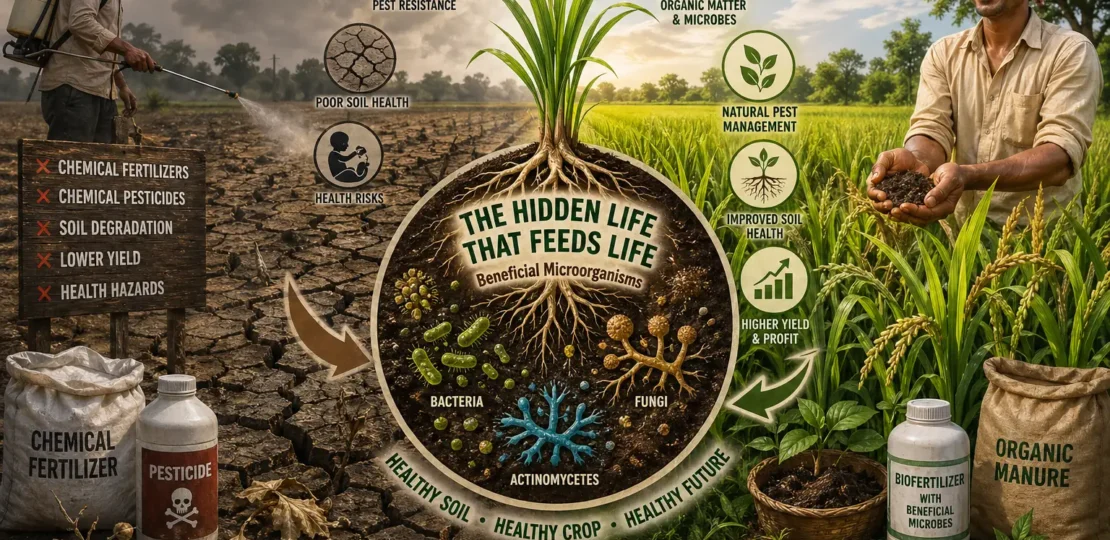
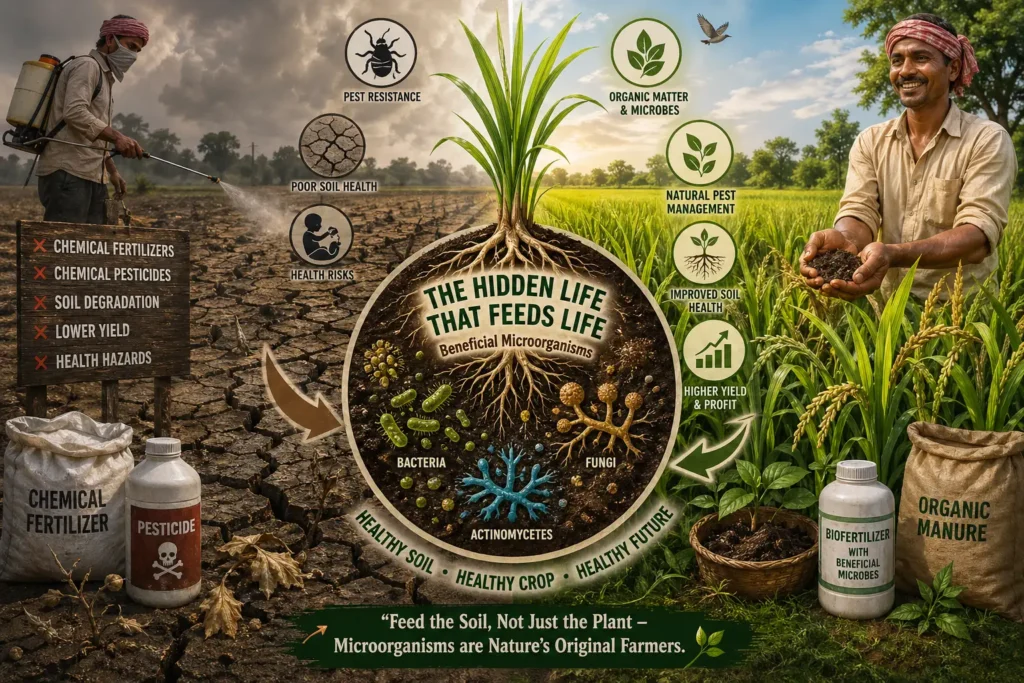
Since the dawn of human civilization, driven by the need to satisfy their hunger, humans have adopted agriculture as an inseparable part of their way of life. At that time, there were no high-yielding varieties of crops, no pressing need or concern for irrigation, and no use of chemical fertilizers or pesticides. Farmers grew crops in the same natural rhythm and manner as their daily eating and sleeping routines. Yet, crops were produced successfully. Without the application of advanced technology, the agriculture of our country as well as the world has survived for thousands of years in an almost completely natural rhythm. The disruptions in this rhythm that have occurred are the result of cultivating high-yielding and hybrid varieties to meet growing demands, the use of irrigation water, increased cropping intensity, and the application of chemical fertilizers and pesticides.
In earlier times, farmers’ homes had cattle sheds full of livestock, and grazing lands were freely available. The dung and urine of livestock would naturally fall on the fields throughout the day. Additionally, the dung and urine swept from the cattle shed would be collected in nearby manure pits. These pits would fill up and the manure would then be carted and applied to the fields. This process added abundant organic matter to the soil. That organic matter served as food, clothing, and shelter for the millions of microorganisms living in the soil. Microorganisms cannot survive without organic matter, and without microorganisms, organic matter does not decompose. The effectiveness of chemical fertilizers is also not realized in the absence of microorganisms. Therefore, traditional farmers, following natural laws—perhaps unknowingly—maintained a proper environment for the nurturing and growth of these beneficial microorganisms.
Wherever there are crops, there will be diseases and pests. Even if in small numbers, they existed in those days as well. People used to spray cow dung solution, garlic juice, cow urine, and liquid manure prepared by decomposing vines and leaves at home. These methods protected the crops. References to such practices can be found in ancient texts. In other words, the tradition of maintaining healthy soil through the application of organic matter has been continuing since the beginning of civilization. The practice of spreading soil from fields where pulse crops (legumes) have been grown onto new, virgin land before sowing pulses has become a deeply ingrained habit in the farming community of our country.
The use of microorganisms for controlling insect pests also has a very ancient history. As early as 2700 years before the birth of Christ, the existence of disease-causing microorganisms in the bodies of honeybees was discovered in China. Ancient Indian literature also contains references to honeybees becoming diseased. Crops have been observed to be affected by various insects and mites, viruses, bacteria, fungi, protozoa, rickettsia, mycoplasma, and nematodes.
In 1879 AD, the Russian scientist Metchnikoff was the first to demonstrate that insect pests could be controlled by infecting them with microorganisms. He proved this by infecting the “grub” stage of beetle-type insect pests of food crops with the fungus Metarhizium anisopliae. This same fungus can easily control the “grub” or immature stages of the “curculio” type of insect pest in sugar beet. More than 3000 microorganisms are capable of infecting and killing insect pests. In 1926, Sanford succeeded in controlling potato scab disease by increasing the population of beneficial microorganisms through the application of organic manure in the soil. In 1930, researchers observed that antibiotics produced by beneficial microorganisms were capable of controlling harmful fungi and bacteria.
What Are Microorganisms?
Microorganisms or microbes are the tiniest microscopic living beings that inhabit nature. They influence the nutrition and growth of living organisms both directly and indirectly. While most microorganisms are beneficial, some play harmful roles. Microorganisms are the oldest form of life on Earth. They exist in countless numbers mixed with water, soil, and dust particles in the air—including bacteria, fungi, viruses, mycoplasma, actinomycetes, and others. These innumerable microorganisms are directly and indirectly involved in the processes of creation, sustenance, and destruction. In the field of agriculture, their role is the broadest and most extensive.
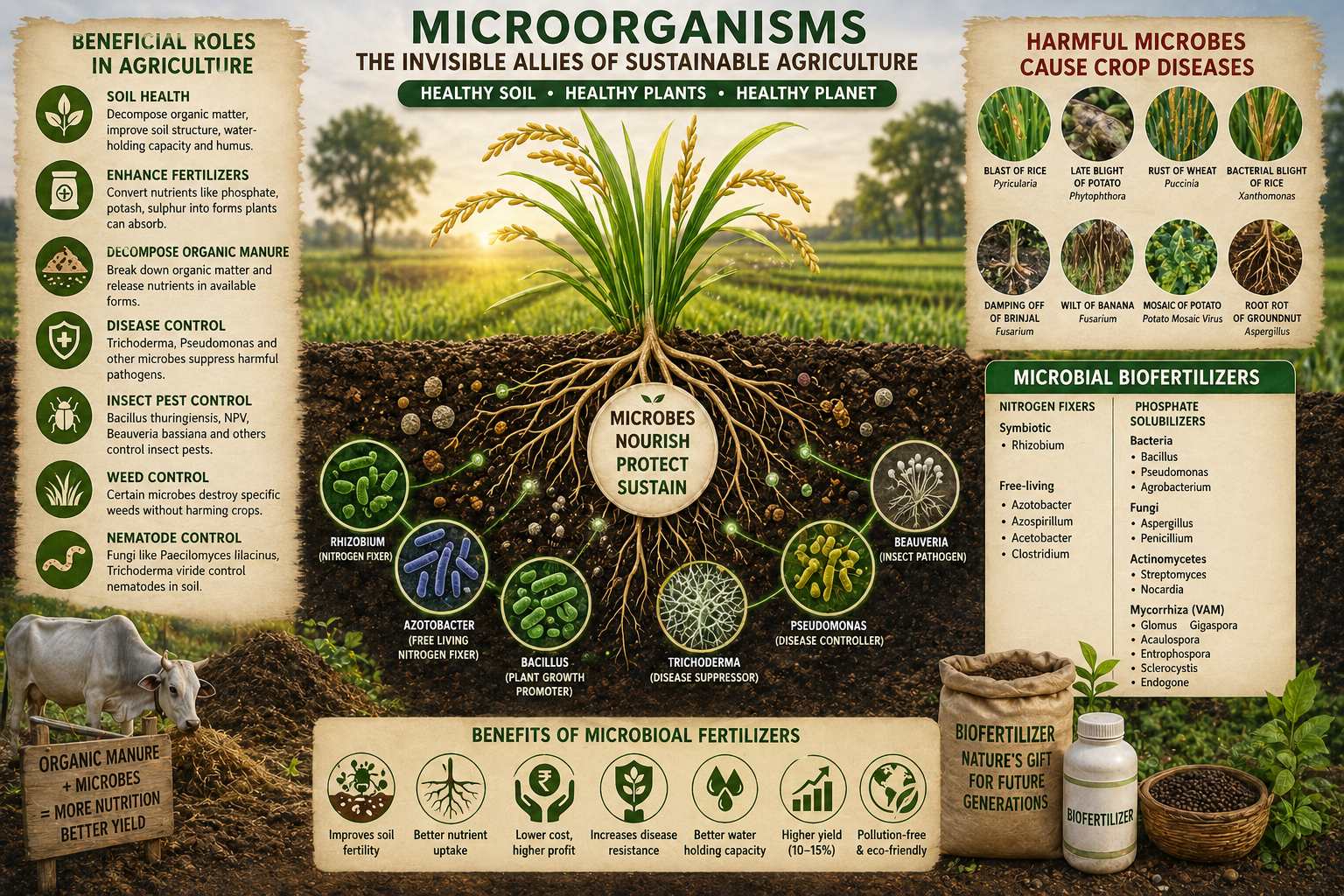
Microorganisms, fungi, and actinomycetes living in the soil not only collect nitrogen from the air and supply it to plants, but some microorganisms also solubilize stored nutrients in the soil (such as phosphates and potash) and make them available to plants on a regular basis. Some of the microorganisms residing in the soil live symbiotically in the roots of plants (for example, Rhizobium bacteria form nodules at the base of leguminous crops). Others live freely in the soil and supply nutrients to plants. Certain special types of microorganisms survive by consuming the “lipids” on plant leaves and, in turn, provide food to the plants.
In ideal soil rich in organic matter, one gram of soil can harbor 1 crore (10 million) bacteria, 10 lakh (1 million) fungi, and 1 lakh (100,000) actinomycetes. Again, in the top 15–20 cm layer of one acre of land, 180–1,800 crore bacteria can be found.
Microorganisms are generally unicellular. Bacteria belong to the animal kingdom, while fungi belong to the plant kingdom. Among the microorganisms living in the soil, only about 5% are harmful, while the remaining 95% are beneficial.
Besides bacteria, fungi, or actinomycetes, quite a few viruses also help control pest insects.
Historical Context of Commercial Use of Microorganisms in Agriculture
In the agricultural sector of this state as well as this country, the traditional system experienced a major disruption in 1956 with the Second Five-Year Plan, when greater emphasis was placed on agriculture.
At that time, our country did not have the capacity to provide two square meals a day to its people and had to depend on the mercy and generosity of foreign nations. Therefore, from that year onward, the slogan “Grow More Food” was adopted, and efforts were launched to increase crop production. Without creating a strong foundation of planning and infrastructure, the rush toward development led to the expected outcome—vast quantities of food grains were produced. We have now moved beyond dependence and have become exporters of agricultural products. However, the uncontrolled and reckless use of chemical fertilizers and chemical pesticides, the exploitation of groundwater, the tendency to cultivate high-yielding and hybrid crop varieties, indifference toward organic manure, the introduction of machinery along with the disappearance of traditional wooden ploughs, and the consequent decline in the number of livestock—all combined—have brought the country’s agricultural system to the brink of a crisis in the pursuit of even higher yields.
Even after applying chemical fertilizers, the desired yield is no longer being achieved. When chemical pesticides are used, more non-target insects and beneficial organisms die than the actual pests. Chemical pesticide residues are now found in cow’s milk and even in mother’s breast milk. In the past few years, many insects that were not previously enemies of crops have turned into crop pests. Due to globalization and GATT agreements, the reduction and withdrawal of subsidies have caused the prices of chemical fertilizers and pesticides to skyrocket. All these factors combined have begun to make people associated with agriculture seriously think about the current situation.
While searching for a way out of this situation, the hidden path has been discovered: the use of organic matter and microorganisms. These ancient and original members of civilization—these microorganisms—despite some limitations, represent the most effective, environment-friendly, profitable, sustainable, and simple medium. Through them, soil fertility can be maintained on one hand, while diseases, pests, and weeds can be controlled on the other. On one side are the sky-high prices of chemical fertilizers and pesticides, and on the other side are the harmful environmental effects and disappointing results caused by their uncontrolled and irregular use. Caught in this dilemma, when the farming community is gasping for relief, the time has truly arrived for the commercial use of beneficial microorganisms in agriculture.
Various government, semi-government, and private organizations have come forward with the commercial production of different types of microorganisms. Now, what is needed is proper knowledge and understanding followed by their correct application.
The government, realizing the seriousness of the problem, has directed chemical fertilizer manufacturers to also produce microbial fertilizers. Commercially, organizations such as IFFCO, Hindustan Fertilizer Corporation, and others have introduced several microbial fertilizers in the market over the past few years.
Keeping in mind the highly intensive cultivation areas like West Bengal and the promising market potential, many private companies and multinational corporations have already started marketing microorganisms suitable for use in agriculture.
However, most of these inputs can be easily produced by the farmers of Bengal themselves. If this effort can be successfully implemented, farmers will easily be able to free themselves from the trap of commercial organizations.
Role of Beneficial Microorganisms in Agriculture
The areas in agriculture where beneficial microorganisms play a special role are as follows:
(a) In Maintaining Soil Health:
The primary component of soil is organic matter. Various types of microorganisms cause the decomposition of this organic matter, making it available in a form that plants can absorb. They help regulate the soil’s acidity and alkalinity, improve soil structure, aggregation, and water-holding capacity, control the soil’s electrical conductivity, and build and enrich the “humus”—the life force of the soil.
(b) In Enhancing the Effectiveness of Chemical Fertilizers:
Various types of chemical fertilizers, upon coming into contact with the soil, undergo numerous physical and chemical processes and break down into forms that plants can absorb. In these complex processes, different types of microorganisms play important roles. Microorganisms such as Clostridium, Micrococcus, Achromobacter, Bacillus, Frateuria, Acetobacter, and many others play a major role in converting complex forms of nutrients like phosphate, potash, and sulfur stored in the soil into forms that plants can readily take up.
RELATED POSTS
View all

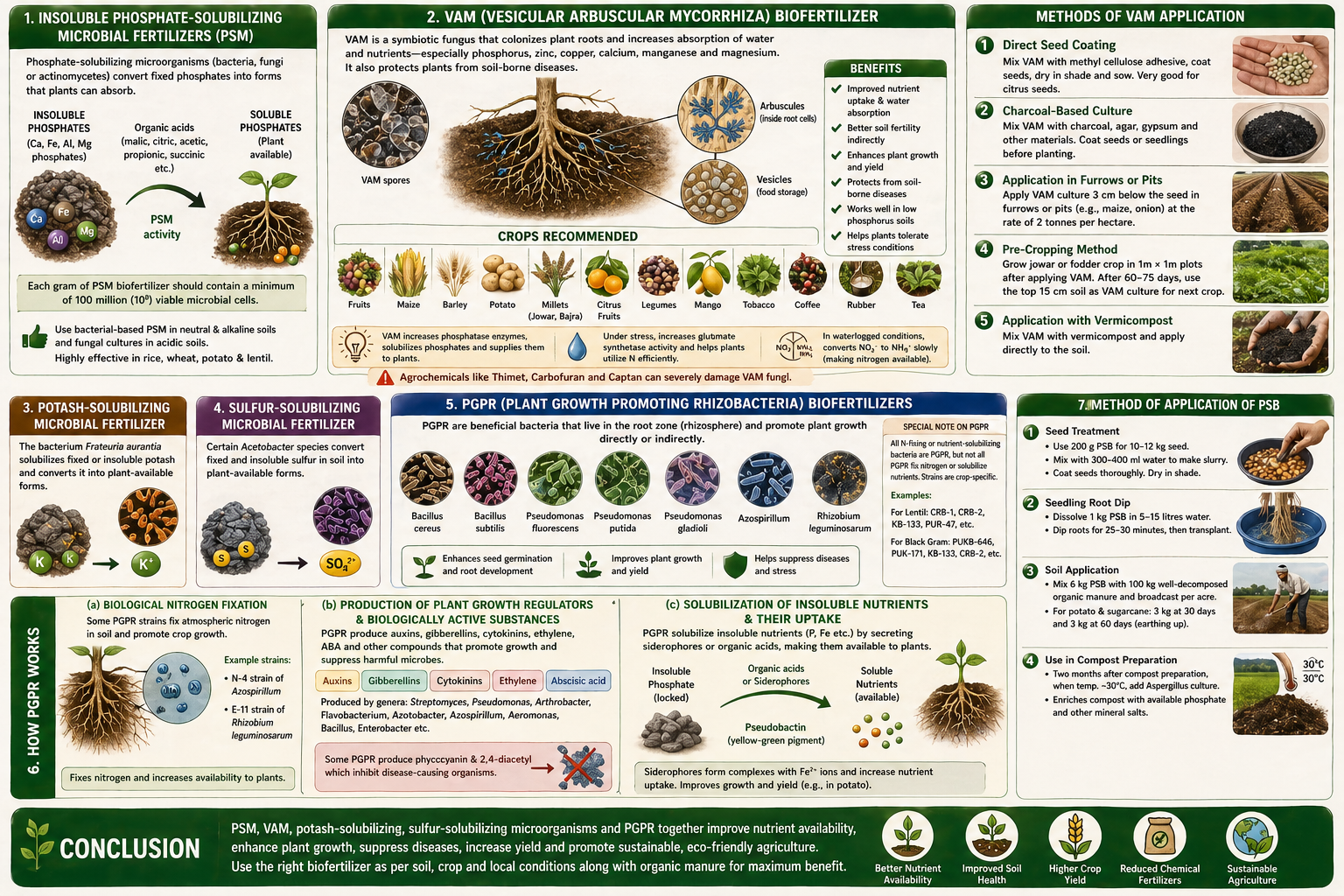
Insoluble Phosphate-Solubilizing Microbial Fertilizers (PSM)
April 25, 2026 | by anisurrahaman235f@gmail.com
(c) In Enhancing the Effectiveness of Organic Manure:
April 25, 2026 | by anisurrahaman235f@gmail.com