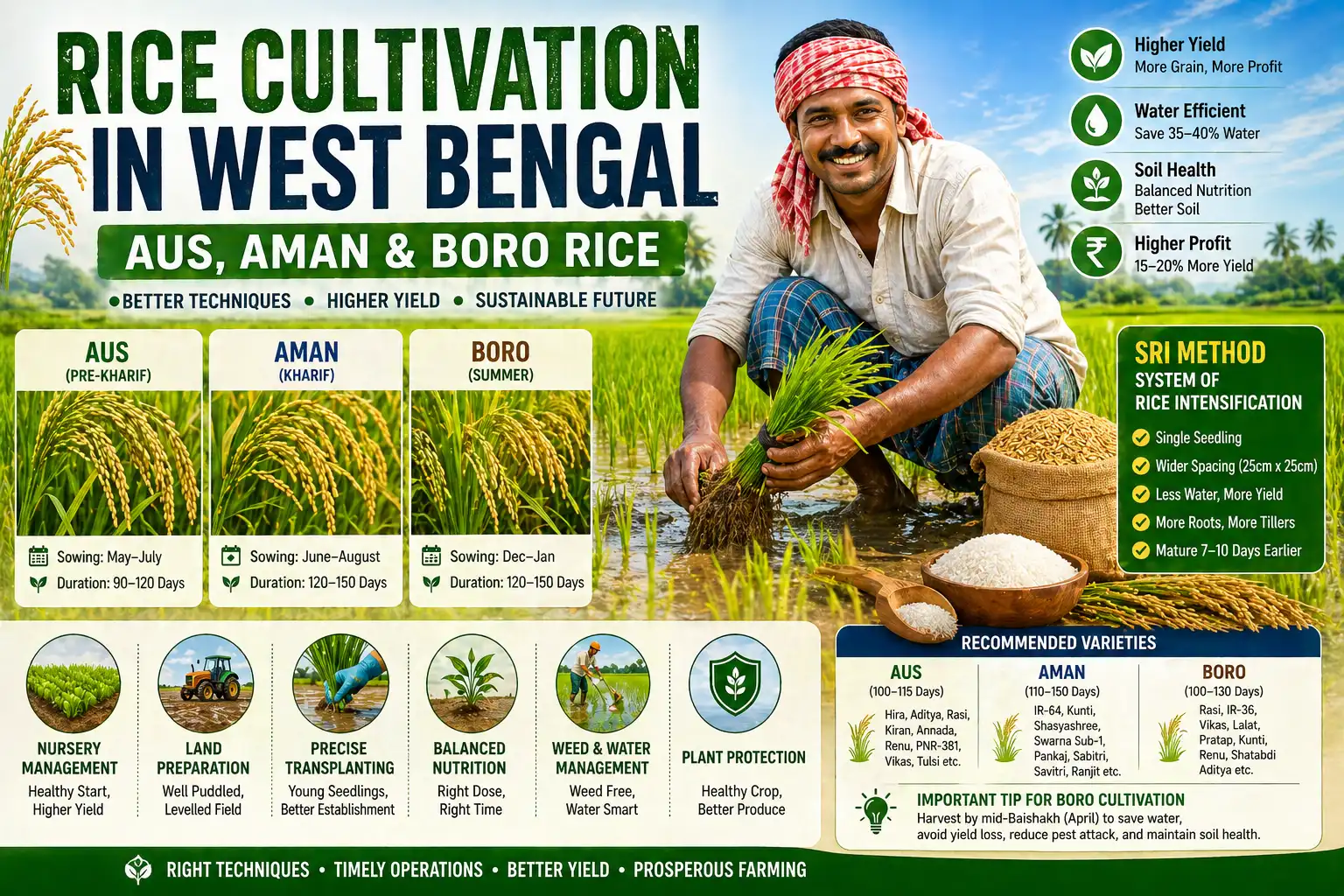
Aus, Aman, and Boro Rice
Rice is the principal crop and staple food of West Bengal. The state holds a prominent position in rice production at the national level. Rice is cultivated almost everywhere in West Bengal. However, with the application of improved scientific techniques under the present changed circumstances, it is possible to further increase rice yield.
Land Selection
- Aus (Pre-Kharif) Rice: Any upland or medium land with sandy loam soil is suitable for Aus rice cultivation.
- Aman (Kharif) Rice: Aman rice can be grown on any type of land — upland, medium, or low land — with sandy loam to clay loam soil.
- Boro (Summer) Rice: Medium to low-lying irrigated lands with sandy loam to clay soil are suitable for Boro rice. Although Aus and Aman rice cultivation are primarily rain-fed, proper irrigation and drainage facilities can significantly increase yield.
Seed Rate
| Sowing Method | Seed Rate per Acre (kg) |
|---|---|
| Broadcast Sowing | Fine rice: 28–32 Medium rice: 32–36 Coarse rice: 36–40 |
| Line Sowing | Fine rice: 28–30 Medium rice: 26–28 Coarse rice: 18–20 |
| Transplanting (Nursery Method) | Aus & Aman: 24–26 kg (for nursery) Boro: 14–16 kg (for nursery) |
Note:
- If seed germination percentage is low, or if dense planting or more seedlings per hill are required, the seed rate should be increased proportionately.
- Always test seed germination capacity before sowing.
- The area required for nursery is approximately 1/10th of the main field area (i.e., 6 katha or 15 decimal nursery for 1 acre main field).
- Do not sow more than 4 kg of seed per katha in the nursery bed.
Seed Selection
Prepare a salt solution by dissolving 1.65 kg of edible salt in 10 litres of water in a bucket. Immerse the selected seeds in this solution. Discard the floating seeds (light or damaged) and collect the sunken seeds (healthy ones). Immediately wash them thoroughly in clean water, dry them in shade, and use for sowing.
This 10-litre salt solution can treat 30–40 kg of seed.
Seed Treatment
Dry Seed Treatment (before broadcasting or sowing in dry nursery):
Mix 2–2.5 g of Thiram 75% WP or 2.5–3 g of Carbendazim 25% WP per kg of seed and treat the seeds.
Wet Seed Treatment (for wet nursery beds):
Dissolve 3 g of Tricyclazole or 4 g of Carbendazim in 1.5 litres of water. Soak 1 kg of selected seeds in this solution for 8–10 hours. Take out only the sunken seeds, drain the water, and incubate them for sprouting.
Appropriate Time for Seed Sowing
Aus Rice
Due to expansion of irrigation facilities, most Aus rice is now transplanted instead of direct broadcasting. The recommended sowing time in different regions of West Bengal is as follows:
| Region | Direct Sowing | Nursery Sowing |
|---|---|---|
| Alluvial Soil Area | Baishakh–Jyaistha (May–June) | — |
| Terai Region | — | Phalgun–Chaitra (March–April) |
| Lateritic Soil Area | — | Jyaistha–Ashar (June–July) |
Aman Rice
Sowing time for Aman rice should be decided considering land topography, rainfall probability, variety duration, and cropping pattern. Since Aman rice is mostly rain-fed, the recommended nursery sowing time according to land type is:
| Land Type | Fine Rice | Medium Duration Varieties | Short Duration Varieties |
|---|---|---|---|
| Upland | Ashar–Shravan (July–August) | Ashar–Shravan (July–August) | Jyaistha–Ashar (June–July) |
| Medium Land | Ashar–Shravan (July–August) | Jyaistha–Ashar (June–July) | — |
| Low Land | Chaitra–Baishakh (April–May) | Baishakh–Jyaistha (May–June) | Medium & Long Duration |
If proper irrigation and drainage facilities are available, sowing time can be adjusted according to variety for better yield.
Boro Rice
Boro rice should be grown only in low-lying areas or near reliable irrigation sources where no other rabi crop can be cultivated due to water stagnation. To avoid yield loss due to shortage of irrigation water at the later stage, restrict Boro cultivation to fields where assured irrigation is available from Poush (December) to mid-Baishakh (April).
Recommended Rice Varieties for West Bengal
Irrigated Land – Early Duration (100–115 days) – Suitable for Aus & Boro
- PNR-381
- Renu
- CSR (S) 5-2-2-5
- Tara
- Ratna
- Parijat
- Mohan
- Vikas
- Narendra Dhan-97
- MTU-1004
- Lal Minikit (WGL-20471)
- Nayanmani
Irrigated Land – Medium Early Duration (115–125 days) – Suitable for Aus & Boro
- Lalat
- IR-64
- IR-36
- MTU-519
- Sufala
- Panth Dhan-6
- Shatabdi (Minikit)
- Sarathi
- Saket-4
- Kshitish
- CSR (S) 11-5-0-2
- CSR (S) 2-1-7
- MTU-1010
- Narendra Dev-359
- Birsa-202
- Radhi
- Kasturi
Irrigated Land – Medium Duration (125–135 days) – Suitable for Aman & Boro
- Kunti
- Jaya
- Ajaya
- Shasyashree
- IR-20
- Suraksha
- Bhuban
- Vikramacharya
- Prakash
- Pratap
- Daya
- Panth Dhan-4
- Mrinal
- Himalaya-741
- Kalimpong-1
- DL Dhan-81
- Sita
- Pusa Basmati-1
- Kabya
- Tapaswini
- Gajapati
- Geetanjali
- Rajeshwari
- Sonasari
- Kanak
- Shweta
- Hari
Rain-fed Upland & Lowland Varieties (Super Fast / Short Duration 65–95 days)
Rain-fed Upland (Aus & Boro):
- Kalyani
- Sneha
- Hira
- Aditya
- Khanika
- Prasanna
Rain-fed Lowland (1 foot water, 140–150 days) – Aman
- Shali
- Manas Sarobar
- Jogen
- Bipasha
- IR-42
- Pankaj
- IET-5656
- Lal Swarna
- Pranav
- Savitri
- Gayatri
- Dharitri
- CR-1002
- CR-1014
- Lunishree
- CSR-6
- CST-7-1
- Shashi
- Puja
- Samba Mahsuri
- Kalinga-3
- Giri
- MTU-1001
- Shyamali
- Purba
- Ranjit
- Bhajram
- Mandavijaya
- Chaitanya
- Swarna Sub-1
- NDR-8001
- NDR-8002
- Barah Abarohi
- Ramachandi
- Godavari
- Krishnaveni
Note: Always choose varieties according to land type, irrigation facility, duration, and local recommendations from the Agriculture Department or Krishi Vigyan Kendra for best results.
RELATED POSTS
View all

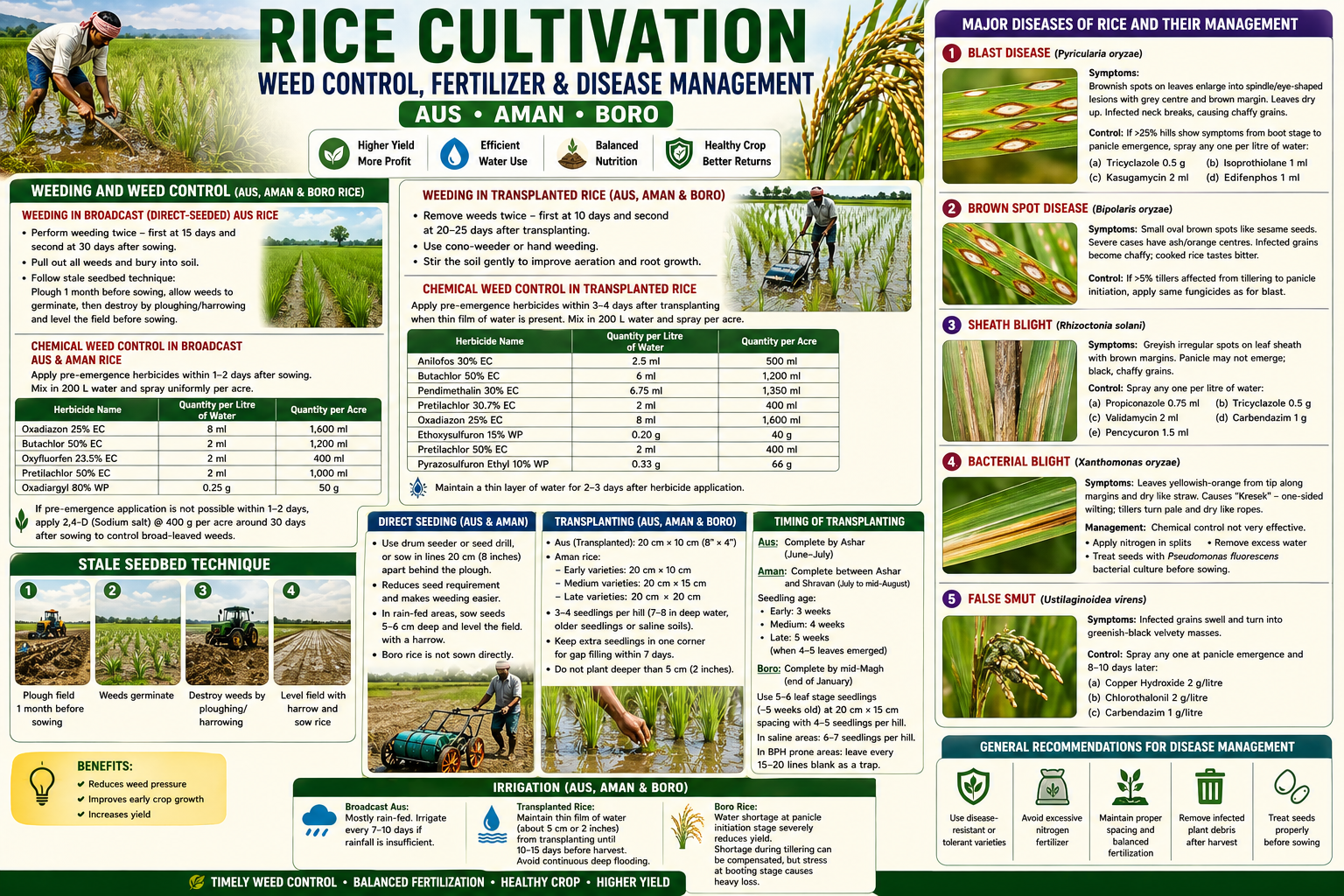
Weeding and Weed Control (Aus, Aman and Boro Rice)
April 27, 2026 | by anisurrahaman235f@gmail.com
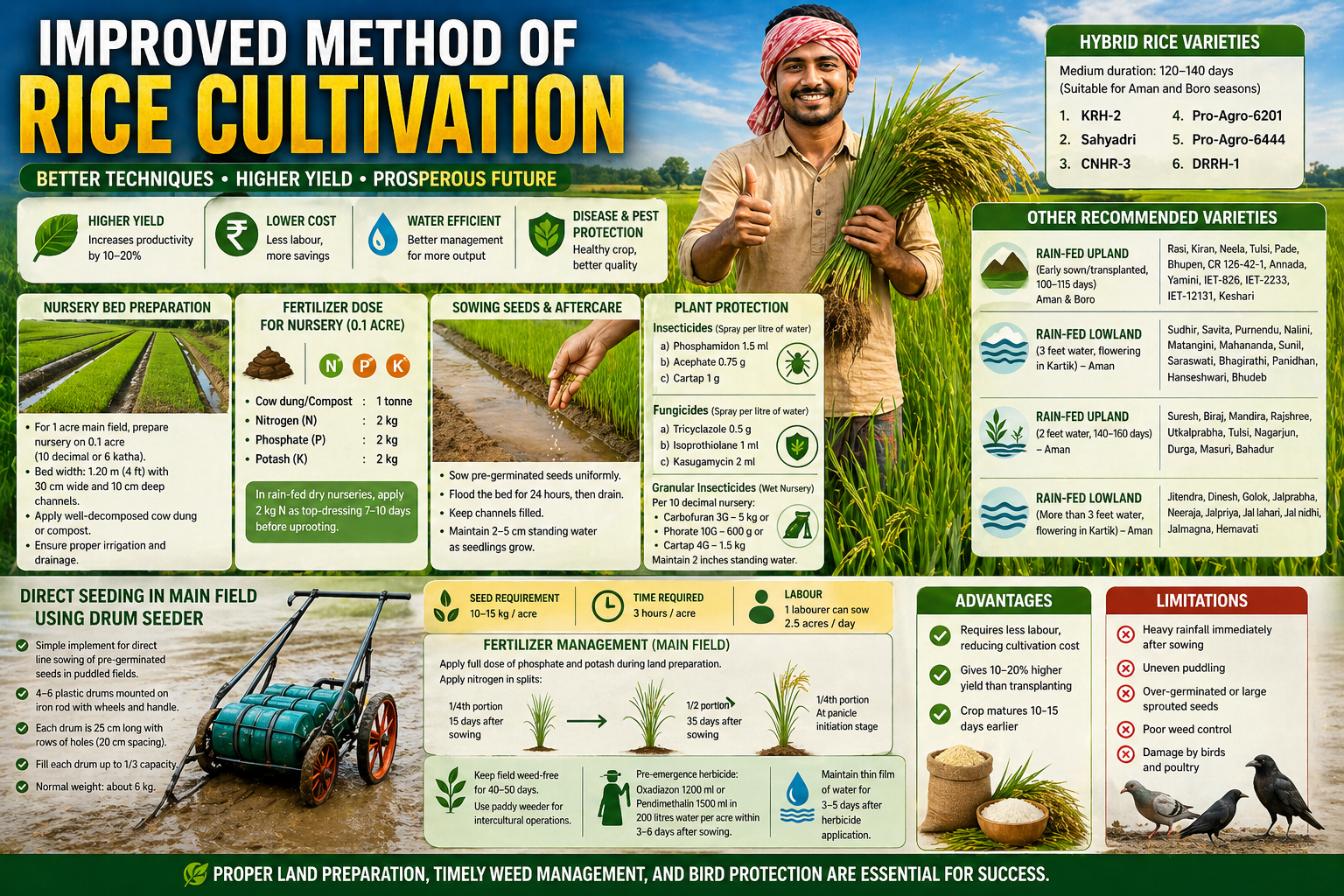
Improved Method of Rice Cultivation / 4
April 27, 2026 | by anisurrahaman235f@gmail.com