

Weeding and Weed Control (Aus, Aman and Boro Rice)
April 27, 2026 | by anisurrahaman235f@gmail.com
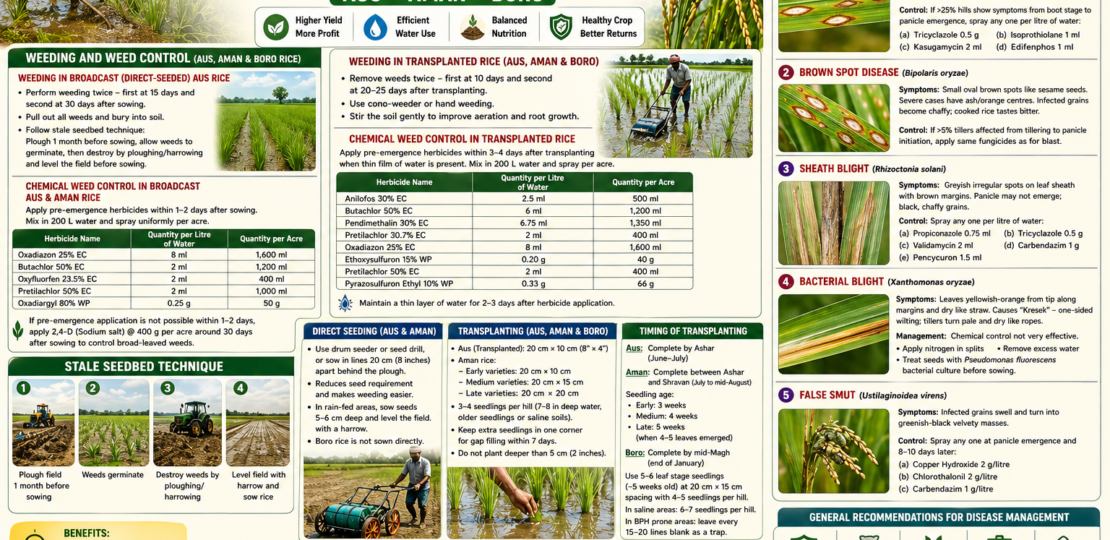
Effective weed management is one of the most important practices in rice cultivation. Weeds compete with rice plants for nutrients, water, sunlight, and space, often causing significant yield reduction if not controlled timely. Proper weeding also improves aeration in the root zone and helps in better tillering and grain filling.
Weeding in Broadcast (Direct-Seeded) Aus Rice
In broadcast Aus rice, perform thorough weeding twice — first at 15 days and second at 30 days after sowing. All weeds should be pulled out and buried into the soil.
To reduce weed infestation significantly, follow the stale seedbed technique. Plough the field at least one month before sowing Aus rice. This allows weeds to germinate. Then destroy the emerged weeds by another ploughing or harrowing. Level the field properly with a harrow before sowing rice seeds. This method greatly reduces weed pressure throughout the crop season.
Chemical Weed Control in Broadcast Aus and Aman Rice
If manual weeding is difficult or delayed, apply pre-emergence herbicides within 1–2 days after sowing. Mix any one of the following herbicides in 200 litres of water and spray uniformly over one acre using a knapsack sprayer:
| Herbicide Name | Quantity per Litre of Water | Quantity per Acre |
|---|---|---|
| Oxadiazon 25% EC | 8 ml | 1,600 ml |
| Butachlor 50% EC | 2 ml | 1,200 ml |
| Oxyfluorfen 23.5% EC | 2 ml | 400 ml |
| Pretilachlor 50% EC | 2 ml | 1,000 ml |
| Oxadiargyl 80% WP | 0.25 g | 50 g |
If it is not possible to apply pre-emergence herbicide within 1–2 days after sowing, apply 2,4-D (Sodium salt) at 400 grams per acre around 30 days after sowing. This post-emergence herbicide effectively controls broad-leaved weeds.
Weeding in Transplanted Rice (Aus, Aman and Boro)
In transplanted fields, weeds should be removed twice — first at 10 days and second at 20–25 days after transplanting. Use a cono-weeder (paddy weeder) or hand weeding. At the same time, gently stir the soil to improve aeration and encourage root growth.
Chemical Weed Control in Transplanted Rice
Apply pre-emergence herbicides within 3–4 days after transplanting when there is a thin film of water in the field. Mix any one of the following in 200 litres of water and spray uniformly over one acre:
| Herbicide Name | Quantity per Litre of Water | Quantity per Acre |
|---|---|---|
| Anilofos 30% EC | 2.5 ml | 500 ml |
| Butachlor 50% EC | 6 ml | 1,200 ml |
| Pendimethalin 30% EC | 6.75 ml | 1,350 ml |
| Pretilachlor 30.7% EC | 2 ml | 400 ml |
| Oxadiazon 25% EC | 8 ml | 1,600 ml |
| Ethoxysulfuron 15% WP | 0.20 g | 40 g |
| Pretilachlor 50% EC | 2 ml | 400 ml |
| Pyrazosulfuron Ethyl 10% WP | 0.33 g | 66 g |
Maintain a thin layer of water for 2–3 days after herbicide application for best results.
Major Diseases of Rice and Their Management
Rice plants are attacked by several diseases during both Kharif (Aus & Aman) and Boro seasons. These diseases can cause heavy yield losses if not managed properly. The most damaging diseases are Blast, Sheath Blight, Brown Spot, Bacterial Blight, and Tungro.
1. Blast Disease (Pyricularia oryzae)
Blast disease is highly destructive under cloudy, humid weather with relative humidity above 90%, night temperature around 24°C or lower, and when susceptible varieties are grown.
Symptoms:
- Small brownish spots appear on leaves.
- Spots enlarge into spindle-shaped or eye-shaped lesions with grey centres and dark brown margins.
- Multiple spots merge, causing leaves to turn reddish-brown and dry up.
- When the neck (node below the panicle) is infected, the panicle breaks, resulting in chaffy grains.
- Nodes can also become black and rotten.
Control Measures:
When more than 25% of hills show blast symptoms on the upper second leaf from the boot stage to panicle emergence, spray any one of the following fungicides per litre of water:
(a) Tricyclazole 0.5 g
(b) Isoprothiolane 1 ml
(c) Kasugamycin 2 ml
(d) Edifenphos 1 ml
2. Brown Spot Disease (Bipolaris oryzae)
Brown spot can attack seedlings, leaves, and grains.
Symptoms:
- Small, oval, brown spots resembling sesame seeds appear on leaves.
- In severe cases, larger spots have ash-coloured or orange centres.
- Heavily infected grains become chaffy. Cooked rice from affected grains tastes bitter.
Control Measures:
If more than 5% of tillers show brown spot from tillering to panicle initiation stage, apply the same fungicides recommended for blast.
3. Sheath Blight (Rhizoctonia solani)
This disease usually appears at the booting stage.
Symptoms:
- Greyish irregular spots appear on the leaf sheath.
- Spots have brown margins.
- In severe cases, the panicle may remain partially enclosed or fail to emerge, resulting in black, chaffy grains.
Control Measures:
Spray any one of the following fungicides per litre of water:
(a) Propiconazole 0.75 ml
(b) Tricyclazole 0.5 g
(c) Validamycin 2 ml
(d) Carbendazim 1 g
(e) Pencycuron 1.5 ml
4. Bacterial Blight (Xanthomonas oryzae)
Symptoms:
- Leaves turn yellowish-orange from the tip downwards along the margins and eventually dry up like straw.
- In the seedling stage or after transplanting, the disease can cause “Kresek” — one-sided wilting where tillers turn pale green and dry up like ropes.
Management:
Chemical control is not very effective.
- Apply nitrogen fertilizer in splits.
- Remove excess water from the field.
- Treat seeds with Pseudomonas fluorescens bacterial culture before sowing.
5. False Smut (Ustilaginoidea virens)
Symptoms:
- Infected grains swell and turn into greenish-black velvety masses.
Control Measures:
Spray any one of the following at panicle emergence and 8–10 days later:
(a) Copper Hydroxide 2 g/litre
(b) Chlorothalonil 2 g/litre
(c) Carbendazim 1 g/litre
General Recommendations for Disease Management
- Use disease-resistant or tolerant varieties.
- Avoid excessive nitrogen fertilizer.
- Maintain proper spacing and balanced fertilization.
- Remove infected plant debris after harvest.
- Treat seeds properly before sowing.
RELATED POSTS
View all

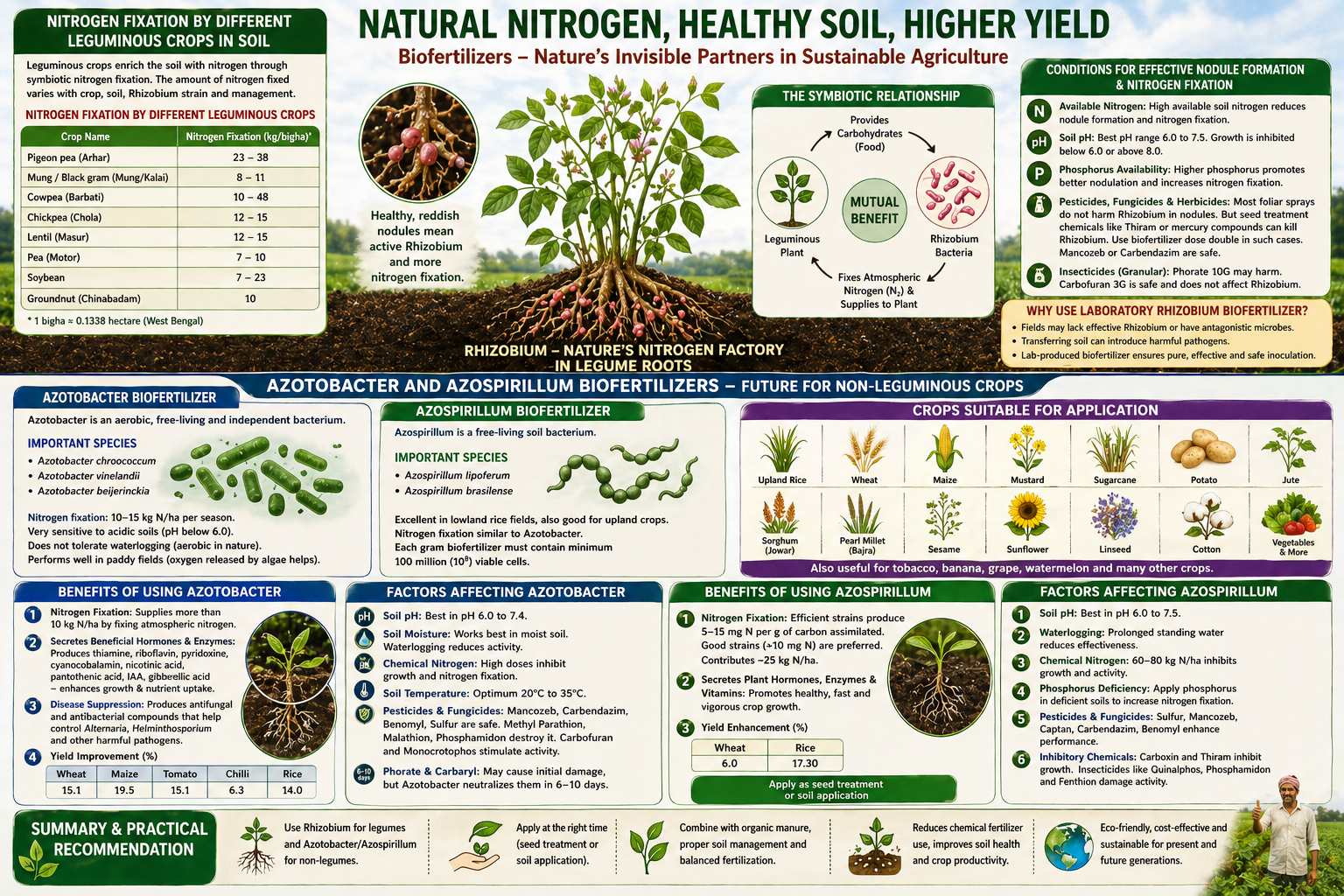
Nitrogen Fixation by Different Leguminous Crops in Soil
April 25, 2026 | by anisurrahaman235f@gmail.com
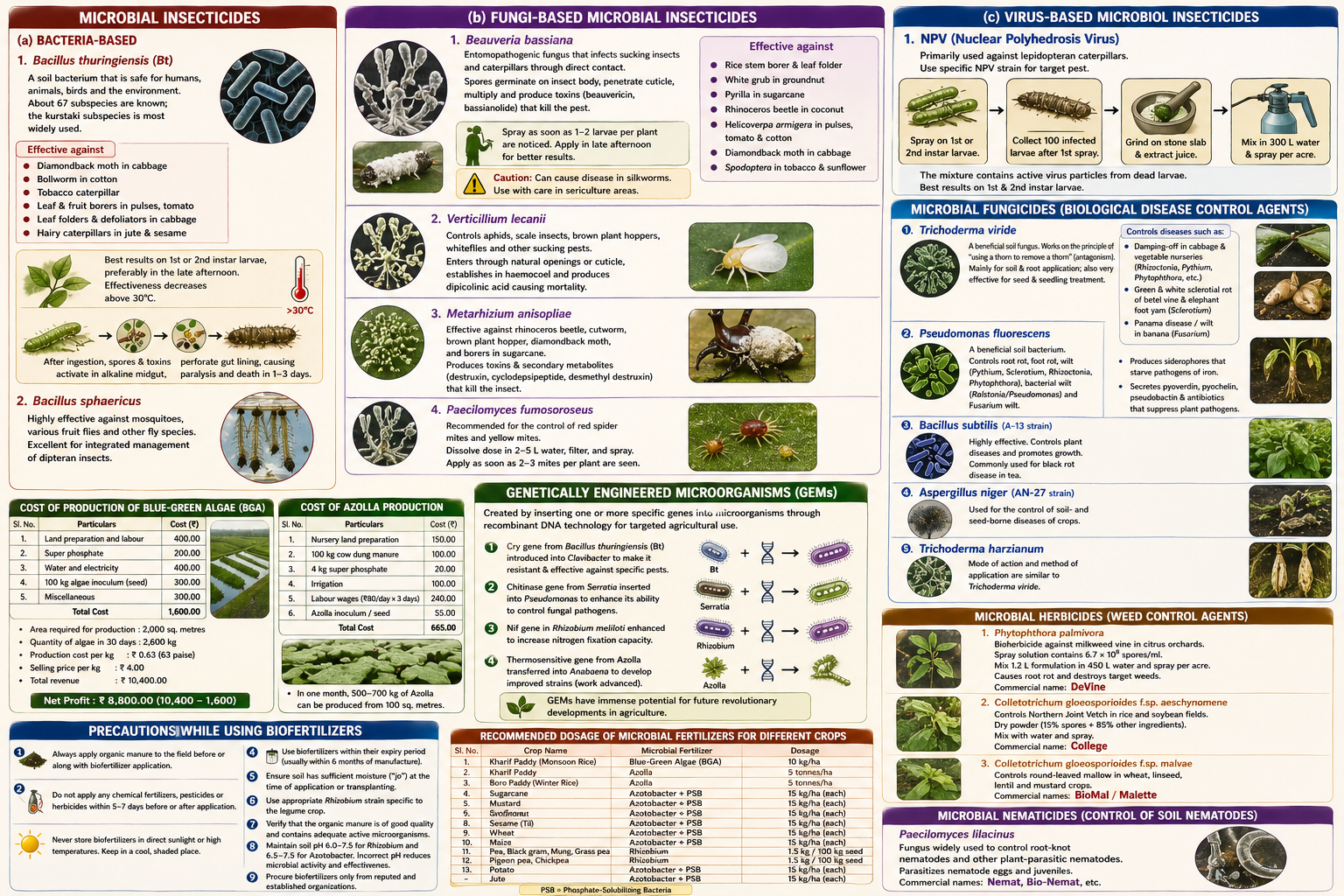
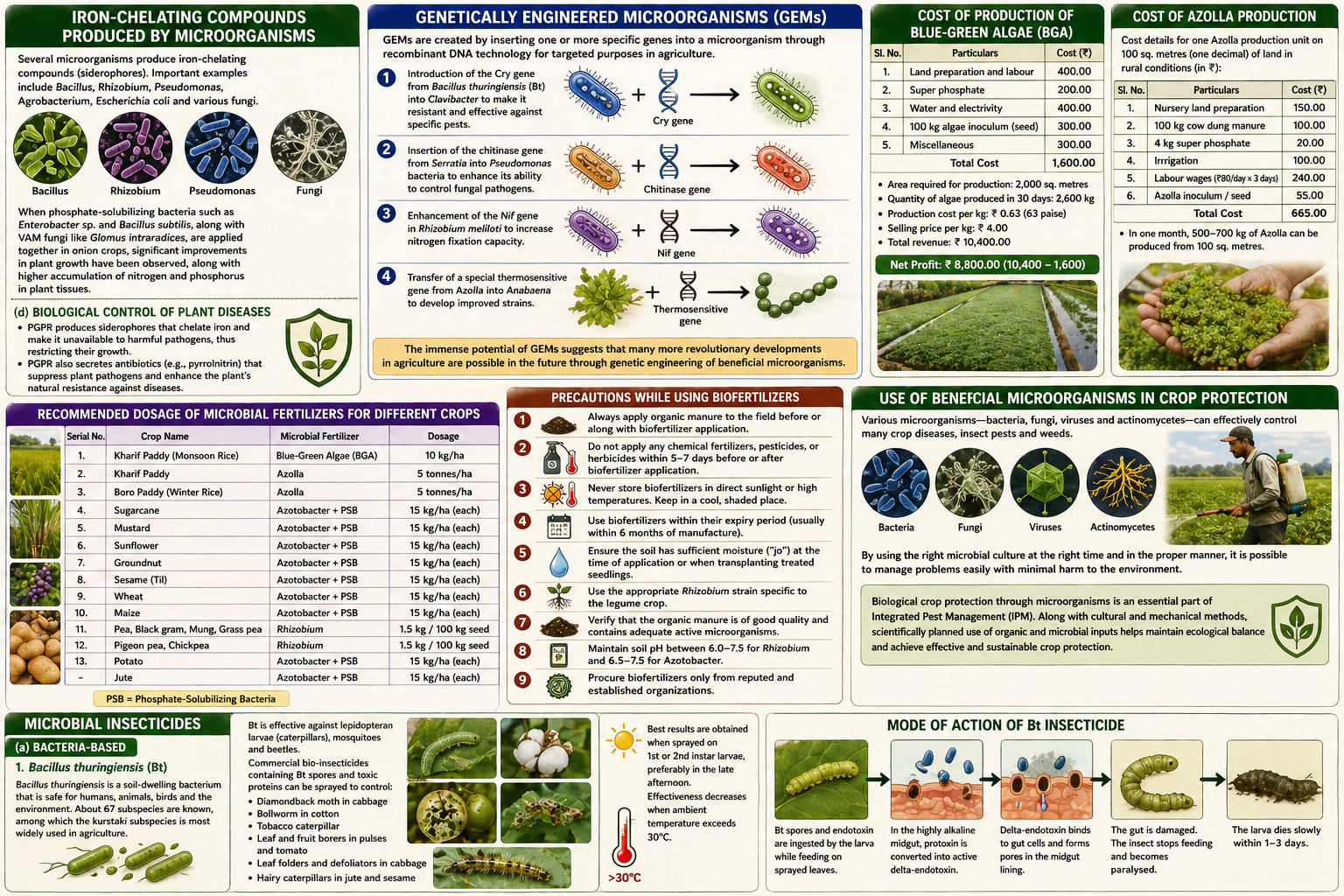
Iron-Chelating Compounds Produced by Microorganisms
April 25, 2026 | by anisurrahaman235f@gmail.com