

When to Use Azotobacter or Azospirillum
April 25, 2026 | by anisurrahaman235f@gmail.com
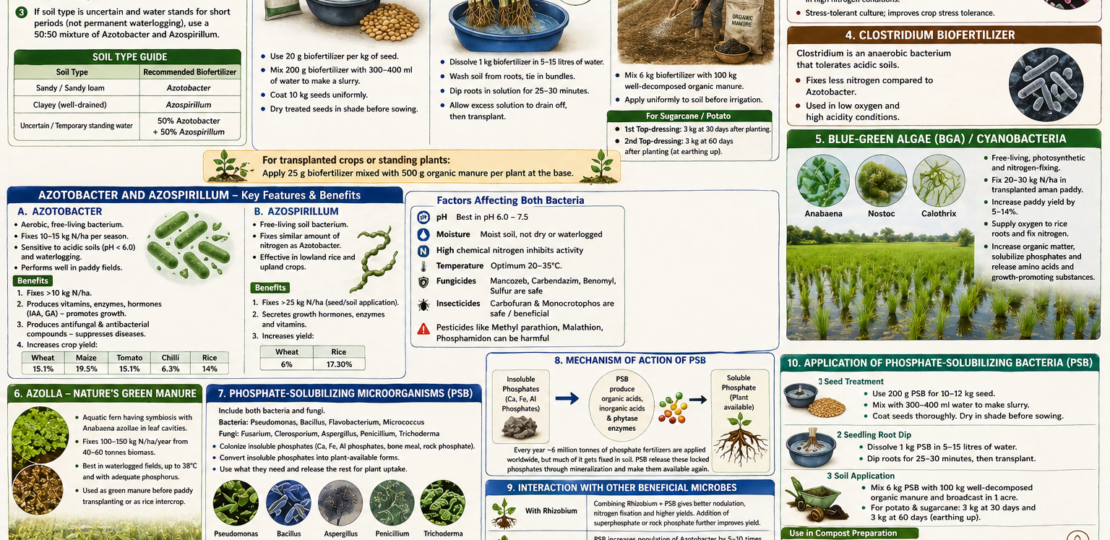
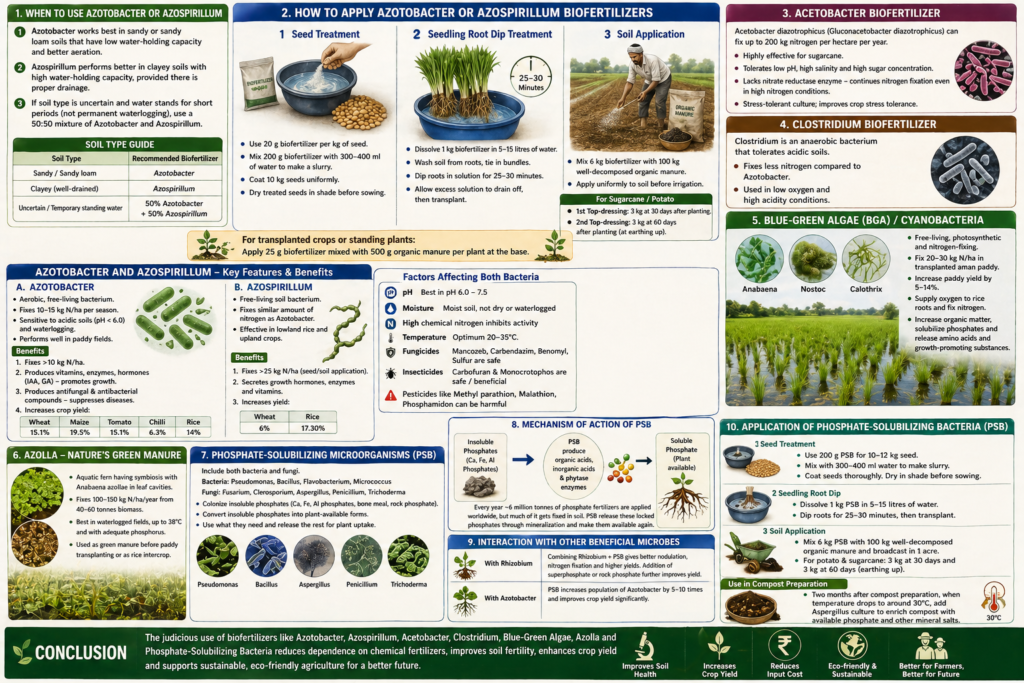
Azotobacter and Azospirillum biofertilizers can be applied to any non-leguminous crop. However, their effectiveness depends on soil type and moisture conditions. Here are the specific situations where each performs best:
- Azotobacter works well in sandy or sandy loam soils that have low water-holding capacity. These lighter soils allow better aeration, which suits this aerobic bacterium.
- Azospirillum performs better in clayey soils with high water-holding capacity, provided there is proper drainage. These soils usually have lower air content, and Azospirillum is more tolerant of such conditions.
- When the soil type is unclear but water tends to stand for short periods (not permanent waterlogging), a 50:50 mixture of Azotobacter and Azospirillum can be used for balanced results.
How to Apply Azotobacter or Azospirillum Biofertilizers
1. Seed Treatment
For effective seed inoculation, use 20 grams of biofertilizer per kg of seed.
Mix 200 grams of the biofertilizer with 300–400 ml of water to make a slurry.
Thoroughly coat 10 kg of seeds with this solution so that every seed gets a uniform layer of the microbial culture.
Dry the treated seeds in shade before sowing.
2. Seedling Root Dip Treatment
Dissolve 1 kg of biofertilizer in 5–15 litres of water to prepare the solution.
Wash off the soil from the roots of seedlings, tie them in bundles, and dip the roots in the solution for 25–30 minutes.
Allow excess solution to drain off, then transplant the seedlings in one acre of land.
3. Soil Application
For one acre, mix 6 kg of Azotobacter or Azospirillum biofertilizer with 100 kg of well-decomposed organic manure (such as farmyard manure or compost).
Apply this mixture uniformly to the soil before irrigation.
For sugarcane or potato crops:
- Apply 3 kg as the first top-dressing 30 days after planting.
- Apply another 3 kg as the second top-dressing 60 days after planting, at the time of earthing up.
For transplanted crops or standing plants: Apply 25 grams of biofertilizer mixed with 500 grams of organic manure per plant at the base of the plant.
[Image Placeholder – Suitable visual: Step-by-step illustration of seed treatment, seedling root dip, and soil application of biofertilizers, or a clear photo of Azotobacter/Azospirillum application in the field.]
Acetobacter Biofertilizer
Acetobacter was discovered in 1988. The species Acetobacter diazotrophicus (also known as Gluconacetobacter diazotrophicus) is widely used as a biofertilizer for sugarcane.
This remarkable bacterium can fix up to 200 kg of nitrogen per hectare per year. It is highly effective in meeting the heavy nitrogen demand of sugarcane crops, thereby reducing the need for chemical nitrogen fertilizers.
Acetobacter diazotrophicus is a special type of beneficial microorganism that can tolerate low pH (acidic soils), high salinity, and high sugar concentrations. Because it lacks the nitrate reductase enzyme, it can continue nitrogen fixation even in the presence of high nitrogen levels. Its culture is stress-tolerant, and its use has been shown to significantly improve the stress tolerance capacity of the crop itself.
Clostridium Biofertilizer
Clostridium is an anaerobic bacterium that can tolerate acidic soil conditions. However, it fixes less nitrogen compared to Azotobacter. It is mainly used in specific situations where oxygen levels are low and soil acidity is high.
Blue-Green Algae (BGA) or Cyanobacteria
Blue-green algae, also known as Cyanobacteria, are free-living, photosynthetic, and nitrogen-fixing microorganisms. Common examples include Anabaena, Nostoc, Aulosira, Calothrix, Tolypothrix, and Cylindrospermum.
When applied in transplanted aman paddy fields, in the presence of sunlight, these algae can fix 20 to 30 kg of atmospheric nitrogen per hectare. This results in substantial savings on nitrogenous fertilizers and increases paddy yield by 5 to 14 percent.
In the presence of sunlight, blue-green algae supply oxygen to the rice roots while simultaneously fixing nitrogen. This is a non-symbiotic process. One species, Anabaena azollae, lives in symbiotic association with the aquatic fern Azolla.
Apart from nitrogen fixation, blue-green algae also increase the organic matter content of the soil, solubilize phosphates, and release amino acids and growth-promoting substances that enhance crop growth.
Azolla
Azolla is a small, floating aquatic fern. It is commonly found in stagnant water bodies. It has branched floating stems, bilobed leaves, and true roots. Among its seven species, Azolla pinnata is the most commonly seen in our country.
Azolla forms a symbiotic relationship with the blue-green alga Anabaena azollae, which lives in the upper lobe of its leaves. Through photosynthesis, the alga fixes atmospheric nitrogen, and when Azolla decomposes, it releases the fixed nitrogen into the soil.
From 40–60 tonnes of Azolla biomass, approximately 100 to 150 kg of nitrogen can be added to one hectare of land per year.
Azolla performs best in waterlogged fields at temperatures up to 38°C and when sufficient phosphorus is available. It can be grown as a green manure crop in fallow fields before paddy transplantation or as an intercrop along with rice in the main field.
Phosphate-Solubilizing Microbial Fertilizers (PSB)
Phosphate-solubilizing microorganisms include both bacteria and fungi. Important bacterial species are Pseudomonas, Bacillus, Flavobacterium, and Micrococcus. Fungal species include Fusarium, Clerosporium, Aspergillus, Penicillium, and Trichoderma.
These microorganisms live by colonizing insoluble forms of phosphate such as calcium phosphate, iron phosphate, aluminium phosphate, bone meal, or rock phosphate. They convert these insoluble phosphates into plant-available forms. The microbes utilize only what they need and release the excess phosphate for plant uptake.
Mechanism of Action of Phosphate-Solubilizing Microorganisms
Every year, approximately 6 million tonnes of phosphate fertilizers are applied to soils worldwide. However, a large portion quickly becomes fixed in the soil in forms that plants cannot absorb. Phosphate-solubilizing biofertilizers help release these fixed (locked) phosphates back into available forms through mineralization. They also produce various organic and inorganic acids and phytase enzymes that convert insoluble phosphates into soluble, plant-usable forms.
Interaction of Phosphate-Solubilizing Microorganisms with Other Beneficial Bacteria and Fungi
- Effect on Rhizobium — Studies on crops like mung, soybean, and lentil have shown that combined application of Rhizobium and phosphate-solubilizing bacteria (PSB) gives better results. When superphosphate or rock phosphate is also added, yield increases further.
- Effect on Azotobacter — When PSB is mixed and applied together with Azotobacter, crop yield improves significantly. PSB can increase the population of Azotobacter by 5 to 10 times, enhancing overall nitrogen fixation and plant growth.
Method of Application of Phosphate-Solubilizing Bacteria (PSB)
- Seed Treatment
For 10–12 kg of seed, use 200 grams of PSB.
Mix the PSB with 300–400 ml of water to make a slurry.
Coat the seeds thoroughly with the solution by hand. Dry the seeds in shade before sowing. - Seedling Root Dip Treatment
Dissolve 1 kg of PSB in 5–15 litres of water.
Dip the roots of seedlings required for one acre in this solution for 25–30 minutes, then transplant. - Soil Application
Mix 6 kg of PSB with 100 kg of well-decomposed organic manure and broadcast uniformly over one acre.
For potato and sugarcane, apply 3 kg at 30 days and another 3 kg at 60 days after planting during earthing up.
Use in Compost Preparation
Two months after compost preparation, when the temperature drops to around 30°C, adding Aspergillus culture can further enrich the compost by increasing available phosphate and other mineral salts.
Conclusion on Biofertilizer Application
Proper selection and timely application of these beneficial microorganisms — Azotobacter, Azospirillum, Acetobacter, Clostridium, Blue-Green Algae, Azolla, and Phosphate-Solubilizing Bacteria — can significantly reduce the use of chemical fertilizers, improve soil fertility, enhance crop yield, and promote sustainable agriculture. Farmers should choose the right biofertilizer based on soil type, crop, and local conditions, and always combine them with good organic manure for best results.
RELATED POSTS
View all

Effectiveness of Different Types of Beneficial Microbial Fertilizers
April 25, 2026 | by anisurrahaman235f@gmail.com

Improved Method of Rice Cultivation / 4
April 27, 2026 | by anisurrahaman235f@gmail.com
Iron-Chelating Compounds Produced by Microorganisms
April 25, 2026 | by anisurrahaman235f@gmail.com