Effectiveness of Different Types of Beneficial Microbial Fertilizers
April 25, 2026 | by anisurrahaman235f@gmail.com
Rhizobium Biofertilizer
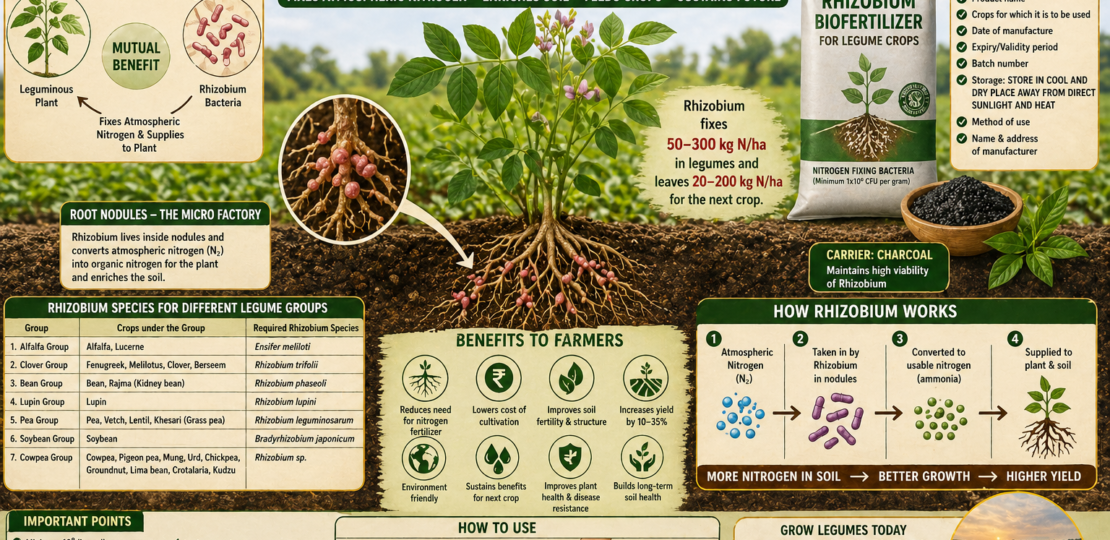
Rhizobium is an extremely small microorganism that cannot be seen without a microscope. It is a highly essential beneficial symbiotic bacterium. In Greek, “rhiza” means root and “bios” means life. Because these bacteria live in the roots, they are named Rhizobium.
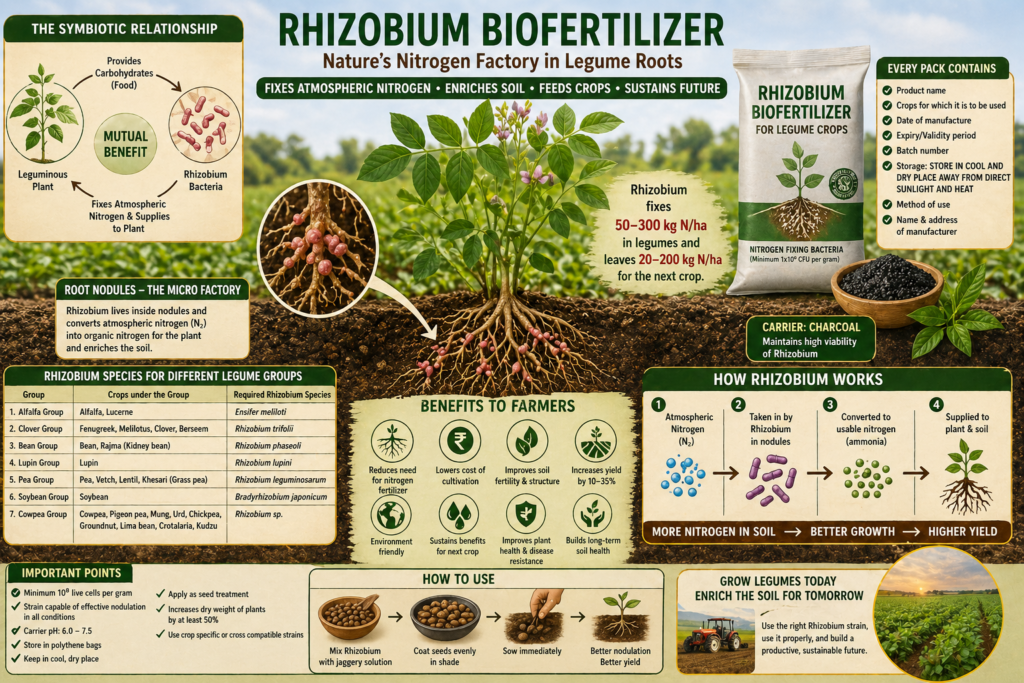
This bacterium forms nodules or tubercles on the roots of leguminous crops (pulse crops and pod-bearing plants). It resides inside these nodules and directly collects nitrogen from the air, fixes it in the soil, and converts it into organic nitrogen, thereby making the land fertile. As a result, these crops do not require much nitrogenous fertilizer. Moreover, this process actually increases the nitrogen content in the soil. Rhizobium biofertilizer is prepared from these beneficial bacteria.
Not all types of Rhizobium can form similar nodules on the roots of every leguminous crop or oilseed. Different species of Rhizobium exist for different leguminous crops. For example, the Rhizobium required for soybean is different from that needed for chickpea. However, the Rhizobium suitable for one particular legume may also form nodules on a few other related crops. For instance, the same strain works for both pea and lentil.
Because of this specific relationship between Rhizobium and leguminous crops, these crops are grouped into several categories. If a farmer cultivates any one crop from a particular group in the field, sufficient Rhizobium bacteria suitable for other crops in the same group will generally remain available in the soil for subsequent seasons. There is also a special bacterium called Azorhizobium caulinodans that helps form nodules on both the roots and stems of Dhaincha (Sesbania) plants.
In addition to different species for different crops, various specific “strains” of Rhizobium are effective. The effectiveness of Rhizobium biofertilizer varies depending on the strain, soil conditions, climate, and proper application.
Important Points to Know About Rhizobium Biofertilizer:
- Rhizobium can be maintained in carriers such as charcoal, organic manure, or lignite. However, since it is difficult to make organic matter completely free from other microbes, charcoal is generally preferred as a carrier.
- Every gram of Rhizobium biofertilizer should contain a minimum of 100 million (10⁸) live Rhizobium cells.
- The strain used must be capable of forming effective nodules under various geographical and climatic conditions.
- The carrier medium used for Rhizobium must be free from other contaminating microorganisms.
- The pH of the carrier or base material should be between 6.0 and 7.5.
- The dry weight of plants treated with Rhizobium should be at least 50% higher than that of untreated plants.
- Rhizobium culture should always be stored in polythene bags.
- Each bag of biofertilizer must contain the following information:
(a) Product name
(b) Crop(s) for which it is to be used
(c) Date of manufacture
(d) Expiry or validity period
(e) Batch number
(f) Storage instructions: “STORE IN COOL AND DRY PLACE AWAY FROM DIRECT SUNLIGHT AND HEAT”
(g) Method of use
(h) Name and address of the manufacturer
Rhizobium Species Suitable for Different Leguminous Crops
| Group Name | Crops under the Group | Required Rhizobium Species |
|---|---|---|
| 1. Alfalfa Group | Alfalfa, Lucerne | Ensifer meliloti (formerly Rhizobium meliloti) |
| 2. Clover Group | Fenugreek, Melilotus, Clover, Berseem | Rhizobium trifolii |
| 3. Bean Group | Bean, Rajma (Kidney bean) | Rhizobium phaseoli |
| 4. Lupin Group | Lupin | Rhizobium lupini |
| 5. Pea Group | Pea, Vetch, Lentil, Khesari (Grass pea) | Rhizobium leguminosarum |
| 6. Soybean Group | Soybean | Bradyrhizobium japonicum |
| 7. Cowpea Group | Cowpea, Pigeon pea (Arhar), Mung, Black gram (Urd), Chickpea, Groundnut, Lima bean, Crotalaria, Kudzu | Rhizobium sp. |
Rhizobium Strains Suitable for Different Pulse Crops
| Pulse Crop (Dalshasya) | Recommended Rhizobium Strains |
|---|---|
| Pigeon pea (Arhar) | CC-1, IHP-195, A-2, A-19, IC-3100 |
| Mung bean (Mung) | (Strains vary by region; commonly used strains include those tested locally) |
| Black gram (Kalai/Urd) | MG-5, KM-1, M-10, GMBS-1, BM, BSP-47, PUR-16, PUR-34, CRU-7, DU-106, KU-1, BKR-1-04 |
| Chickpea (Chola) | F-6, F-75, H-45, IC-76 |
| Lentil (Masur) | LB-4, LLR-22, LR-51-97, LRB-1, LRB-2, LWBR-1, L-1-77, L-21-83 |
| Pea (Motor) | P-10-76 |
| Grass pea (Khesari) | K-5 |
How Rhizobium Works
Nitrogen is a major component of protein, and protein is the primary building block of living organisms. Therefore, nitrogen is absolutely essential for the formation and growth of body cells in all living beings—whether humans or plants. Without adequate nitrogen, no organism can grow properly.
The atmosphere contains a large amount of nitrogen—approximately 77.17% by volume. However, it remains beyond the reach of most plants and animals because nitrogen is a relatively inert (inactive) element. In humans, this need is met through protein-rich food; in plants, it is usually supplied through artificially manufactured nitrogenous chemical fertilizers.
Yet, what neither humans nor plants can do directly, these tiny Rhizobium bacteria achieve through nature’s wonderful mechanism. They can take nitrogen directly from the air and fix it into the soil in a usable form, which they then utilize for their own needs.
Because they can fix nitrogen straight from the atmosphere, these bacteria are called “nitrogen-fixing” microorganisms. Since their “factory” or home is inside the root nodules of leguminous plants, these crops do not need to worry about nitrogen supply. The nitrogen produced by the bacteria meets the plant’s requirements. In return, the plant supplies the bacteria with necessary carbohydrate-type food. This creates a beautiful symbiotic relationship between leguminous plants and Rhizobium bacteria.
As a result of this mutual understanding, the amount of nitrogen in the soil also increases. The more well-nourished and reddish the nodules are, the more efficient the nitrogen-fixing ability of the Rhizobium inside them.
Even after meeting the crop’s own needs, some fixed nitrogen remains in the soil. Therefore, after growing leguminous crops, farmers can reduce the recommended dose of nitrogen fertilizer for the next crop (such as rice or jute) by a certain amount.
If a farmer grows good-nodulating pulse crops or leguminous oilseeds without applying any chemical nitrogen fertilizer, the amount of nitrogen fixed in the soil can be estimated from standard data. On average, Rhizobium inoculation in legumes can fix 50–300 kg of nitrogen per hectare, depending on the crop, strain, soil conditions, and management practices. Well-managed legume crops often contribute 20–200 kg N/ha that becomes available to subsequent crops, helping reduce chemical fertilizer use while improving soil fertility in a natural, sustainable way.
Extended Explanation on the Importance and Effectiveness of Rhizobium Biofertilizer
The use of Rhizobium biofertilizer is one of the most eco-friendly and cost-effective methods in modern sustainable agriculture. It not only meets the nitrogen requirement of the current leguminous crop but also leaves a residual benefit for following non-legume crops. This symbiotic nitrogen fixation process is highly efficient because it occurs directly at the root zone where the plant needs it most.
In regions like West Bengal with intensive cropping systems, proper use of suitable Rhizobium strains can significantly lower cultivation costs, reduce environmental pollution from chemical fertilizers, and maintain long-term soil health. Farmers are encouraged to select crop-specific or cross-compatible strains and apply them correctly—usually as seed treatment—to achieve maximum nodulation and nitrogen fixation.
When combined with organic manure and proper soil management (maintaining neutral pH, adequate moisture, and avoiding excessive chemical nitrogen), Rhizobium biofertilizers can increase crop yield by 10–35% in legumes while enhancing overall soil microbial activity.
This ancient yet scientifically validated partnership between plants and microorganisms continues to offer a powerful tool for reducing dependence on synthetic inputs and building resilient agricultural systems.
RELATED POSTS
View all


Insoluble Phosphate-Solubilizing Microbial Fertilizers (PSM)
April 25, 2026 | by anisurrahaman235f@gmail.com