

What Is Hostinger? A Complete Beginner’s Guide (Updated for 2026)
August 1, 2026 | by anisurrahaman235f@gmail.com
If you have ever tried to start a blog, a small business website, or an online store, you have probably come across the name Hostinger. It shows up in almost every “cheapest web hosting” list online, but very few guides explain what the company actually does, how it works behind the scenes, and whether it fits someone who has never built a website before. This guide breaks all of that down in plain language, using the most recent information available as of August 2026.
A Quick Background on Hostinger
Hostinger is a web hosting and domain registration company that was originally founded in 2004 in Kaunas, Lithuania, under the name Hosting Media. The company later launched sub-brands such as 000webhost (a free hosting service that has since been discontinued) and Hosting24, before consolidating everything under the Hostinger name in 2011. Today, the company is headquartered in Lithuania and is led by CEO Daugirdas Jankus, with Arnas Stuopelis serving as Chairman of the Board.
Over the past two decades, Hostinger has grown from a small regional hosting provider into one of the most widely used hosting companies in the world, now serving customers across more than 150 countries with a workforce of over 1,000 employees and annual revenue in the hundreds of millions of euros. What made the company popular in the first place is still its biggest selling point today: aggressively low introductory pricing combined with a surprisingly capable feature set for beginners.
What Exactly Does Hostinger Do?
In simple terms, Hostinger rents out space on its servers so that your website’s files, images, databases, and emails can be stored somewhere and made accessible to visitors 24 hours a day. Without a hosting provider, a website you build on your own computer would only be visible to you.
Hostinger’s service lineup is organized into a few main categories:
- Shared Hosting – Your website shares server resources with other websites, which keeps costs low. This is the most common starting point for beginners.
- Cloud Hosting – Your site runs on a cluster of connected servers rather than a single machine, offering better reliability and performance for growing websites.
- VPS (Virtual Private Server) Hosting – You get a dedicated slice of server resources with full root access, aimed at developers and more technical users who need more control.
- Managed WordPress Hosting – Optimized specifically for WordPress websites, with automatic updates, caching, and WordPress-specific performance tuning.
- Email Hosting – Professional email addresses using your own domain name (for example, you@yourbusiness.com), available through Titan Email or Google Workspace integration.
- Domain Registration – Hostinger also sells domain names directly, supporting more than 300 top-level domains (like .com, .net, .store, and country-specific extensions).
There is also Minecraft server hosting and Windows-based VPS plans for gamers and developers who need something outside the standard website use case.
hPanel: Hostinger’s Custom Control Panel
Most web hosting companies use a third-party control panel called cPanel, which can feel cluttered to first-time users. Hostinger instead built its own in-house dashboard called hPanel, included with every hosting plan except VPS. hPanel is generally considered more visually organized and beginner-friendly than cPanel, with plain-language menus for managing domains, databases, email accounts, SSL certificates, and website files. Some long-time hosting users note a short adjustment period if they are used to cPanel’s layout, but most beginners find it easier to navigate precisely because it was not designed with server administrators in mind first.
Hostinger’s AI Tools: A Growing Focus for 2026
One of the more notable shifts in Hostinger’s product strategy over the last couple of years has been a heavy investment in artificial intelligence tools aimed at non-technical users. As of 2026, this includes:
- AI Website Builder – Launched in 2023, this tool generates a complete website draft based on a short text description of your business or idea, which you can then edit using a drag-and-drop interface.
- Kodee – An AI support agent that, as of early 2026, handles the large majority of Hostinger’s customer support interactions, capable of performing more than 350 admin-level tasks such as website migrations, backups, server health checks, and WordPress content updates using natural language commands.
- Hostinger Horizons – A newer AI-assisted development tool that gives users more direct control over building and customizing web applications rather than just static websites.
This AI-first direction is a deliberate attempt to differentiate Hostinger from older, more traditional hosting companies, and it is increasingly central to how the company markets itself to first-time website owners who do not want to touch code.
Hostinger Pricing in 2026: What You Actually Pay
Pricing is where Hostinger gets most of its attention, and it is also where beginners need to read carefully. As of mid-2026, Hostinger’s shared web hosting plans are generally structured as follows:
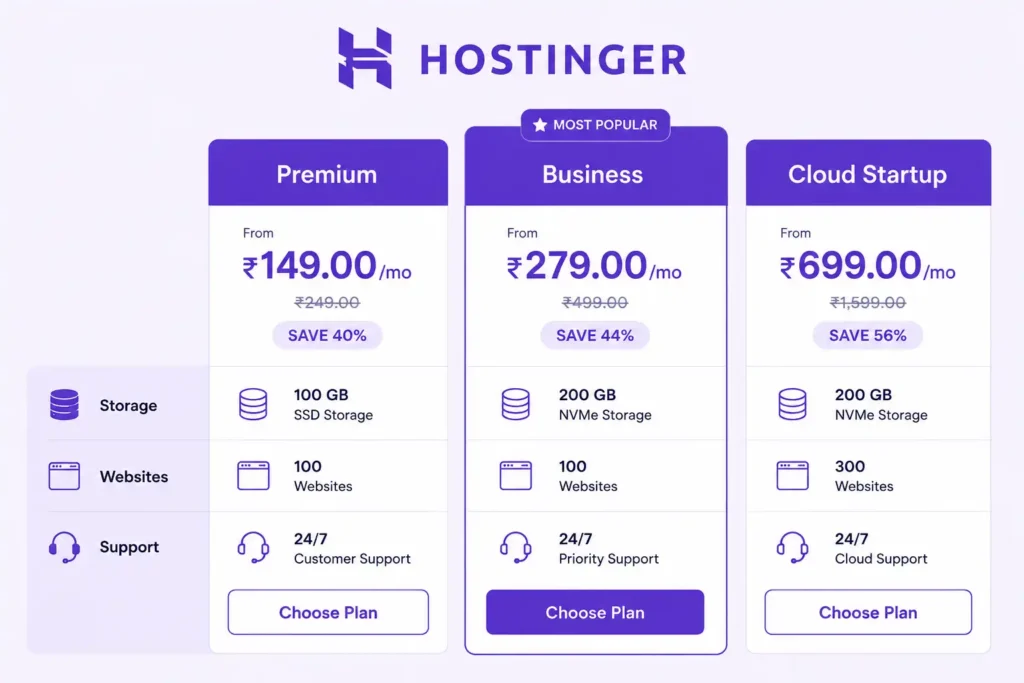
- Premium plan – The entry-level shared hosting tier, typically priced around $1.99 to $2.99 per month when billed on a long-term (24 or 48-month) contract, covering a handful of websites with SSD or NVMe storage depending on the promotion running at the time.
- Business plan – A mid-tier shared hosting plan offering more storage, more websites, and faster NVMe-based storage, usually priced a few dollars higher per month than Premium.
- Cloud Startup plan – The top shared/cloud hosting tier, which adds priority support and a dedicated IP address, features that are missing from the cheaper plans.
- VPS plans (KVM 1–8) – Self-managed virtual private servers ranging from roughly $4.99 up to around $25.99 per month depending on CPU, RAM, and storage allocation.
- Email hosting – Starts at well under a dollar per mailbox per month on long-term plans.
Two details matter here. First, Hostinger’s lowest advertised prices almost always require paying the entire contract term upfront, not a recurring monthly charge — so a “$1.99/month” plan on a 48-month term actually means paying roughly $95 at checkout. Second, renewal pricing after your first term ends is significantly higher than the promotional rate, sometimes several times higher. This is common across the budget hosting industry, not unique to Hostinger, but it is worth budgeting for in advance.
On the positive side, nearly all Hostinger hosting plans include a free domain name for the first year, a free SSL certificate, free automatic website migration from another host, standard DDoS protection, and a built-in malware scanner — all without extra add-on fees.
Data Centers and Server Locations
Hostinger operates data centers across eight countries, including Brazil, Indonesia, India, Lithuania, the Netherlands, Singapore, the United Kingdom, and the United States. When you sign up, you can typically choose the data center location closest to your target audience, which helps reduce loading times for visitors in that region. This global spread is one reason Hostinger has become popular well beyond Europe, including a large user base in South Asia and Latin America.
Customer Support: What to Expect
Hostinger provides 24/7 customer support through live chat and email, and as mentioned earlier, a large share of these interactions are now handled by the Kodee AI agent before being escalated to a human agent if needed. One notable gap is that Hostinger does not offer phone support, which may matter to users who prefer speaking with someone directly rather than typing out a support ticket or chat message.
Who Should Actually Use Hostinger?
Based on everything above, Hostinger tends to make the most sense for:
- First-time website owners who want the lowest possible entry cost
- Bloggers, freelancers, and small business owners building a single site or a small handful of sites
- Users who are comfortable with chat-based support instead of phone support
- People who want AI-assisted tools to speed up the website-building process without hiring a developer
It is generally a less ideal fit for large enterprises needing dedicated hosting, agencies managing hundreds of client sites without add-on packages, or businesses that specifically require guaranteed phone support as part of their operations.
How to Get Started with Hostinger (Basic Steps)
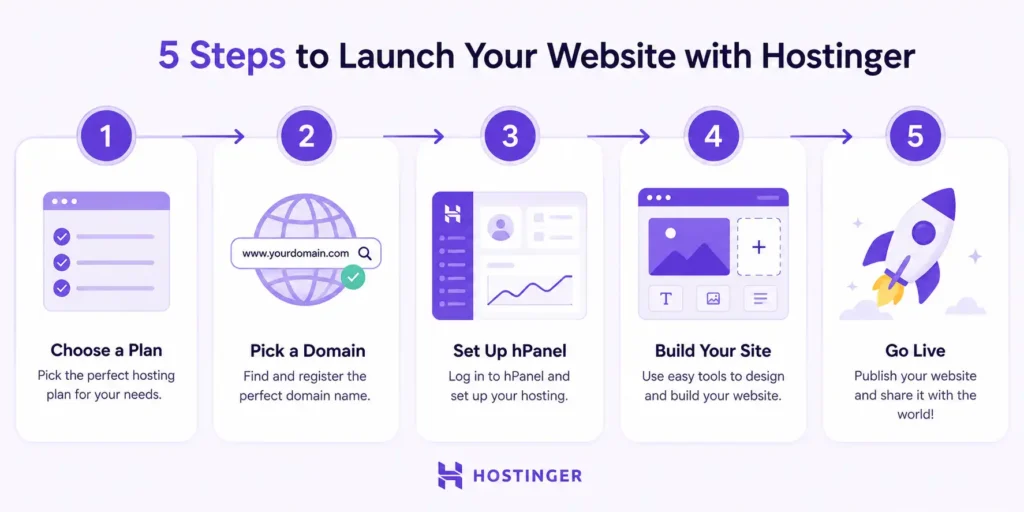
- Visit Hostinger’s website and compare the shared hosting plans (Premium, Business, or Cloud Startup) based on how many websites you plan to run.
- Choose a billing term — shorter terms cost more per month but reduce your upfront commitment.
- Register a new domain name or connect a domain you already own.
- Use hPanel or the AI Website Builder to either install WordPress manually or generate a starting website from a text description.
- Customize your site’s design, add your content, and connect any necessary email addresses through hPanel.
- Review your SSL certificate status (usually enabled automatically) before publishing your site live.
Frequently Asked Questions
Is Hostinger good for complete beginners?
Yes. Its hPanel dashboard and AI Website Builder are specifically designed to reduce the learning curve for people who have never managed a website before.
Does Hostinger offer a money-back guarantee?
Yes, Hostinger offers a 30-day money-back guarantee on most hosting plans, though certain items like domain names and VPS licenses are typically excluded from refunds.
Can I migrate an existing website to Hostinger for free?
In most cases, yes, as long as your site is built on an open-source platform such as WordPress and meets Hostinger’s migration eligibility terms.
Will my hosting price stay the same after the first term?
No. Renewal pricing is higher than the promotional rate, so check the renewal price on the pricing page before committing to a long-term plan.
Final Thoughts
Hostinger has positioned itself as one of the more approachable web hosting companies for people who are building their very first website, largely because of its low entry pricing, simplified hPanel dashboard, and growing suite of AI-powered tools. That said, the long-term contract structure and renewal price increases are worth understanding clearly before you commit, so that the low advertised price does not come as a surprise later on. For beginners who want an affordable, guided starting point into the world of websites, Hostinger remains one of the more practical options available in 2026.
RELATED POSTS
View all

Hostinger vs Bluehost: Complete Hosting Comparison (2026)
August 1, 2026 | by anisurrahaman235f@gmail.com
How to Create a Website with Hostinger in 2026
August 2, 2026 | by anisurrahaman235f@gmail.com
Best Hosting for Small Business Websites in 2026
August 2, 2026 | by anisurrahaman235f@gmail.com