Zero Tillage or No-Till Method of Wheat Cultivation
May 8, 2026 | by anisurrahaman235f@gmail.com
Zero tillage, also known as the no-till method, is a modern, resource-efficient, and climate-smart technique of wheat cultivation. In West Bengal, this method has gained popularity because traditional land preparation after aman rice harvest is often delayed due to wet and puddled soil conditions. This delay pushes wheat sowing beyond the optimum window, resulting in significant yield loss. Research has shown that every day’s delay in sowing after 25–30 December reduces wheat yield by approximately 1% per hectare. The zero tillage method effectively overcomes this problem by allowing timely sowing without conventional ploughing.
This system is low-cost, labour-saving, simple, sustainable, profitable, water-conserving, soil-health improving, and environmentally friendly. It is particularly suitable for intensive rice-wheat cropping systems in the state.
What is Zero Tillage / No-Till Method?
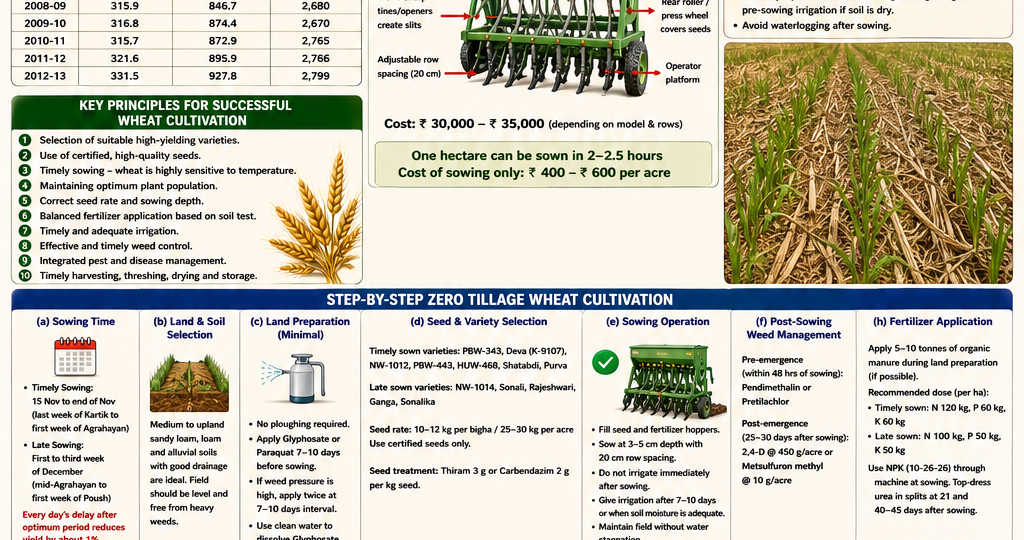
Zero tillage is a conservation agriculture practice where wheat seeds are sown directly into the undisturbed soil without any prior ploughing or land preparation. A specially designed zero-till seed drill machine (also called a happy seeder or zero-till drill) is used. This machine simultaneously performs multiple operations:
- Opens narrow slits in the soil
- Places seeds and fertilizers at the correct depth
- Covers the seeds with soil
The machine is pulled by a 35–45 HP tractor and can sow in 6 or 9 rows at a time.
Advantages of Zero Tillage Method
- Allows sowing 7–10 days earlier than conventional methods.
- Requires much less seed (10–12 kg per bigha / 25–30 kg per acre).
- Fertilizer is placed precisely near the root zone, reducing nutrient loss and increasing efficiency.
- Better weed suppression due to residue retention.
- Stronger root system helps plants resist lodging.
- Saves 30–40% irrigation water.
- Improves soil structure, organic matter content, and microbial activity.
- Reduces soil erosion and conserves moisture.
- One acre can be sown in 40–60 minutes, saving time and labour.
- Higher yield (10–15% more) and higher net profit compared to conventional methods.
- Environmentally sustainable — reduces fuel consumption and greenhouse gas emissions.
Zero Tillage Machine – Features and Cost
The zero-till drill looks similar to a conventional seed drill but is specially engineered.
- Cost: ₹ 30,000 – ₹ 35,000 (depending on model and rows).
- It has separate hoppers for seed and fertilizer.
- 6 or 9 sharp tines/openers create narrow slits.
- Row spacing is adjustable (usually 20 cm).
- Depth of sowing can be adjusted (ideal depth: 3–5 cm).
- A rear roller or press wheel covers the seeds.
- One operator stands on the platform to monitor seed and fertilizer flow.
With this machine, one hectare can be sown in about 2–2.5 hours at a cost of only ₹ 400–600 per acre.
Precautions for Using Zero Tillage Machine
- The field must be reasonably level and free from heavy weeds.
- Sow seeds at 3–5 cm depth for best germination.
- Use only dry, free-flowing granular fertilizers to prevent clogging.
- No additional harrowing is needed after sowing.
- Ensure proper moisture at sowing time — light pre-sowing irrigation may be given if the soil is too dry.
- Avoid waterlogging after sowing.
Step-by-Step Zero Tillage Wheat Cultivation
(a) Sowing Time
- Timely Sowing: 15 November to end of November (last week of Kartik to first week of Agrahayan).
- Late Sowing: First to third week of December (mid-Agrahayan to first week of Poush).
(b) Land and Soil Selection
Medium to upland sandy loam, loam, and alluvial soils with good drainage are ideal. The field should be reasonably level. Heavy weed infestation must be managed before sowing.
(c) Land Preparation (Minimal)
- No ploughing is required.
- Apply non-selective herbicide (Glyphosate or Paraquat) 7–10 days before sowing to control existing weeds.
- If weed pressure is very high, apply herbicide twice at 7–10 days interval.
- Glyphosate should be dissolved in clean water only.
(d) Seed and Variety Selection
Timely Sown Varieties: PBW-343, Deva (K-9107), NW-1012, PBW-443, HUW-468, Shatabdi, Purva.
Late Sown Varieties: NW-1014, Sonali, Rajeshwari, Ganga, Sonalika.
Seed Rate: 10–12 kg per bigha (25–30 kg per acre). Use certified seeds only.
Seed Treatment: Treat seeds with Thiram 3 g or Carbendazim 2 g per kg seed to prevent seed-borne diseases.
(e) Sowing Operation
- Fill the seed and fertilizer hoppers of the zero-till drill.
- Sow at 3–5 cm depth with 20 cm row spacing.
- Do not irrigate immediately after sowing. Wait 7–10 days or until soil moisture is adequate.
- Maintain field without water stagnation.
(f) Post-Sowing Weed Management
- Pre-emergence Herbicides: Apply Pendimethalin or Pretilachlor within 48 hours of sowing.
- Post-emergence Herbicides: Apply 2,4-D (450 g/acre) or Metsulfuron methyl (10 g/acre) at 25–30 days after sowing for broad-leaved weeds.
(g) Irrigation
- First irrigation at crown root initiation stage (21 days after sowing) — most critical.
- Second at maximum tillering (42–45 days).
- Third at flowering (65–70 days).
- Fourth at milk stage (110–115 days).
(h) Fertilizer Application
- Apply 5–10 tonnes of organic manure during land preparation (if possible).
- Recommended Dose (per hectare):
- Nitrogen: 120 kg (timely sown) / 100 kg (late sown)
- Phosphate: 60 kg / 50 kg
- Potash: 60 kg / 50 kg
Use NPK complex fertilizer (10-26-26) through the machine at sowing and top-dress urea in splits at 21 and 40–45 days after sowing.
Harvesting
Wheat grown under zero tillage matures 7–10 days earlier than conventional methods. Harvest when 80% grains turn golden and hard. Timely harvesting prevents losses due to storms or rain.
Conclusion
The zero tillage method is a revolutionary approach for wheat cultivation in West Bengal. It solves the problem of delayed sowing after aman rice, reduces cultivation cost, conserves soil moisture and fertility, saves water, and increases net profit. With proper training, machine availability, and awareness, this method can significantly boost wheat production and make wheat farming more sustainable and profitable for the farmers of the state.
previous reading part 4
RELATED POSTS
View all

Rice Cultivation Area, Production, and Yield in West Bengal Over the Past Years
April 27, 2026 | by anisurrahaman235f@gmail.com