

Improved Method of Wheat Cultivation
May 8, 2026 | by anisurrahaman235f@gmail.com
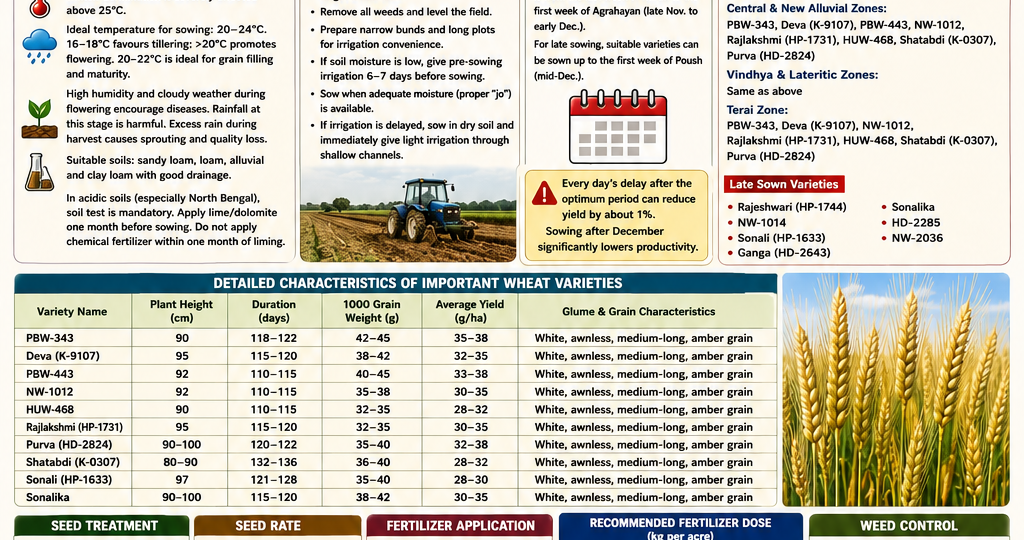
Wheat is the second most important cereal crop in West Bengal after rice. It plays a vital role in ensuring food security and providing nutritional security to the people. However, in recent years, both the area under wheat cultivation and its productivity have been facing challenges. The main reasons include the shortening of the winter season due to climate change, heavy reliance on relatively long-duration varieties, insufficient availability of quality seeds, imbalanced fertilizer application, and irregular irrigation facilities. Additionally, pre-monsoon storms (Kalbaishakhi) in South Bengal and early rains in North Bengal during the harvesting period frequently damage the crop.
Under these changing conditions, it is essential to adopt improved, climate-resilient, and scientifically proven technologies tailored to West Bengal’s agro-climatic conditions to enhance wheat production and productivity.
Wheat Cultivation Area, Production and Productivity in West Bengal
| Year | Area (Thousand Ha) | Production (Thousand MT) | Average Yield (kg/ha) |
|---|---|---|---|
| 1996-97 | 351.1 | 839.0 | 2,390 |
| 2001-02 | 434.0 | 961.5 | 2,215 |
| 2002-03 | 425.7 | 985.7 | 2,315 |
| 2003-04 | 400.1 | 841.5 | 2,103 |
| 2004-05 | 366.7 | 773.5 | 2,109 |
| 2005-06 | 350.6 | 799.9 | 2,281 |
| 2006-07 | 352.6 | 917.3 | 2,602 |
| 2007-08 | 307.0 | 764.5 | 2,490 |
| 2008-09 | 315.9 | 846.7 | 2,680 |
| 2009-10 | 316.8 | 874.4 | 2,670 |
| 2010-11 | 315.7 | 872.9 | 2,765 |
| 2011-12 | 321.6 | 895.9 | 2,786 |
| 2012-13 | 331.5 | 927.8 | 2,799 |
Key Principles for Successful Wheat Cultivation
To achieve higher and stable yields, farmers must strictly follow these practices:
- Selection of suitable high-yielding varieties according to agro-climatic zone and sowing time.
- Use of certified, high-quality seeds.
- Timely sowing — wheat is highly sensitive to temperature.
- Maintaining optimum plant population per unit area.
- Correct seed rate and sowing depth.
- Balanced fertilizer application based on soil test recommendations.
- Timely and adequate irrigation.
- Effective and timely weed control.
- Integrated pest and disease management.
- Timely harvesting, threshing, proper drying, and scientific storage.
Climate and Soil Requirements
Wheat grows best under cool and dry weather with a sufficiently long winter. Germination is severely affected when temperature exceeds 25°C. The ideal temperature for sowing is 20–24°C. A temperature range of 16–18°C promotes good tillering, while temperatures above 20°C initiate reproductive growth and flowering. Temperatures between 20–22°C are optimal for grain filling and maturity.
High relative humidity and cloudy weather during the flowering stage encourage various diseases. Rainfall or prolonged cloudy conditions at this stage are harmful. Excessive rain during harvesting causes grain sprouting and quality deterioration.
Wheat performs well in sandy loam, loam, alluvial, and clay loam soils with good drainage facilities. In acidic soils of North Bengal and other regions, soil testing is mandatory. Apply lime or dolomite one month before sowing as per soil test recommendation and mix thoroughly with the soil. Do not apply any chemical fertilizer within one month of liming.
Land Preparation
Plough the field 3–5 times followed by repeated harrowing to bring the soil to a fine tilth. Remove all weeds completely and level the field properly. For better irrigation management, prepare narrow bunds and divide the field into long plots. If soil moisture is low, give a pre-sowing irrigation 6–7 days before planting. Sow seeds when the soil has adequate moisture (“jo”). If irrigation is delayed, sow in dry soil and immediately provide light irrigation through shallow channels. This practice ensures uniform and better germination.
Sowing Time
The optimum sowing period for wheat in West Bengal is from the last week of Kartik to the first week of Agrahayan (late November to early December). For late sowing, suitable varieties can be sown up to the first week of Poush (mid-December). Every day’s delay after the optimum period can reduce yield by about 1%. Sowing after December results in significantly lower productivity.
Variety Selection
The following varieties have performed well in different agro-climatic zones of West Bengal:
Timely Sown Varieties
- Central & New Alluvial Zones: PBW-343, Deva (K-9107), PBW-443, NW-1012, Rajlakshmi (HP-1731), HUW-468, Shatabdi (K-0307), Purva (HD-2824)
- Vindhya & Lateritic Zones: Same as above
- Terai Zone: PBW-343, Deva (K-9107), NW-1012, Rajlakshmi (HP-1731), HUW-468, Shatabdi (K-0307), Purva (HD-2824)
Late Sown Varieties
- Rajeshwari (HP-1744)
- NW-1014
- Sonali (HP-1633)
- Ganga (HD-2643)
- Sonalika
- HD-2285
- NW-2036
Detailed Characteristics of Important Wheat Varieties
| Variety Name | Plant Height (cm) | Duration (days) | 1000 Grain Weight (g) | Average Yield (q/ha) | Glume & Grain Characteristics |
|---|---|---|---|---|---|
| PBW-343 | 90 | 118–122 | 42–45 | 35–38 | White, awnless, medium-long, amber grain |
| Deva (K-9107) | 95 | 115–120 | 38–42 | 32–35 | White, awnless, medium-long, amber grain |
| PBW-443 | 92 | 110–115 | 40–45 | 33–38 | White, awnless, medium-long, amber grain |
| NW-1012 | 92 | 110–115 | 35–38 | 30–35 | White, awnless, medium-long, amber grain |
| HUW-468 | 90 | 110–115 | 32–35 | 28–32 | White, awnless, medium-long, amber grain |
| Rajlakshmi (HP-1731) | 95 | 115–120 | 32–35 | 30–35 | White, awnless, medium-long, amber grain |
| Purva (HD-2824) | 90–100 | 120–122 | 35–40 | 32–38 | White, awnless, medium-long, amber grain |
| Shatabdi (K-0307) | 80–90 | 132–136 | 36–40 | 28–32 | White, awnless, medium-long, amber grain |
| Sonali (HP-1633) | 97 | 121–128 | 35–40 | 28–30 | White, awnless, medium-long, amber grain |
| Sonalika | 90–100 | 115–120 | 38–42 | 30–35 | White, awnless, medium-long, amber grain |
Seed Treatment
Treat seeds before sowing to prevent seed-borne diseases. Mix 3 g Thiram or 2 g Carbendazim per kg of seed thoroughly. In false smut-prone areas, use 2.5 g Carboxin per kg seed.
In nematode-infested areas, soak seeds in 5% salt solution, discard floating seeds (affected ones), wash the sunken healthy seeds, dry them, and then treat with fungicide.
Seed Rate
- Timely sown irrigated conditions: 40 kg per acre.
- If 1000-grain weight is more than 38 g (bold seeds), increase seed rate by 10–15%.
- Late sown conditions: 48 kg per acre.
- Broadcast sowing: 50 kg per acre.
Fertilizer Application
Apply 2 tonnes of compost and 6 kg each of Azotobacter and PSB per acre during land preparation. In acidic soils of Terai and hill regions, apply 4–8 quintals of dolomite per acre 3 weeks before sowing and mix thoroughly. Do not apply chemical fertilizers within one month of liming.
Recommended Fertilizer Dose (kg per acre)
| Fertilizer | Terai & Hill Region | Other Regions |
|---|---|---|
| Basal | ||
| Urea | 53 kg | 62 kg |
| SSP | 150 kg | 175 kg |
| MOP | 40 kg | 46.5 kg |
| 1st Top Dressing (21 days after sowing) | Urea: 27 kg | Urea: 31 kg |
| 2nd Top Dressing (45 days after sowing) | Urea: 27 kg | Urea: 31 kg |
In zinc-deficient soils, apply 10 kg zinc sulphate per acre. In sulphur-deficient soils, use Single Super Phosphate to meet part of the sulphur requirement. For molybdenum deficiency, spray 0.5 g ammonium molybdate per litre of water.
Weed Control
Weeds like Phalaris minor, Avena fatua, and broad-leaved weeds can reduce wheat yield by up to 40%. Keep the field weed-free for the first 40–45 days.
Apply pre-emergence herbicides within one week of sowing when soil has sufficient moisture:
- Sulfosulfuron 12 g/acre or Pendimethalin 1,300 ml/acre in 200 litres of water.
Post-emergence: Metribuzin 450 g/acre or Metsulfuron methyl 10 g/acre at 25–30 days after sowing.
Irrigation Management
Wheat is highly responsive to irrigation. One acre of irrigation water used for Boro rice can support 5 acres of wheat. Avoid waterlogging as it causes yellowing and plant death.
Critical Irrigation Stages:
- Crown root initiation (21 days after sowing) — Most important.
- Tillering completion (40–45 days).
- Booting / Panicle initiation (50–55 days).
- Flowering (65–70 days).
- Milk stage (110–115 days).
With limited water, prioritize crown root initiation and flowering stages. With 4 irrigations, apply at crown root initiation, tillering, flowering, and milk stage. With 6 irrigations, add booting and late milk stages.
Proper irrigation scheduling, combined with balanced nutrition and timely weed control, can significantly boost wheat yield and quality in West Bengal.
Continue Reading Part 3
RELATED POSTS
View all

Improved Method of Wheat and Maize Cultivation
May 8, 2026 | by anisurrahaman235f@gmail.com
Crop Protection in Wheat Cultivation
May 8, 2026 | by anisurrahaman235f@gmail.com