Insoluble Phosphate-Solubilizing Microbial Fertilizers (PSM)
April 25, 2026 | by anisurrahaman235f@gmail.com
Phosphate-solubilizing microorganisms present in the soil can be bacteria, fungi, or actinomycetes. These are commonly abbreviated as PSM or Phosphate Solubilizing Microorganisms.
When superphosphate or other phosphate fertilizers are applied to the soil, the soluble phosphate quickly reacts with calcium, iron, aluminium, and magnesium present in the soil and gets converted into insoluble phosphate compounds. Our country’s soils also contain large amounts of insoluble mineral phosphates.
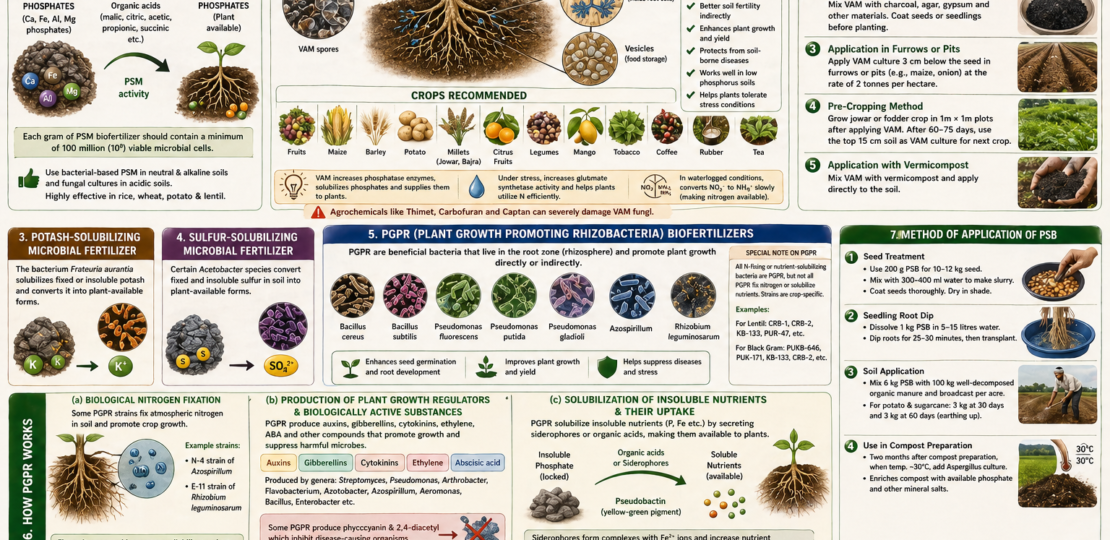
After application, phosphate-solubilizing microorganisms produce various organic acids such as malic acid, citric acid, acetic acid, propionic acid, succinic acid, and others. These acids participate in continuous organic-chemical reactions in the soil and help dissolve the insoluble phosphates, converting them into forms that plants can easily absorb and utilize.
In commercial products, each gram of PSM biofertilizer should contain a minimum of 100 million (10⁸) viable microbial cells. Using bacterial-based PSM in neutral and alkaline soils and fungal cultures in acidic soils increases the efficiency of applied phosphate. This effect is particularly noticeable in crops like rice, wheat, potato, and lentil.
VAM (Vesicular Arbuscular Mycorrhiza) Biofertilizer
Vesicular Arbuscular Mycorrhiza, commonly known as VAM, is a type of symbiotic fungus. The important genera include Glomus, Gigaspora, Acaulospora, Entrophospora, Sclerocystis, and Endogone.
These fungi cannot fix nutrients themselves, but they form an extensive network of hyphae around and inside the roots of plants (for example, litchi). They create special structures called vesicles and arbuscules inside the root cells, which is why they are called Vesicular Arbuscular Mycorrhiza.
By colonizing the plant roots, VAM helps the plant absorb water and essential nutrients from the soil — especially phosphorus, zinc, copper, calcium, manganese, and magnesium. It also protects the plant from various soil-borne diseases. As a result, the presence of VAM indirectly makes the soil more fertile for the crop.
VAM biofertilizer is recommended for many crops including fruits, maize, barley, potato, millets (jowar, bajra), citrus fruits, leguminous crops, mango, tobacco, coffee, rubber, tea, and others.
The arbuscules increase the quantity of phosphatase enzymes, which helps solubilize phosphates and supply them to the plant. Therefore, VAM works very well in soils with low or fixed (locked) phosphorus. During stress conditions, it increases glutamate synthetase enzyme activity to produce ammonium ions and overcome the crisis. In waterlogged conditions, it slowly converts nitrate (NO₃⁻) ions into ammonium (NH₄⁺) ions with the help of nitrate reductase, making nitrogen available to the plant.
However, the use of certain agrochemicals such as Thimet, Carbofuran, and Captan can severely damage the growth and effectiveness of VAM fungi.
Methods of VAM Application
- Direct Seed Coating
Mix VAM with methyl cellulose-based adhesive, coat the seeds thoroughly, dry them in shade, and sow. This method gives good results, especially for citrus seeds. - Charcoal-Based Culture
Mix VAM with charcoal, agar, gypsum, and other materials to prepare a carrier. Coat seeds or seedlings with this mixture before planting. - Application in Furrows or Pits
For crops grown in furrows or pits (such as maize and onion), apply VAM culture 3 cm below the seed at the rate of 2 tonnes per hectare for excellent results. - Pre-Cropping Method
In some crops, after applying VAM, the subsequent crop also benefits through the root system, and continuous multiplication of VAM occurs in the soil. Prepare small 1m × 1m plots, burn 2 kg of straw inside furrows, mix organic matter, coat jowar or fodder crop seeds with VAM, and grow for 60–75 days. The top 15 cm soil from this plot can then be used as VAM culture for the next crop. - Application with Vermicompost
Mix VAM with vermicompost and apply directly to the soil for good results.
Potash-Solubilizing Microbial Fertilizers
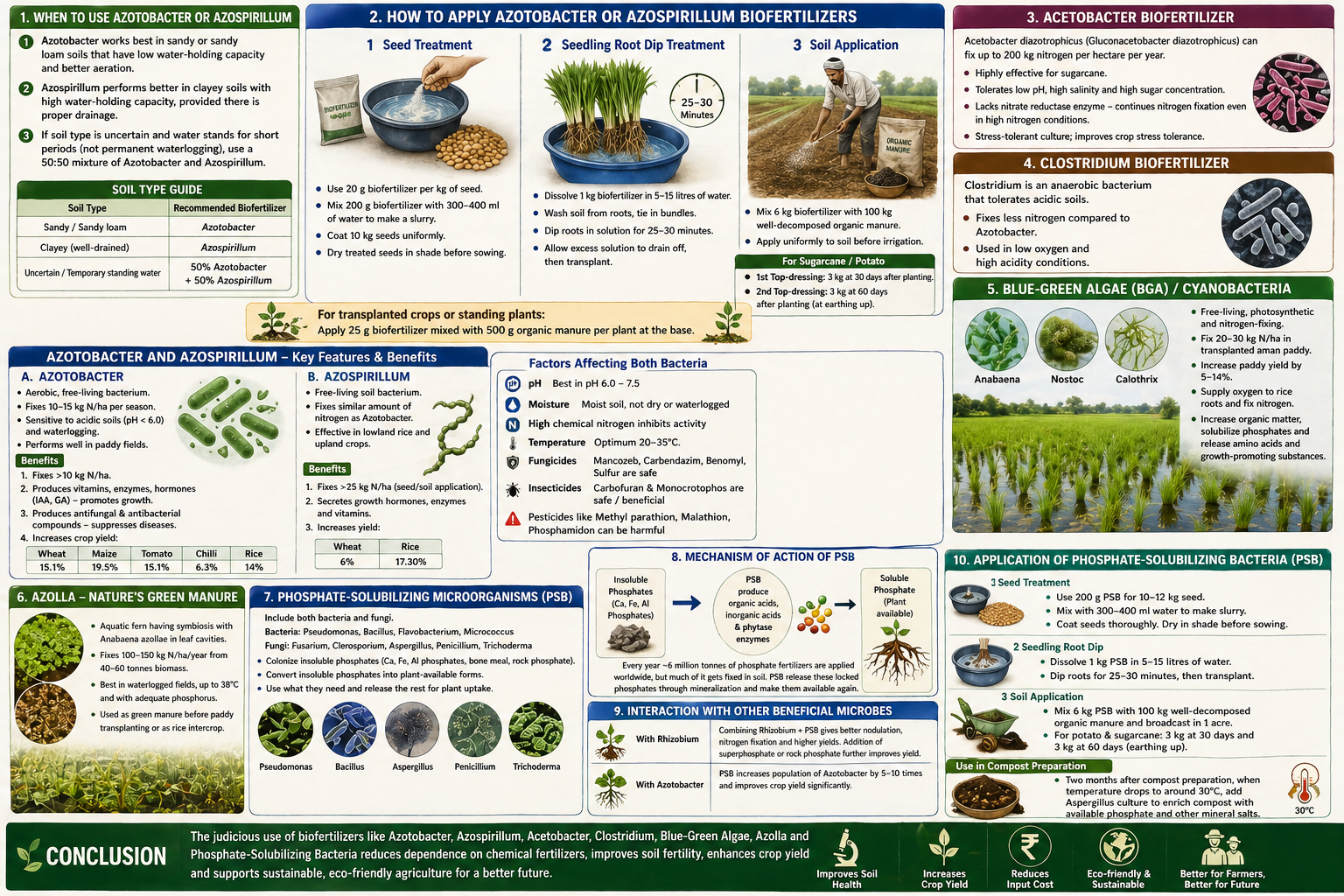
The bacterium Frateuria aurantia solubilizes fixed or insoluble potash present in the soil and converts it into forms that crops can readily absorb.
Sulfur-Solubilizing Microbial Fertilizers
Certain species of Acetobacter bacteria convert fixed and insoluble sulfur in the soil into plant-available forms.
PGPR (Plant Growth Promoting Rhizobacteria) Biofertilizers
PGPR stands for Plant Growth Promoting Rhizobacteria. These are beneficial bacteria that live in the root zone (rhizosphere) and promote plant growth. Rhizobacteria can be either beneficial or harmful. The beneficial ones that directly or indirectly help in plant growth and development are cultured and used as PGPR biofertilizers.
Important PGPR bacteria include:
- Bacillus cereus
- Bacillus firmus
- Bacillus licheniformis
- Bacillus circulans
- Bacillus subtilis
- Pseudomonas gladioli
- Pseudomonas fluorescens
- Pseudomonas putida
- Pseudomonas cepacia
PGPR biofertilizers help in seed germination and root development of seedlings. They enhance overall crop growth and yield both directly and indirectly.
How PGPR Works
PGPR bacteria living in the root zone perform several important functions:
(a) Biological Nitrogen Fixation
Some PGPR strains help in biological nitrogen fixation in the soil. For example, the “N-4” strain of Azospirillum and the “E-11” strain of Rhizobium leguminosarum fix nitrogen in rice fields and promote rice plant growth.
(b) Production of Plant Growth Regulators and Biologically Active Substances
PGPR produce and release various organic compounds such as plant growth regulators, phytohormones, and biologically active substances. These include auxins, gibberellins, cytokinins, ethylene, and abscisic acid. Genera such as Streptomyces, Pseudomonas, Arthrobacter, Flavobacterium, Azotobacter, Azospirillum, Aeromonas, Bacillus, and Enterobacter produce these substances. They counteract the harmful activities of pathogenic or deleterious microorganisms in the root zone and promote plant growth. Some PGPR also produce compounds like phycocyanin and 2,4-diacetyl phloroglucinol that inhibit the growth and multiplication of disease-causing organisms.
(c) Solubilization of Insoluble Nutrients and Their Simplification for Plant Uptake
PGPR solubilize insoluble plant nutrients such as phosphorus and iron present in the soil by secreting siderophores or organic acids, making them easily available to plants. Siderophores are low-molecular-weight compounds that form complexes with ferrous (Fe²⁺) ions. Certain Pseudomonas bacteria produce a yellow-green pigment called pseudobactin (a type of siderophore) that helps increase growth and yield in potato crops.
Special Note on PGPR
It is important to remember that while all nitrogen-fixing or insoluble nutrient-solubilizing bacteria can be considered PGPR, not all PGPR necessarily fix nitrogen or solubilize nutrients. PGPR have specific strains that perform best on particular crops. For example, notable PGPR strains for lentil include CRB-1, CRB-2, KB-133, PUR-47, etc. For black gram, suitable strains include PUKB-646, PUK-171, KB-133, and CRB-2.
Conclusion
Phosphate-solubilizing microorganisms (PSM), VAM, potash-solubilizing bacteria, sulfur-solubilizing bacteria, and PGPR together form a powerful group of beneficial microbial fertilizers. Their proper use can significantly reduce dependence on chemical fertilizers, improve nutrient availability, enhance plant growth, suppress diseases, and increase crop yields in a sustainable and environment-friendly manner. Farmers should select the right microbial product according to soil type, crop, and local conditions, and apply them carefully along with organic manure for maximum benefit.
RELATED POSTS
View all