

Best Domain Registrars for Beginners in 2026
August 2, 2026 | by anisurrahaman235f@gmail.com

Buying your first domain name sounds like it should be simple, and technically it is — but the registrar market has quietly gotten more complicated over the past couple of years, with new players entering, old assumptions about “safe” choices no longer holding up, and pricing structures that reward some habits and punish others. This guide focuses specifically on what actually matters for a beginner buying their first domain, not what matters to a domain investor managing a portfolio of five hundred names.
What a Beginner Actually Needs From a Registrar
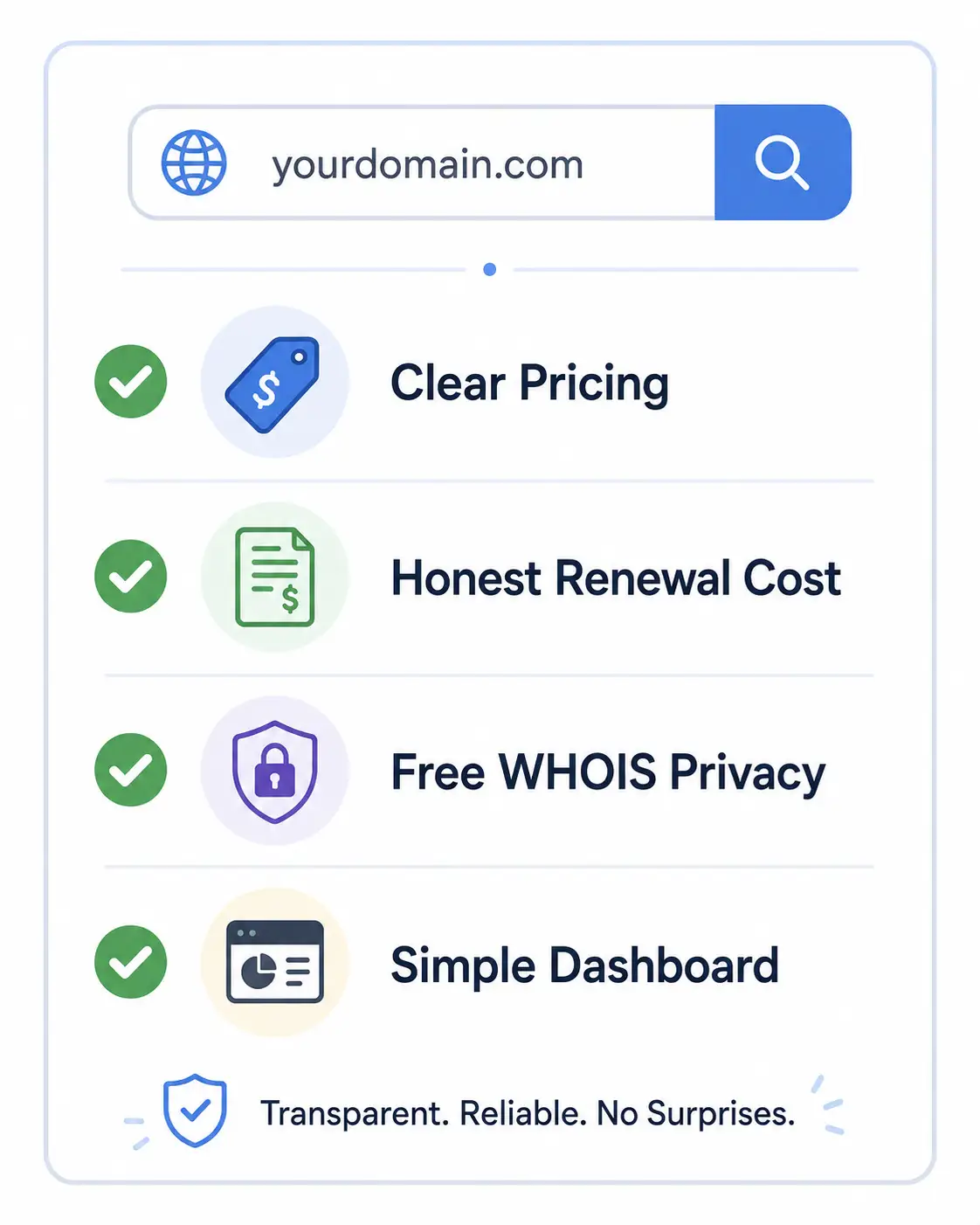
Domain investors and agencies care about things like bulk API access and portfolio management tools. A first-time buyer cares about something much simpler: a clear price today, an honest price at renewal, free privacy protection so your home address doesn’t end up in a public database, and a dashboard that doesn’t require a tutorial just to update a DNS record. Every registrar on this list was chosen specifically because it holds up well against those four criteria, not because it has the most features overall.
Namecheap — Best Overall for Beginners
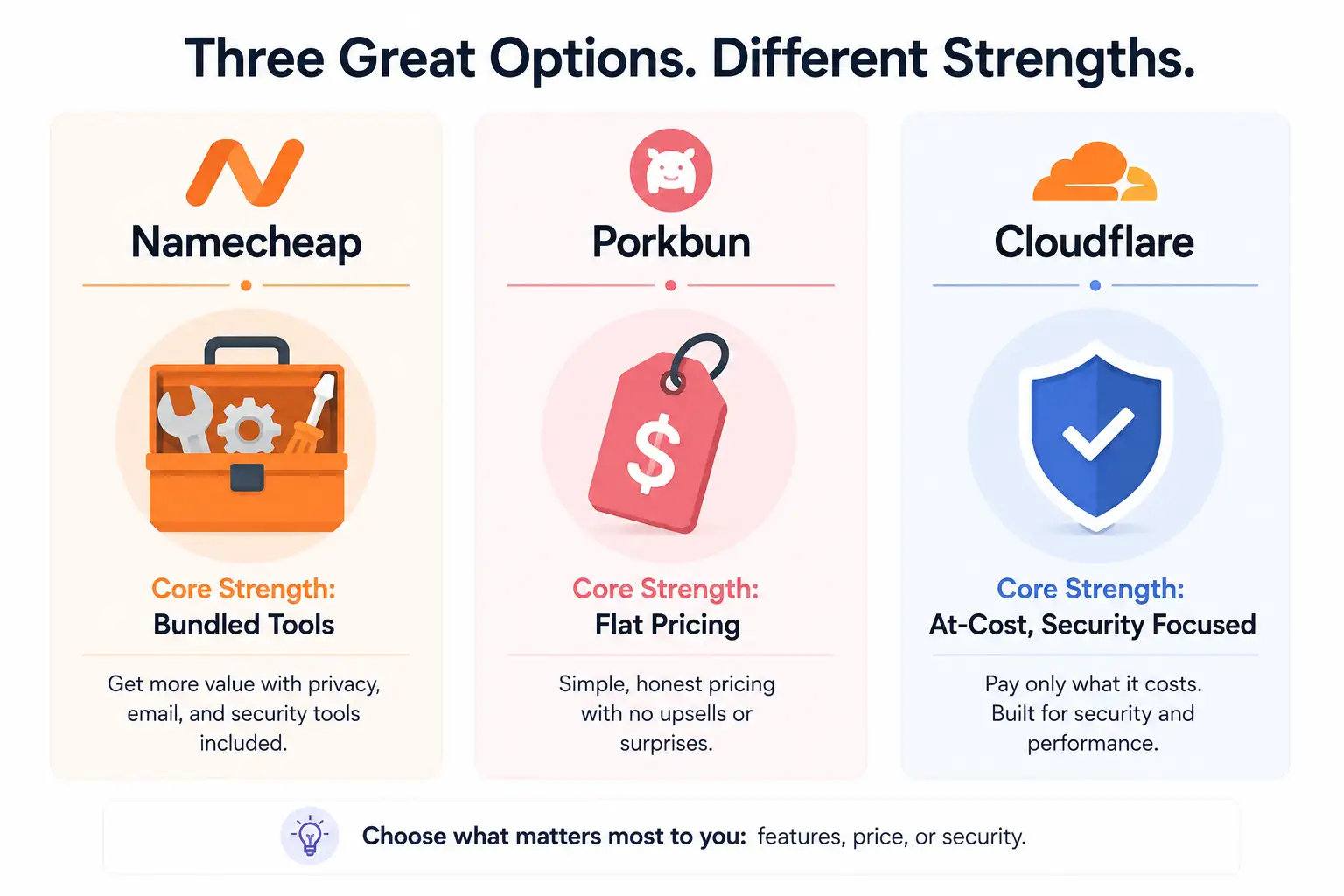
Namecheap remains one of the most consistently recommended registrars for first-time buyers, and the reason isn’t just price — it’s that Namecheap bundles domains, hosting, email, and SSL certificates together in a way that lets a beginner manage an entire first website from a single account without juggling multiple companies. Pricing on standard TLDs typically runs in the $6 to $15 per year range, and the interface is generally considered approachable without oversimplifying to the point of hiding useful settings.
The honest caveat worth knowing upfront: Namecheap’s checkout flow has a reputation for pushing add-ons and upsells during purchase, so it’s worth slowing down and unchecking any pre-selected boxes for services you didn’t specifically ask for. Renewal pricing is also moderately higher than the introductory rate, so it shouldn’t be mistaken for a flat-pricing registrar the way some competitors on this list are.
Porkbun — Best for Transparent, Flat Pricing
Porkbun has built a loyal following specifically by avoiding the bait-and-switch pricing model most of the industry relies on. A standard .com domain runs around $11.08 per year, and — this is the part that matters — it renews at that same $11.08 the following year, with no hidden jump waiting for you twelve months later. Free WHOIS privacy and automatic SSL are included by default, and the interface handles the core tasks a beginner actually needs without unnecessary complexity.
For someone who specifically wants to avoid the classic renewal-price surprise that catches so many first-time domain buyers off guard, Porkbun is one of the most consistently reliable choices available in 2026.
Cloudflare Registrar — Best for Zero Markup (With Real Tradeoffs)
Cloudflare Registrar operates differently from a traditional registrar: it sells domains at the exact wholesale price Cloudflare itself pays, with no markup added at registration or renewal. For a .com domain, this currently lands around $10.46 per year, a genuinely honest price with nothing hidden behind it. Free WHOIS privacy is included automatically as well.
The tradeoffs are real, though, and worth understanding before choosing this option as a total beginner. Cloudflare Registrar requires you to already have a Cloudflare account and generally expects you to use Cloudflare’s own DNS service, rather than offering the more general-purpose domain management dashboard other registrars provide. There’s no beginner-friendly domain name search and suggestion tool either. It’s an excellent choice for someone comfortable with a slightly more technical setup, but not the gentlest starting point for a total first-timer.
Spaceship — Best New Option for User Experience
Spaceship is a newer registrar, owned by Namecheap but built and branded separately, and it has quickly earned a reputation for having one of the cleanest, most modern user interfaces in the entire registrar market. Pricing sits right around wholesale cost as well, at roughly $9.98 per year for .com registration and renewal alike, undercutting even some of the more established flat-pricing competitors. For a beginner who specifically values a clean, uncluttered dashboard experience, Spaceship is one of the strongest newer entries worth considering in 2026.
IONOS — Best If You Want Domain and Hosting Bundled Tightly
If your priority is getting a domain and hosting set up together with minimal separate account management, IONOS stands out for aggressive first-year domain pricing bundled directly with hosting plans, along with 24/7 phone support, which is a genuine advantage for beginners who specifically want the option to call someone rather than rely entirely on chat or email. This convenience comes at the cost of being less competitive on pure standalone domain pricing compared to Porkbun, Cloudflare, or Spaceship if you’re only buying a domain and plan to host elsewhere.
An Important 2026 Warning: Why GoDaddy Isn’t on This List
GoDaddy has historically been one of the most recognized names in domain registration, and older articles online still frequently recommend it out of habit. As of a February 2026 Terms of Service change, however, GoDaddy reclassified its entire customer base — reportedly more than 21 million accounts — as “Business Customers,” a shift that stripped away certain EU consumer protections and introduced more restrictive arbitration terms into its standard agreement. This change has led several independent reviewers to specifically walk back previous GoDaddy recommendations for typical first-time buyers, particularly for beginners based in the EU. It’s worth being aware of this shift specifically because so much older content online hasn’t been updated to reflect it.
Should You Buy Your Domain From Your Hosting Company or a Separate Registrar?
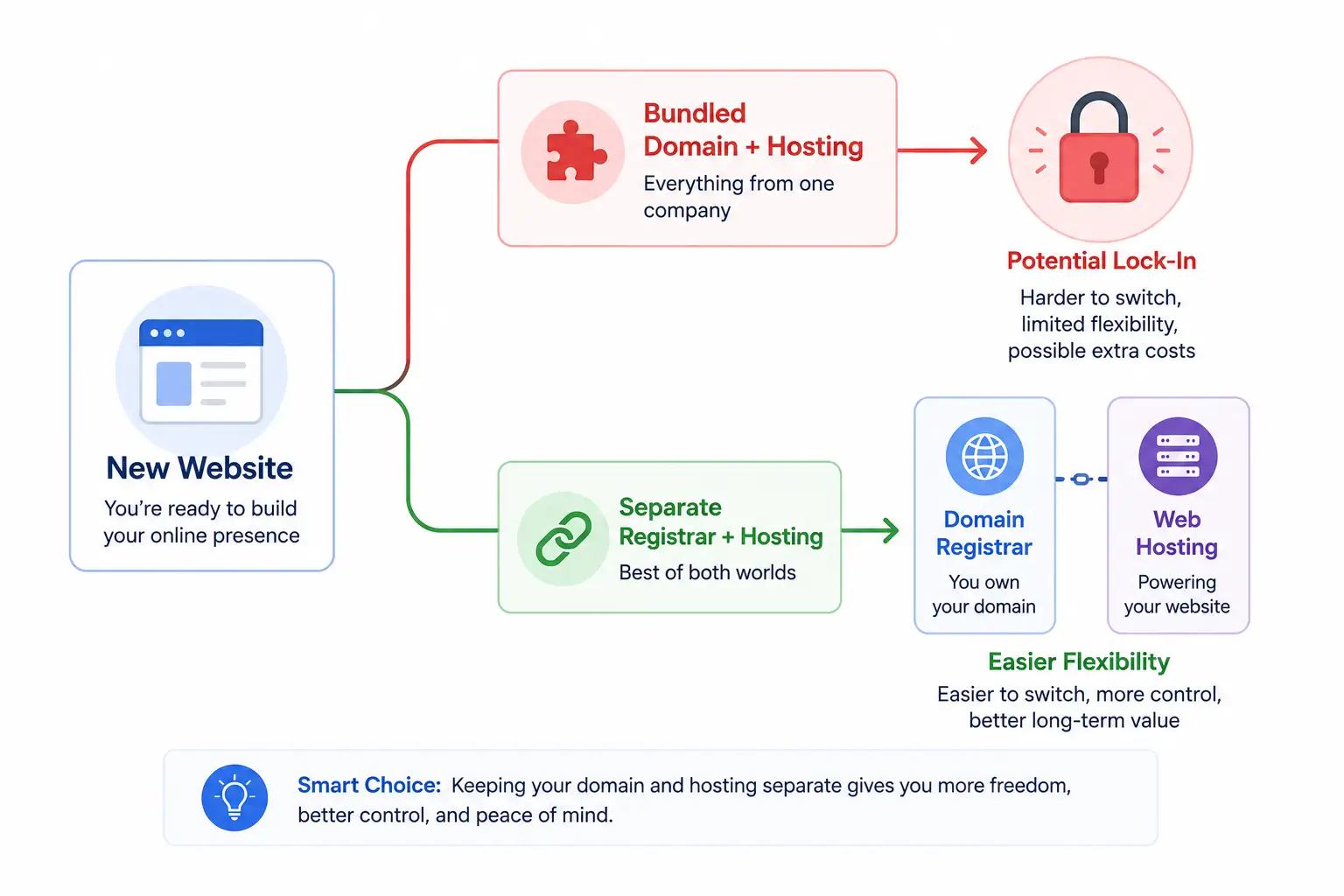
This is one of the more genuinely useful questions a beginner can ask before buying anything. Bundling a “free” domain with your hosting plan is convenient, but it comes with a real tradeoff: domains registered through a bundled hosting deal can be more difficult to transfer if you later decide to switch hosting providers, and the “free” period typically only covers the first year before reverting to standard registrar pricing anyway.
Keeping your domain registration at a dedicated registrar, separate from wherever you host your website, generally makes future migrations smoother and avoids a form of soft lock-in that bundled domains can create. For a genuinely long-term project, registering separately with a straightforward registrar like Porkbun, Namecheap, or Spaceship, and then pointing that domain at whichever hosting provider you choose, tends to be the more flexible approach.
Frequently Asked Questions
Is it better to buy a domain and hosting from the same company?
Not necessarily. It’s more convenient for beginners, but keeping them with separate providers generally makes future hosting migrations easier and avoids potential domain transfer friction down the line.
Why do some registrars charge different renewal prices than their first-year price?
Many registrars use discounted first-year pricing as a customer acquisition strategy, then renew at a rate closer to or above actual wholesale cost. Flat-pricing registrars like Porkbun and Cloudflare avoid this by charging the same rate at registration and renewal.
Is free WHOIS privacy actually important for a beginner?
Yes, generally. Without it, your name, address, and contact information become part of the public WHOIS database by default in many jurisdictions, which most beginners prefer to avoid for basic privacy reasons.
Should I avoid GoDaddy entirely because of the 2026 Terms of Service change?
It depends on your priorities and location. The change primarily affects consumer protection standing and arbitration terms rather than technical service quality, but it’s a legitimate factor worth weighing, particularly for EU-based buyers, before choosing GoDaddy over the alternatives listed here.
Final Thoughts
For most beginners in 2026, Namecheap remains the most balanced starting point thanks to its combination of bundled tools and genuine beginner-friendliness, Porkbun and Cloudflare are worth strong consideration if avoiding renewal price surprises matters most to you, and Spaceship is an increasingly compelling newer option if interface quality is your priority. Whichever registrar you choose, the two habits that matter most for a first-time buyer are checking the actual renewal price before clicking buy, and thinking carefully about whether bundling your domain with your hosting plan is worth the potential flexibility trade-off later on.
This guide reflects publicly available registrar pricing and policy information as of August 2026. Pricing, terms, and promotional offers change frequently, so it is worth confirming current details directly on each registrar’s website before purchasing.
RELATED POSTS
View all

How to Create a Website with Hostinger in 2026
August 2, 2026 | by anisurrahaman235f@gmail.com
Beginner’s Guide to Hostinger hPanel (2026 Edition)
August 2, 2026 | by anisurrahaman235f@gmail.com

The Complete Beginner’s Guide to Launching Your First Website (2026)
August 2, 2026 | by anisurrahaman235f@gmail.com