

Hostinger vs SiteGround: Which Hosting Provider Is Better? (2026)
August 1, 2026 | by anisurrahaman235f@gmail.com
Hostinger and SiteGround sit at almost opposite ends of the hosting market, even though both frequently appear on the same “best WordPress hosting” lists. One built its entire identity around aggressive pricing and raw speed. The other built its identity around premium infrastructure, polished tooling, and support quality, and prices accordingly. Comparing them isn’t really about finding a winner in every category — it’s about figuring out which tradeoff actually matches your budget and your patience for renewal-price surprises.
This comparison draws on independent 2026 testing data covering speed, uptime, pricing structure, and feature sets for both providers, rather than relying on either company’s own marketing claims.
Quick Verdict
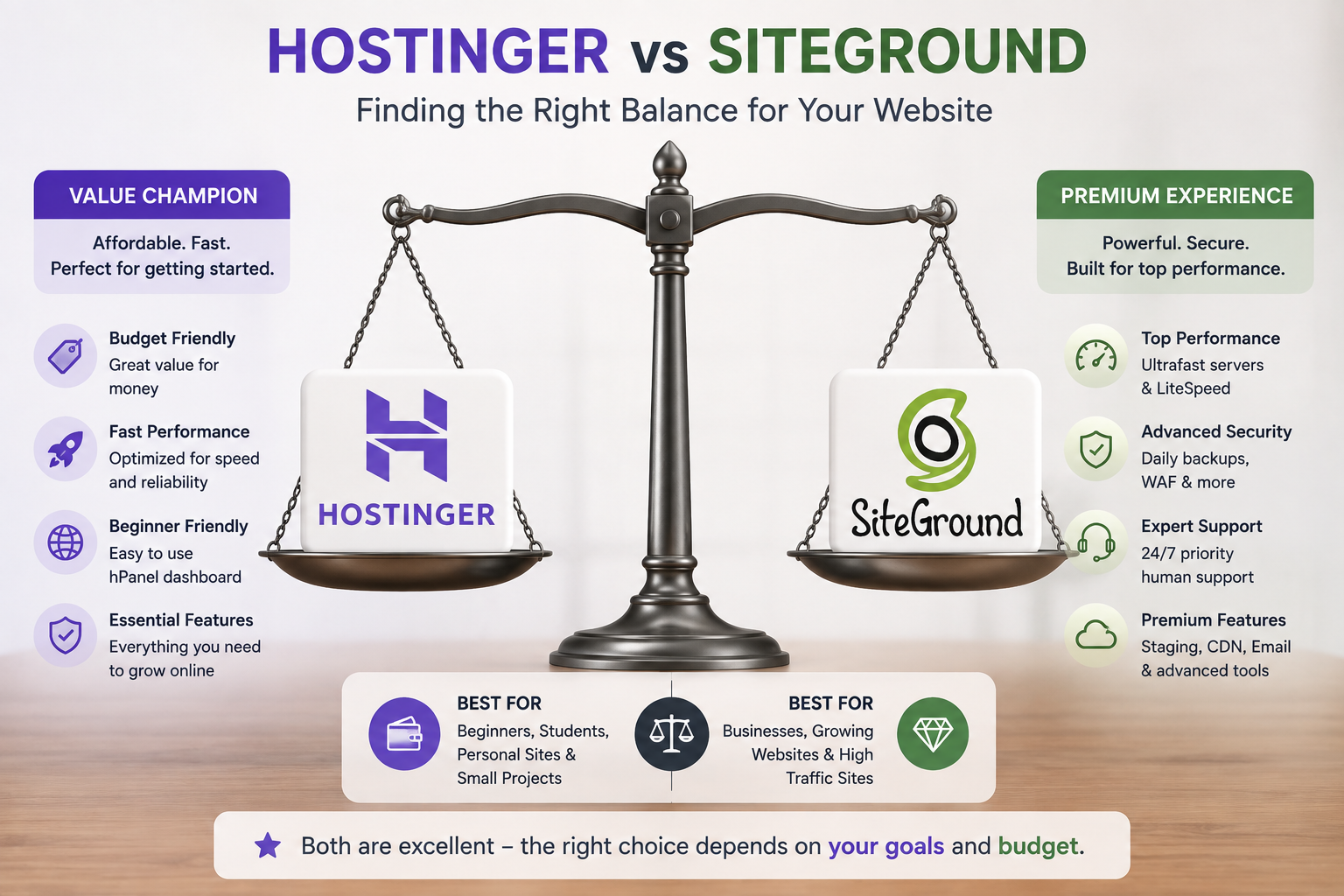
Hostinger wins decisively on price, both at signup and — more importantly — at renewal, while still delivering competitive speed and generous included features. SiteGround wins on infrastructure polish, WordPress-specific tooling, and customer support consistency, running entirely on Google Cloud Platform with proprietary performance technology that few budget hosts attempt to match. If cost efficiency matters most, Hostinger is the clear choice. If you’re running a client-facing or business-critical WordPress site where support quality justifies a higher bill, SiteGround remains a strong premium option.
Company Background
Hostinger has spent recent years scaling aggressively, expanding data centers across multiple continents and investing in a modern LiteSpeed-based infrastructure stack while keeping prices at the budget end of the market. SiteGround, founded in 2004, took a different path — migrating its entire infrastructure to Google Cloud several years ago and building custom in-house technology like Ultrafast PHP and its SuperCacher caching system specifically to push performance beyond what typical shared hosting delivers.
That’s the core tension in this comparison: Hostinger tries to get you 90% of premium performance at a fraction of the price, while SiteGround tries to justify a higher price by consistently delivering closer to the full 100%.
Pricing Comparison
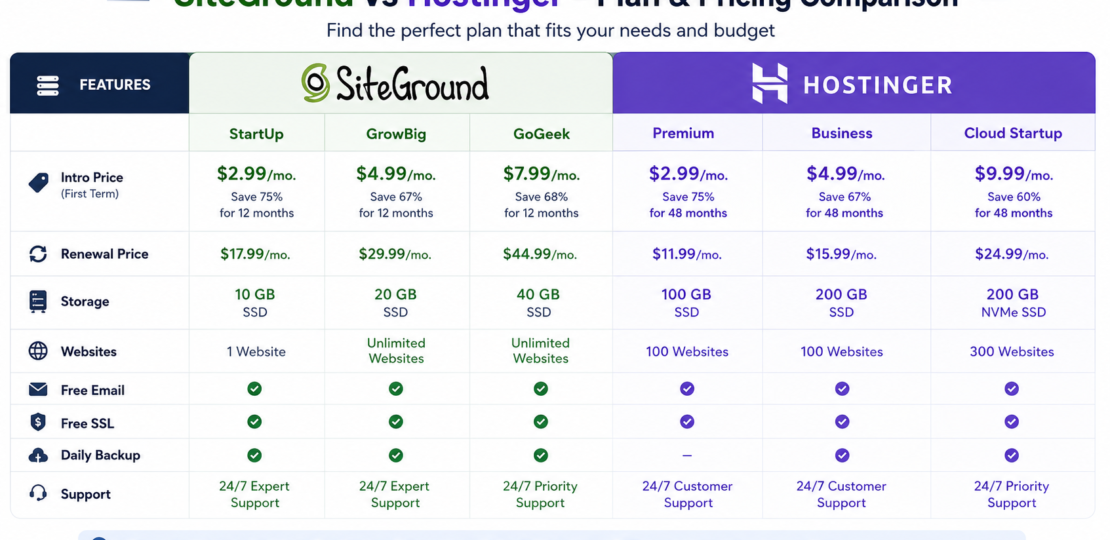
SiteGround’s shared hosting comes in three tiers — StartUp, GrowBig, and GoGeek — with introductory pricing often starting around $2.99–$3.99/month depending on region and promotions. The catch is the renewal jump: multiple independent reviewers in 2026 have flagged renewal increases as steep as 50% year-over-year on some plans, and SiteGround’s long-term pricing is consistently among the higher end of the shared hosting market once the promotional period ends. Storage is also comparatively limited — 10GB on StartUp, 20GB on GrowBig, and 40GB on GoGeek — which is modest next to most budget competitors.
Hostinger’s shared plans (Premium, Business, Cloud Startup) start even lower, typically in the $2–5/month range on long-term contracts, and while renewal pricing does increase, independent trackers generally place Hostinger’s long-term cost well below SiteGround’s for comparable resources. Hostinger also tends to offer more storage at each price point.
The bottom line: SiteGround’s pricing buys you specific premium infrastructure and support, while Hostinger’s pricing is built to be the more affordable option at every stage — introductory and renewal alike. If long-term cost predictability matters to you, run the actual renewal-year math on both before deciding, since promotional pricing on either site can be misleading on its own.
Performance and Speed: What the Data Actually Shows
Both hosts test well in 2026 — this isn’t a case of one being fast and the other slow. It’s closer to two different flavors of “fast.”
SiteGround benefits directly from running on Google Cloud’s global network, which independent testers credit for consistently low-latency routing across major regions. Average page load times in third-party tests generally land in the 1–2 second range, with server response times around 700ms in some benchmark sets, and uptime monitoring has repeatedly recorded figures at or extremely close to 100% during multi-week testing windows. SiteGround’s proprietary Ultrafast PHP technology and AI-driven anti-bot system also contribute to handling traffic spikes without the performance dips that plague weaker shared hosting setups.
Hostinger, running LiteSpeed Enterprise across its plans by default, has posted comparably strong or even slightly faster raw numbers in several 2026 speed benchmarks — independent tests have measured Hostinger’s Time to First Byte around 180–300 milliseconds on cache-enabled plans, with fully loaded page times often under 1.5 seconds. Hostinger’s uptime figures have also landed at or near 99.9%–100% across long-term monitoring periods.
In practice, the performance gap between the two in 2026 is narrower than the price gap — both are genuinely fast, reliable hosts. SiteGround’s advantage shows up more in consistency under heavier, more complex workloads and traffic spikes, which matters more for agencies and higher-traffic business sites than for a standard blog or small business page.
Features Comparison
| Feature | Hostinger | SiteGround |
|---|---|---|
| Infrastructure | Global multi-continent data centers | Google Cloud Platform |
| Web server tech | LiteSpeed Enterprise | Ultrafast PHP + SuperCacher |
| Control panel | Custom hPanel | Custom Site Tools |
| Free CDN | Included from Business plan up | Included on all plans |
| Free SSL | Yes, all plans | Yes, all plans |
| Daily backups | Included on Business/Cloud tiers | Included on GrowBig and GoGeek only (not StartUp) |
| Storage (entry plan) | Generally more generous | 10GB on StartUp |
| Security extras | DDoS protection, malware scanning | AI-driven anti-bot system, web application firewall |
| AI tools | AI website builder, AI troubleshooting | SG Optimizer plugin (WordPress-focused) |
| Data center choice | Multiple regions available | Multiple regions, including UK/EU options |
Both providers hold back daily automatic backups from their absolute cheapest tier, so if that feature matters to you specifically, you’ll need at least the second tier from either company.
Ease of Use
hPanel (Hostinger) is streamlined and fast, with real-time resource monitoring baked directly into the dashboard so you can watch CPU, RAM, and bandwidth usage as you work. Site Tools (SiteGround) takes a similarly modern approach but leans further into WordPress-specific workflows — staging environments, the SG Optimizer plugin, and integrated caching controls are all easy to reach without digging through menus.
For a general-purpose site, hPanel feels slightly faster to navigate day-to-day. For a WordPress-specific project where staging environments and fine-grained caching control matter, Site Tools is arguably the more purpose-built interface of the two.
Customer Support
This is where SiteGround has built much of its reputation. Independent testers who’ve contacted SiteGround support at various hours — including late nights and weekends — have generally reported fast, knowledgeable responses, and the company is frequently cited as one of the more consistently well-reviewed hosts for support quality in the budget-to-mid-tier market.
Hostinger’s 24/7 live chat support handles routine issues efficiently, but as with most budget hosts, independent reviews note that response quality can become less consistent for advanced technical questions or during high-demand periods. Neither host offers the kind of dedicated account-manager support you’d get from an enterprise-tier plan, but between the two, SiteGround edges ahead on support consistency, which is part of what justifies its higher price tag.
Security Features
Both hosts take security seriously, just with different emphases. SiteGround’s AI-driven anti-bot system and custom web application firewall are specifically designed to catch and block malicious traffic before it reaches your site, alongside daily backups on its higher tiers. Hostinger bundles DDoS protection and malware scanning into every plan tier by default, including its cheapest option — a meaningful advantage for budget buyers who want baseline protection without upgrading.
Neither approach is clearly superior; SiteGround’s tools are more specialized for sophisticated threats, while Hostinger’s advantage is that strong security isn’t gated behind a pricier plan.
Who Should Choose Hostinger?
- Budget-conscious buyers who want the lowest realistic long-term cost, including at renewal
- Sites needing more storage and bandwidth at the entry price point
- International audiences who benefit from Hostinger’s broader data center footprint
- Developers who want AI-assisted tools and a fast, modern dashboard without a premium price tag
- Anyone comfortable resolving issues through live chat rather than needing deep, specialized support
Who Should Choose SiteGround?
- WordPress-focused site owners who want staging environments and specialized optimization tools built in
- Businesses or agencies where support consistency and infrastructure polish justify a higher monthly cost
- Sites expecting complex traffic patterns or spikes where SiteGround’s Google Cloud backbone and anti-bot protection add real value
- Users who prioritize a long-established, security-focused hosting brand over the lowest possible price
Final Verdict
Hostinger is the stronger value pick for the vast majority of small to mid-sized websites in 2026 — it delivers genuinely competitive speed, includes more security features by default, and costs meaningfully less both at signup and at renewal. SiteGround remains the more premium, WordPress-specialized option, and for agencies, business-critical sites, or anyone who has been burned by weak support elsewhere, the extra cost buys real, measurable consistency.
Neither company is a bad choice — this comparison comes down to priorities, not quality gaps. If your budget is the deciding factor, Hostinger is very hard to beat. If you’re building something where downtime or a slow support response has real business consequences, SiteGround’s premium infrastructure and support track record make the higher renewal price easier to justify. Whichever you choose, factor the renewal price into your decision from day one — both hosts are considerably more expensive after the introductory term ends.
RELATED POSTS
View all

Hostinger vs GoDaddy Hosting: Performance and Pricing Review (2026)
August 2, 2026 | by anisurrahaman235f@gmail.com
20 Things to Check Before Buying a Web Hosting Plan (2026)
August 2, 2026 | by anisurrahaman235f@gmail.com
Best Domain Registrars for Beginners in 2026
August 2, 2026 | by anisurrahaman235f@gmail.com