

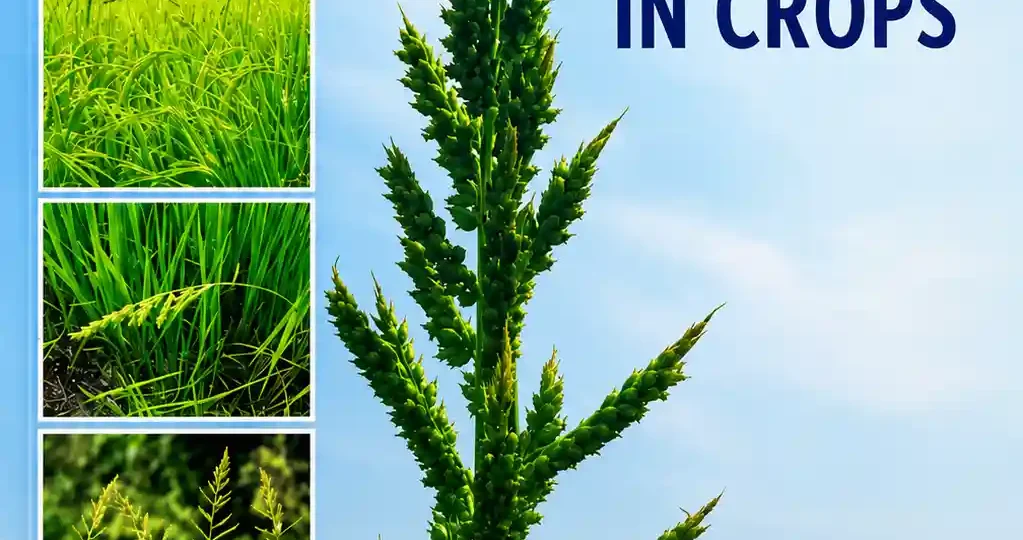
Weed
Weeds do not have any separate species; they belong to the same family as crop plants and are similar in size, shape, and physiological aspects. Weeds are unwanted and ugly plants that grow in crop fields, which increase the cost of crop production and reduce the quality of the crop; these are called weeds. According to agricultural scientists, crop losses in India due to various enemies amount to approximately 30,000.00 crore taka. Of which weeds cause 37 percent damage, i.e., approximately 11,500.00 crore taka, which is much more than diseases (22%) and insect pests (29%). Due to global warming, the incidence of weeds is increasing and new weeds are emerging. Such as wild rice (Oryza rufipogon). Due to environmental pollution, temperature is increasing and greenhouse gases are increasing, as a result the incidence of heat-tolerant weeds is increasing and C-4 weeds are growing. In anaerobic environment, weeds like Eichhornia crassipes, Oryza rufipogon, Panicum repens etc. are increasing.
In aerobic environment, Desmodium triflorum, Phalaris minor, Euphorbia heterophylla are increasing.
In the global context, weed infestation reduces food grain production by 287-320 million tons, which is 11.7 percent of the world’s food grain production. In our country, various crops suffer 12-78 percent yield loss due to weeds. Jute, sesame, broadcast rice, especially zero-tillage rice, broadcast rice, and wheat are particularly damaged by weeds. If weeding or weed control is not done in time, no yield is obtained.
In a broader sense, weeds are of two types:
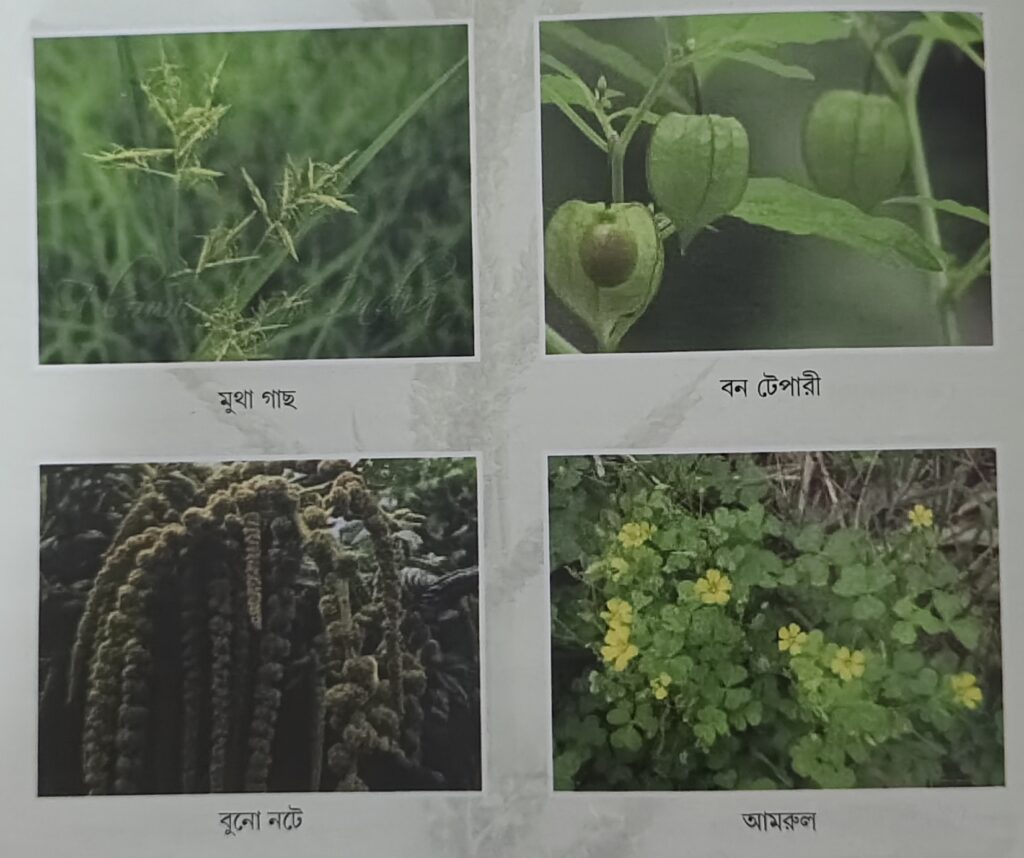
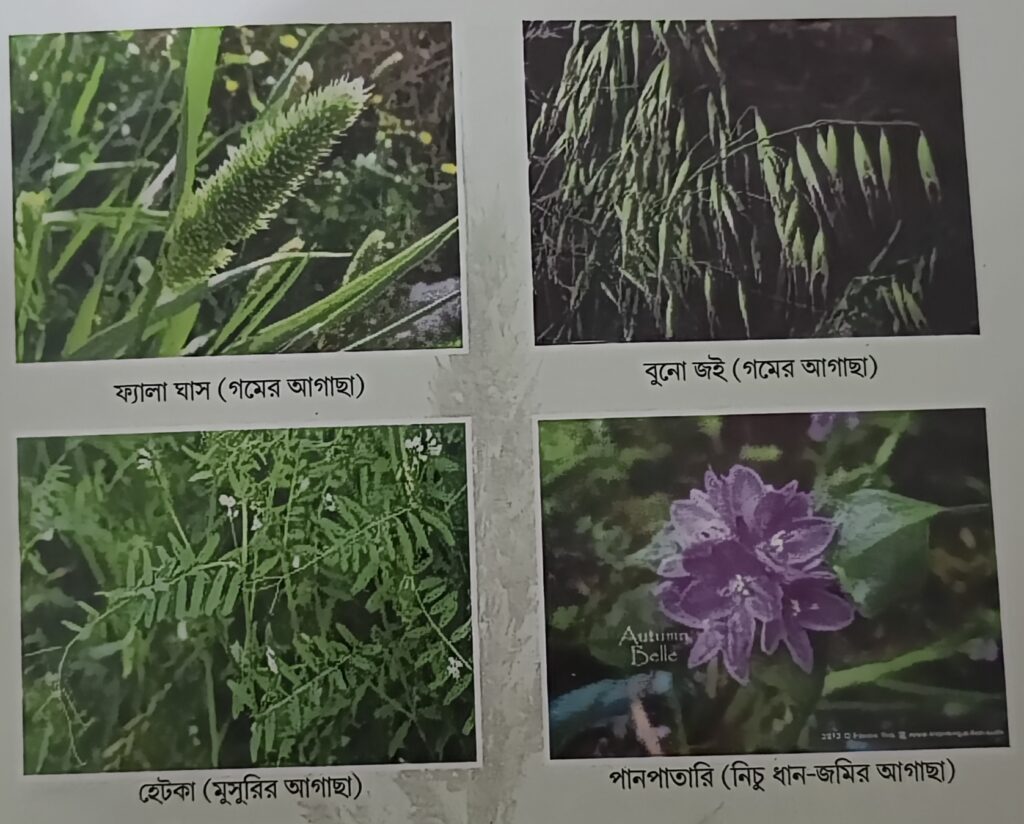
- Absolute Weeds – Unwanted plants that grow in crop fields, reduce the quality of the crop, and compete with the crop to reduce production. For example – Shyama, Mutha, Fela etc.
- Relative Weeds – These are economically important other species of crops that grow in a crop field or a different variety of crop that is not desired is called a relative weed. For example – if lalata grows in Swarnadhan field or mustard grows in wheat field. When such weeds appear, they should be removed immediately to maintain the purity of the crop.
Special harmful characteristics of weeds:
Weeds can spread very quickly due to some special characteristics compared to ordinary crops. For example – Parthenium seeds came to our country in wheat imported from America. Today Parthenium has covered any fallow land in the country, which is impossible in the case of any crop. Therefore, knowing these characteristics is essential in weed control.
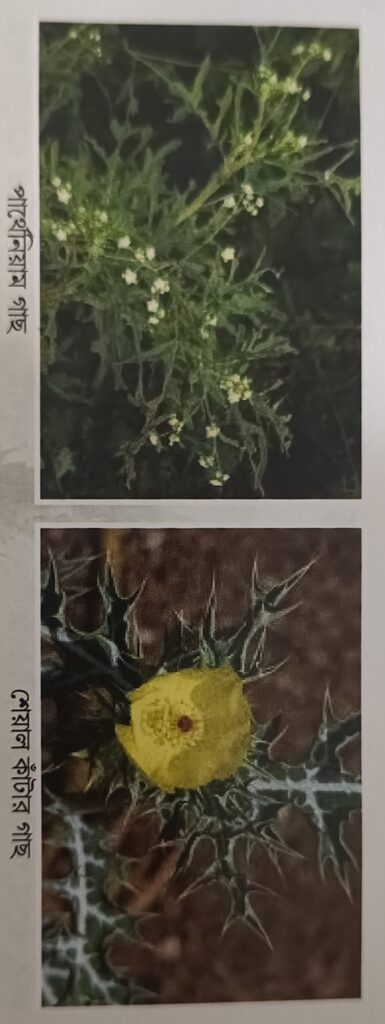
Parthenium causes skin diseases, asthma, breathing difficulties, and bitter taste in milk in humans and mammals. Various harmful diseases are caused by the toxic effect of Parthenium’s chemicals. Parthenium Awareness Week is observed from 16-22 August.
Eating oil mixed with Shealkanta seeds and mustard seeds causes terrible neurological disease, which can lead to paralysis. Everyone must remember the incident in Behala. Shealkanta plants cannot be distinguished in the early stage.
- Seeds can easily spread from one place to another:
Weed seeds can easily spread from one place to another through crop seeds, irrigation water, with the help of wind, sticking to the bodies of various domestic animals and humans, through cow dung manure, and through animals and birds. As a result, if any place remains fallow, it quickly becomes filled with weeds. In most cases, the seeds are light and have a parachute-like structure, so they can easily float with the help of wind from one place to another.
a) Through air: Seeds of Kash, Kush, Akanda, Kuruchi, Jarul can spread very easily over long distances through the air.
b) Through human clothing: Chor Kanta, Apang, Kul etc.
c) Through animal fur and skin: Okra, Baghnakh.
d) Through crop seeds: Shyama, Shiyal Kanta, Bathua, Fela.
e) Through agricultural machinery: Mutha, Shyama.
f) Through bird droppings: Lantana, Jangla Methi.
g) Through water: Padma, algae.
h) Through organic manure: Note, Bathua, Rabonlata.
- Ability to produce abundant seeds:
Annual weeds can produce a large number of seeds in a short time, with which they can spread over a wide area in a short time. A wild Note plant can produce one crore seeds per year. Similarly, Bathua can produce 10-15 thousand seeds per year, and one Parthenium plant can produce 20-25 thousand seeds per year. That is why most of the year the fields remain filled with Durba, Shyama, Molanta, and wild Note.
- Ability to tolerate adverse environments.
Weeds can grow easily in adverse environments where no crop can grow. Weeds have immense adaptability to various changing environments. As a result, weeds can grow in barren land, saline areas, deserts, rocky areas, waterlogged lands, or on building cornices where there is almost no water or nutrients.
- Look similar to crops:
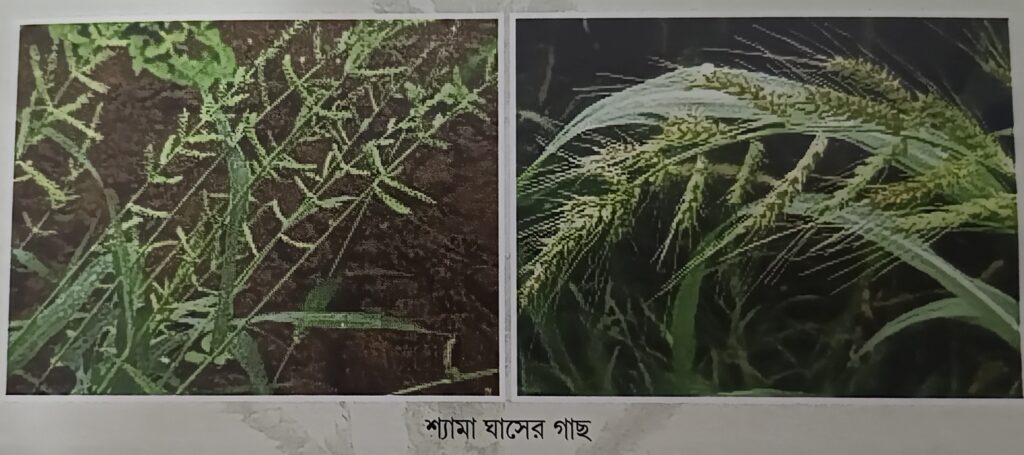
In many cases, weed seedlings look like crop plants. For example – Shyama grass seedlings under rice seeds look exactly the same, so Fela grass in wheat fields cannot be distinguished.
Also, because crop seeds look like weed seeds, crop seeds and weed seeds cannot be separated before sowing. Shealkanta seeds with mustard, wild onion seeds with onion, Hetka with masoor, Nikori seeds with barsim.
- Ability to compete with crops and aggressiveness:
A major example of this is that Shyama grass flowers always bloom above rice flowers. This is a major example of aggression. They take water, food, and nutrients from the soil and occupy the space of the crop, creating intense competition. Competition between crops and weeds is most intense during the early growth stage of the crop. Shyama, Mutha, Punarnava, Bathua have much higher aggressive ability.
- Resistance to chemicals.
Today, more than 113 weeds have developed resistance to various chemicals. Resistance of Akanda, Mutha, Parthenium to chemical herbicides is observed. If a particular chemical is used for a long time in the same area, weeds become resistant to that chemical. Mainly the chemicals to which resistance has developed are Simazine, Atrazine, Propanil, Butachlor etc. For example, Propanil at 2000 g/ha is resistant to Shyama grass. Larsia hexandra is resistant to Pretilachlor 50 EC 400 g/ha.
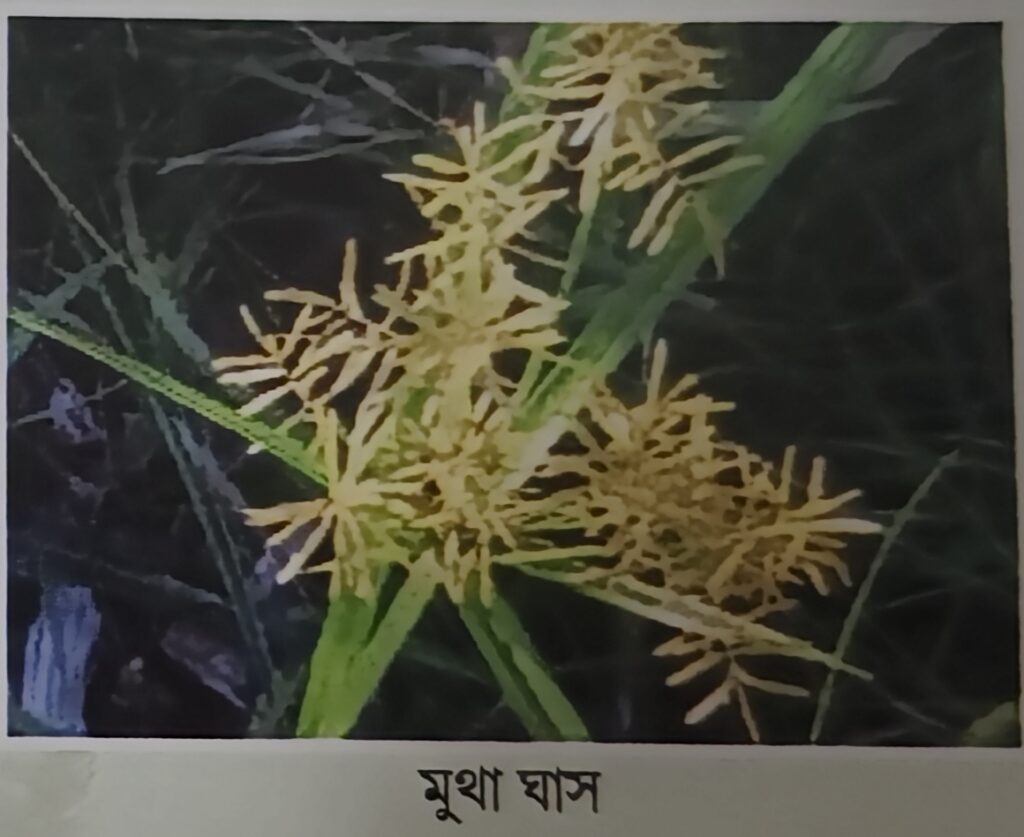
- Long roots: Roots of Mutha, Kash, and Convolvulus go several feet deep into the soil, making them very difficult to eradicate.
- Ability to spread easily: Seeds of various weeds are made in such a way that they can spread easily with the help of air, water, and animals. Seeds of Cuscuta and Blepharis can easily float in the air.
- Seed survival ability: Weed seeds can survive for many years longer than crop seeds. For example, even if Bathua seeds remain buried under soil for 10 years, 80 percent of the seeds retain germination capacity.
- Various weeds have such smell, taste, and are thorny that cows and goats do not want to eat them. For example, wild brinjal.
Classification of Weeds:
To properly control weeds, it is necessary to know the classification of weeds. Weeds can be divided into different groups. Among them, the acceptable classifications are discussed below:
(ক) According to Cotyledons: Monocotyledonous, such as grass type and Dicotyledonous, such as broad-leaved.
(খ) According to Life Cycle: Annual, Biennial and Perennial.
(গ) According to Family: Grass, Legume, Brinjal, Mutha (Sedge), Mustard family.
Monocotyledonous: These have one cotyledon in the seed. They are mainly grass-type and have simple leaves. The stem may be solid or hollow. Nodes and internodes are present. Roots are shallow and fibrous. These are mainly of two types of grasses such as – (Grasses) Shyama, Ulu, Chor Kanta and Pati grass or Mutha (Sedges) type.
Dicotyledonous: These have two cotyledons in the seed. Generally, they are called broad-leaved weeds. Their leaves can be simple, compound, ovate and rectangular. Such as – Bathua, Dhatura, Kalmi etc.
Classification according to Life Cycle: The life cycle of a plant means the time period from seed to seed production, i.e., the time from seed falling in the soil, becoming a plant, then flowering, fruiting and seed production.
(ক) Annual: These mainly complete their life cycle within one year in a few seasons. They generally grow along with the crop and complete their life cycle with the crop. If they grow in the rainy season, they are called Kharif weeds and if in winter, they are called Rabi weeds.
For example – Bathua, Buno Jai, Bindimutha, Kendot etc.
(খ) Biennial: These take more than one year and less than two years to complete their life cycle. In the first year, vegetative growth occurs and in the second year, they produce flowers and fruits and seeds. Such as – Chicory, Wild Radish etc.
(গ) Perennial: These weeds can survive year after year and produce seeds once or multiple times in their life cycle. Besides, they reproduce through various vegetative methods such as – rhizome, bulb, tuber, sucker, stolon etc.
Benefits of Weeds: Although weeds cause a lot of damage to crops, they also provide many benefits.
- Production of Organic Manure: Weeds produce organic manure and increase soil fertility. Legume family weeds add organic nitrogen to the soil such as – Wild Methi, Wild Pea, Lajjabati etc. Besides, compost manure can be produced from water hyacinth, Parthenium and other decomposable weeds. Azolla and blue-green algae increase the fertility power of the soil.
- Soil Conservation: Weeds cover the soil and prevent soil erosion. They act as soil cover and spread roots deep into the soil to help conserve soil and water. Weeds help in conserving river embankments, railway lines, and irrigation dams.
- Used as Food and Medicine: We eat weeds like Kalmi, Note, Bathua, Shushni etc. as vegetables. Many weeds are also highly nutritious as animal feed. Such as – Durba, Keshut, Wild Pea etc. Dhatura, Akanda, Keshut etc. weeds are used as various medicines. Dhatura is used in making medicine for asthma and Keshut is used to prevent premature greying of hair. Parthenium is used in making medicine for allergy. Akanda is used for amoebiasis, ringworm, fever, tooth diseases and Apang for piles, boils, pneumonia, and Amrul for eye diseases, cough, and itching.
- Used in Making Necessary Items for Humans: Various weeds are used in making household items. For example – rope from Babui, incense sticks from Mutha and Bena plants, baskets, seats and mats from Sor and Kash, and Pati grass. Sor, Hogla, Ulu etc. weeds are used for thatching houses, fences, and as fuel.
- Used in Recreation and Decoration: Leaves, flowers, branches and fruits of various weeds look very beautiful and are used to decorate gardens. Lantana, Water Hyacinth etc. are used as ornamental plants in gardens. Besides, lotus is used in worship and Shalu in aquatic gardens. Durba is used in worship.
- Pollution Control: Weeds help keep the environment clean by absorbing toxic gases from the environment. Aquatic weeds absorb heavy metals from polluted water and prevent water pollution.
Harmful Aspects of Weeds:
Besides causing a lot of damage to crops, weeds also harm humans and various animals by causing various diseases and health problems. Weeds often mimic (Mimicry) crops during the early growth stage, so they cannot be distinguished. Besides crop fields, wetlands, gardens, and non-agricultural lands are also severely damaged by weeds.
(ক) Weeds Compete with Crops:
Weeds germinate simultaneously or in phases with the crop and grow together. At this time, they compete for space, light, water, nutrients, food etc. Competition is highest during the first 10-30 days of early growth, which hinders crop growth. As a result, the supply of food and other materials decreases, the plant falls behind in competition, and in this situation, weeds dominate the crop and weaken it. In the struggle for existence, weeds engage in competition with crops for light, water, and food elements, which results in hindered crop growth and production.
- Crop Growth is Hindered: This mainly depends on several factors – simultaneous seed germination, weeds grow much faster than crops during early growth, larger photosynthetic area, larger stomata size, and increased root length help weeds get ahead in competition.
- Reduction in Production: Scientists have calculated that uncontrolled sugarcane fields lose 35-36 kg nitrogen, 6-7 kg phosphate, and 40-50 kg potash per hectare due to weeds. It has also been seen that weed control can save 300-500 tons of water per acre.
Scientists have observed that wheat fields lose 20-90 kg nitrogen, 2-13 kg phosphate, 28-54 kg potash due to weeds and overall reduce yield by 26-38%. In broadcast rice, weeds remove 20-37 kg nitrogen, 5-14 kg phosphate, 17-48 kg potash and cause 47-86% yield loss.
The critical period of competition between crop and weed is described below:
- Potato – From planting to first 4 weeks and yield may decrease by 50-80%.
- Jute – From sowing to first 6 weeks and yield may decrease by 30-50%.
- Wheat – From sowing to 30-45 days and yield may decrease by 24-40%.
- Sesame – From sowing to 15-45 days and yield may decrease by 20-50%.
- Broadcast Rice – From sowing to 15-40 days and yield may decrease by 20-28%.
- Transplanted Rice – From transplanting to 30-45 days and yield may decrease by 20-40%.
(খ) Weeds as Alternate Hosts for Diseases and Pests:
Weeds act as shelter for various insects, disease pathogens, and parasites, helping them complete their life cycle and survive in adverse times. When there is no crop in the field, these enemies survive on weeds and later attack the crop when it grows. For example, sheath rot disease of rice survives in Durba and Shyama grass. Similarly, yellow mosaic virus is hosted in Cuscuta and wild chilli weeds, grasshoppers are hosted in Mutha and Durba. Rice tungro virus takes shelter in Shyama grass.
(গ) Weeds Reduce Seed Quality:
If weed seeds mix with crop seeds, that seed cannot be considered as pure seed. If there are 5 Shyama grass seeds among 100 rice seeds, that rice seed will not be considered as certified seed.
How Weeds Easily Spread in Crop Fields:
- Through Crop Seeds: In many cases, the seeds that farmers sow in the field are mixed with weed seeds. In many cases, farmers do not have proper knowledge about seeds. Such as – Chicory with Barsim, Shyama grass with rice, Fela grass with wheat, Shealkanta with mustard etc.
- Through Farmyard and Compost Manure: If farmyard manure is not fully decomposed or not properly prepared, weed seeds remain mixed in the organic manure.
For example – Bathua, Wild Note etc. Cattle eat these weed seeds while grazing in the field.
- Through Agricultural Machinery: Seeds and vines of many weeds can spread from one field to another with the help of tractors, power tillers, and weeding tools.
Ecosystem of Weeds:
The ecosystem of weeds refers to the interrelationship of weeds with soil, crops, humans, and various biological factors. Human role is also important behind the spread and change of weeds in a particular region.
(ক) Weeds and Weather:
There is a very close relationship between weed distribution and weather. Just as seen in the case of crops. Some weeds grow in desert areas, some in waterlogged areas, and some have the ability to adapt and spread in various areas. For example – Bino Note and Opuntia grow in desert regions. Water hyacinth grows in waterlogged areas.
(খ) Weeds and Soil:
Most weeds grow in specific types of soil. Some grow in acidic soil, some in alkaline soil, and some grow in all types of soil. Kochia and salt grass grow in acidic soil.
(গ) Weeds and Crops:
Many weeds coexist with many crops. In many cases, their seeds are similar in size and shape, germinate simultaneously, and look the same in the early stage, making them difficult to distinguish. For example – Fela grass cannot be distinguished from wheat plants in any way before flowering. A list is given below.
Crop | Name of Weed
1) Upland Rice | Shyama, Mutha, Kendot.
2) Lowland Rice | Shyama, Mutha, Panpatari, Dadmari, Shushuni, Jalmutha.
3) Wheat | Fela, Buno Jai, Bathua, Shiyal Kanta, Wild Rai, Wild Pea.
4) Potato | Mutha, Bathua, Kendot, Digitaria.
5) Mustard | Durba, Mutha, Bathua, Shiyal Kanta, Shyama.
6) Sesame | Mutha, Kalmi, Dudhiya, Note, Shiyal Kanta.
7) Jute | Wild Jute, Mutha, Kalmi, Dudhiya, Note, Wild Brinjal, Hazar Dana.
8) Pulse Crops | Durba, Mutha, Bathua, Hetka, Wild Pea.
RELATED POSTS
View all

Introduction to Different Microbial Bio-Insecticides and Their Application Rates
April 25, 2026 | by anisurrahaman235f@gmail.com
Weeding and Weed Control (Aus, Aman and Boro Rice)
April 27, 2026 | by anisurrahaman235f@gmail.com
Iron-Chelating Compounds Produced by Microorganisms
April 25, 2026 | by anisurrahaman235f@gmail.com