

Maize, also known as corn, is rapidly gaining popularity in West Bengal and across India. It is no longer just a fodder crop — today, roasted corn (bhutta), popcorn, baby corn, cornflakes, and sweet corn are widely consumed and commercially important. Among all cereal crops, maize has the highest yield potential. With the adoption of improved high-yielding hybrids, scientific management practices, and modern technologies, maize productivity can be significantly increased, making it a highly profitable crop for farmer’s
l
Maize Production Scenario in West Bengal
| Year | Area (Thousand Ha) | Production (Thousand MT) | Average Yield (kg/ha) |
|---|---|---|---|
| 1996-97 | 34.5 | 83.5 | — |
| 2001-02 | 33.3 | 86.4 | 2,596 |
| 2002-03 | 27.7 | 55.3 | — |
| 2003-04 | 55.5 | 126.1 | 2,270 |
| 2004-05 | 64.6 | 190.5 | 2,948 |
| 2005-06 | 71.8 | 207.3 | — |
| 2006-07 | 85.4 | 253.5 | 2,967 |
| 2007-08 | 77.2 | 244.4 | 3,167 |
| 2008-09 | 107.7 | 385.2 | 3,942 |
| 2009-10 | 97.7 | — | — |
| 2010-11 | 88.6 | 352.3 | 3,974 |
| 2011-12 | 117.8 | 364.1 | 3,722 |
| 2012-13 | 123.0 | 461.4 | 3,751 |
| 2013-14 | 143.9 | 620.5 | 4,312 |
The data clearly shows a consistent increase in both area and productivity over the years, indicating the growing importance of maize in the state’s agricultural economy.
Soil and Climate Requirements
Maize is a warm and humid season crop, but it can be successfully grown under varied agro-climatic conditions. For good germination and early seedling growth, a temperature of 32–34°C is ideal. It performs best in upland and medium upland conditions with sandy loam to loam soils. The optimum soil pH range is 5.5–7.5. Maize does not tolerate waterlogging, so good drainage is essential.
Variety Selection
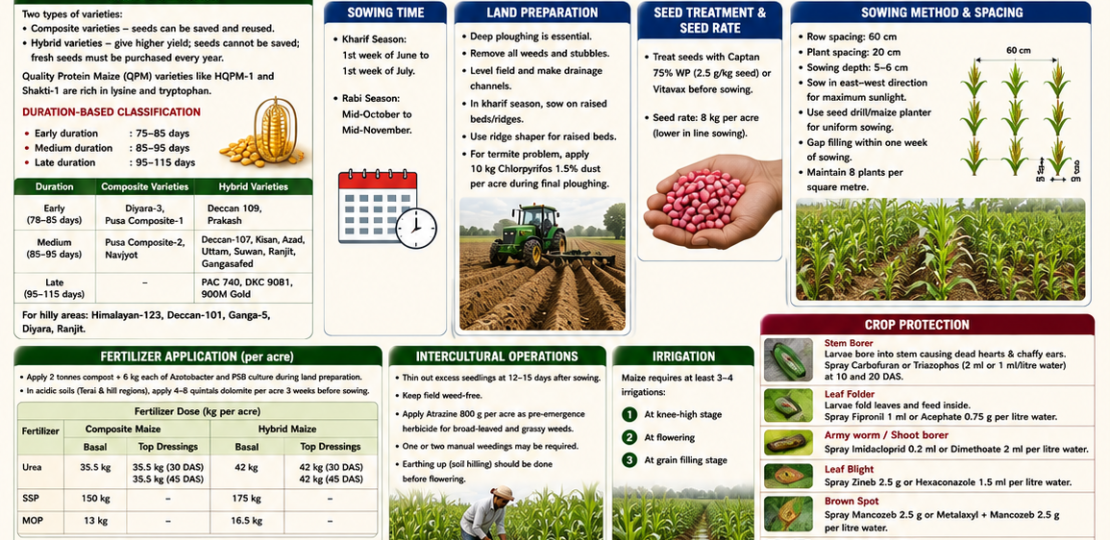
There are two main types of maize varieties:
- Composite varieties — These can be saved and reused by farmers for the next season.
- Hybrid varieties — These give significantly higher yields but seeds cannot be saved; fresh hybrid seeds must be purchased every year.
Quality Protein Maize (QPM) varieties rich in lysine and tryptophan amino acids, such as HQPM-1 and Shakti-1, have also been developed.
Duration-based Classification:
- Early duration (75–85 days)
- Medium duration (85–95 days)
- Late duration (95–115 days)
Recommended Varieties:
| Duration | Composite Varieties | Hybrid Varieties |
|---|---|---|
| Early (78–85 days) | Diyara-3, Pusa Composite-1 | Deccan 109, Prakash |
| Medium (85–95 days) | Pusa Composite-2, Navjyot | Deccan-107, Kisan, Azad, Uttam, Suwan, Ranjit, Gangasafed |
| Late (95–115 days) | — | PAC 740, DKC 9081, 900M Gold |
For hilly areas, suitable varieties include Himalayan-123, Deccan-101, Ganga-5, Diyara, and Ranjit.
Sowing Time
- Kharif Season: First week of June to first week of July.
- Rabi Season: Mid-October to mid-November.
Land Preparation
Deep ploughing is essential. Remove all weeds and stubbles. Level the field properly and create drainage channels. In the kharif season, sow on raised beds or ridges. A tractor-drawn ridge shaper can be used for making raised beds. If termite infestation is a problem, apply 10 kg Chlorpyrifos 1.5% dust per acre during the final ploughing.
Fertilizer Application
Apply 2 tonnes of compost + 6 kg each of Azotobacter and PSB culture per acre during land preparation. In acidic soils of Terai and hill regions, apply 4–8 quintals of dolomite per acre 3 weeks before sowing.
Recommended Fertilizer Dose for Maize (kg per acre)
| Fertilizer | Composite Maize | Hybrid Maize |
|---|---|---|
| Basal | ||
| Urea | 35.5 kg | 42 kg |
| SSP | 150 kg | 175 kg |
| MOP | 13 kg | 16.5 kg |
| 1st Top Dressing (30 days after sowing) | Urea: 35.5 kg | Urea: 42 kg |
| 2nd Top Dressing (45 days after sowing) | Urea: 35.5 kg | Urea: 42 kg |
In zinc and sulphur deficient soils, apply 8 kg sulphur, 10 kg zinc sulphate, and 4 kg borax mixed with organic manure at land preparation. In Terai and hill regions, increase nitrogen, phosphate, and potash by 8 kg, 4 kg, and 4 kg per acre respectively.
Seed Treatment
Treat seeds with Captan 75% WP (2.5 g per kg seed) or Vitavax before sowing to prevent seed-borne diseases.
Seed Rate
8 kg per acre. Seed rate is lower when sown in lines.
Sowing Method and Spacing
- Row-to-row distance: 60 cm
- Plant-to-plant distance: 20 cm
- Sowing depth: 5–6 cm
Sowing in east-west direction maximizes sunlight utilization. Use a seed drill or maize planter for uniform sowing. Gap filling should be done within one week of sowing. Maintain an average of 8 plants per square metre.
Intercultural Operations
Thin out excess seedlings 12–15 days after sowing. Keep the field weed-free. Apply Atrazine 800 g per acre as pre-emergence herbicide for broad-leaved and grassy weeds. One or two manual weedings may be required. Earthing up (soil hilling) should be done before flowering.
Irrigation
Maize requires at least 3–4 irrigations:
- At knee-high stage
- At flowering
- At grain filling stage
Crop Protection
Stem Borer: Larvae bore into the stem, causing dead hearts and chaffy ears. Spray Carbofuran or Triazophos (2 ml or 1 ml per litre water) at 10 and 20 days after sowing.
Leaf Folder: Larvae fold leaves and feed inside. Spray Fipronil 1 ml or Acephate 0.75 g per litre water.
Army worm / Shoot borer: Spray Imidacloprid 0.2 ml or Dimethoate 2 ml per litre water.
Leaf Blight: Spray Zineb 2.5 g or Hexaconazole 1.5 ml per litre water.
Brown Spot: Spray Mancozeb 2.5 g or Metalaxyl + Mancozeb 2.5 g per litre water.
Bacterial Stalk Rot: Ensure proper drainage and spacing. Avoid waterlogging.
Bird Damage: Use reflective tapes, old fishing nets, or noise-making devices. Manual guarding during milky stage is effective.
Harvesting
For green cobs (roasting), harvest when grains are in the milky stage. For dry grain, harvest when husk turns brown and grains are hard (20–25% moisture). Maize stalks can be used as green fodder or fuel. Average grain yield under good management ranges from 7–9 quintals per acre.
Conclusion
Maize has tremendous potential in West Bengal due to its high yield, multiple uses, and increasing market demand. By adopting improved hybrids, timely sowing, balanced fertilization, proper irrigation, and integrated pest management, farmers can achieve significantly higher yields and income. With the right package of practices, maize can become a highly profitable and sustainable crop, complementing rice-based cropping systems in the state.
RELATED POSTS
View all


What Is an SSL Certificate and Why Does Your Website Need One?
August 2, 2026 | by anisurrahaman235f@gmail.com