

Improved Method of Wheat and Maize Cultivation
May 8, 2026 | by anisurrahaman235f@gmail.com
Wheat Cultivation
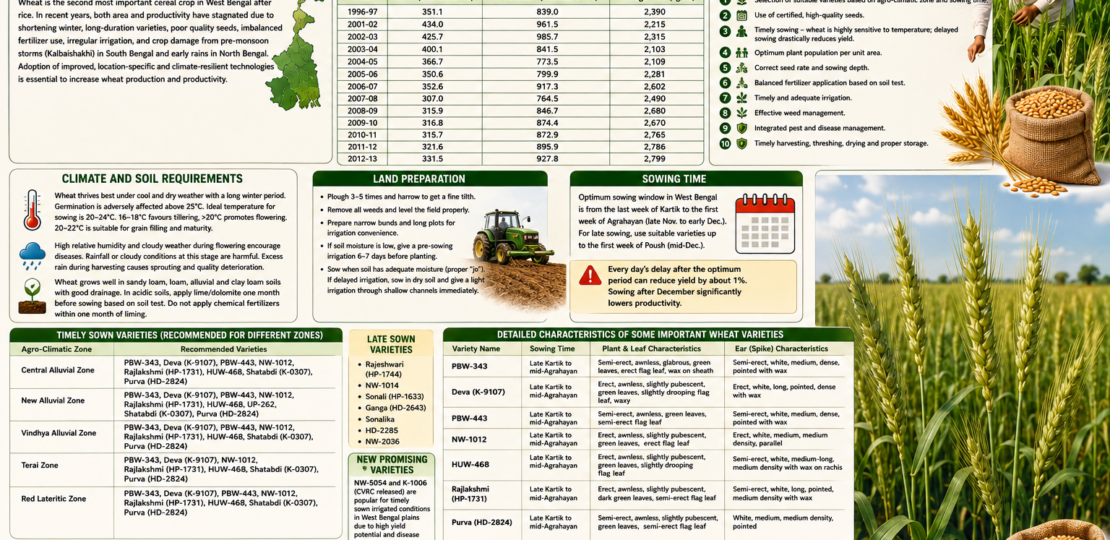
Wheat holds the second most important position after rice as a cereal crop in West Bengal. It is a major rabi season crop that significantly contributes to food security and farmer income. However, in recent years, both the area under wheat cultivation and productivity have shown stagnation or decline in the state. The primary reasons include shortening of the winter period due to climate change, heavy dependence on relatively long-duration varieties, inadequate supply of quality seeds, imbalanced fertilizer use, and irregular irrigation. Additionally, pre-monsoon storms (Kalbaishakhi) in South Bengal and early rains in North Bengal during the harvesting period often cause significant damage to the crop.
In this changed scenario, it has become essential to adopt improved, location-specific, and climate-resilient technologies to increase wheat production and productivity in West Bengal.
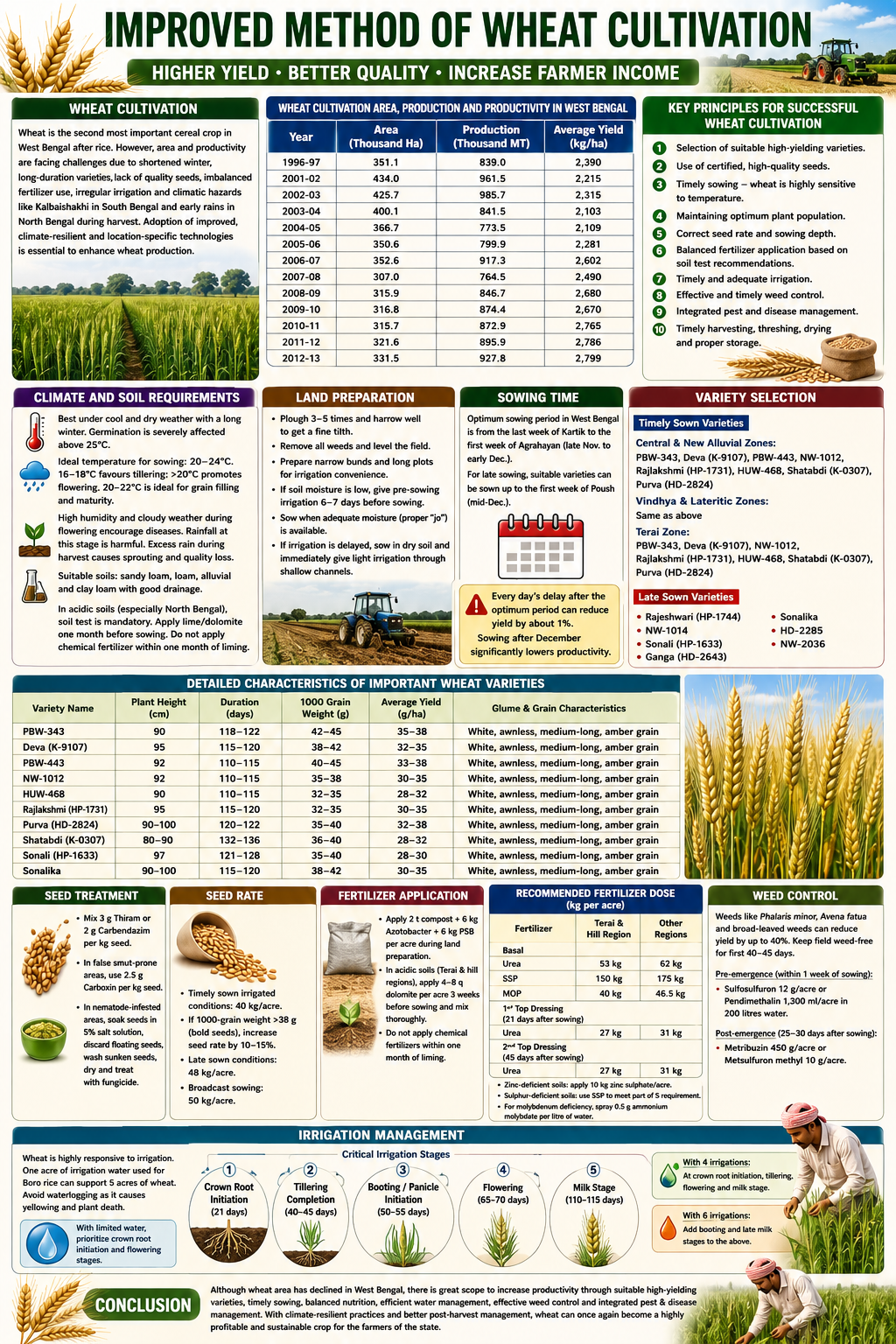
Wheat Cultivation Area, Production and Productivity in West Bengal
| Year | Area (Thousand Ha) | Production (Thousand MT) | Average Yield (kg/ha) |
|---|---|---|---|
| 1996-97 | 351.1 | 839.0 | 2,390 |
| 2001-02 | 434.0 | 961.5 | 2,215 |
| 2002-03 | 425.7 | 985.7 | 2,315 |
| 2003-04 | 400.1 | 841.5 | 2,103 |
| 2004-05 | 366.7 | 773.5 | 2,109 |
| 2005-06 | 350.6 | 799.9 | 2,281 |
| 2006-07 | 352.6 | 917.3 | 2,602 |
| 2007-08 | 307.0 | 764.5 | 2,490 |
| 2008-09 | 315.9 | 846.7 | 2,680 |
| 2009-10 | 316.8 | 874.4 | 2,670 |
| 2010-11 | 315.7 | 872.9 | 2,765 |
| 2011-12 | 321.6 | 895.9 | 2,786 |
| 2012-13 | 331.5 | 927.8 | 2,799 |
Key Principles for Successful Wheat Cultivation in West Bengal
To achieve higher and stable yields, farmers must follow these essential practices:
- Selection of Suitable Varieties based on agro-climatic zone and sowing time.
- Use of certified, high-quality seeds.
- Timely sowing — wheat is highly sensitive to temperature; delayed sowing drastically reduces yield.
- Optimum plant population per unit area.
- Correct seed rate and sowing depth.
- Balanced fertilizer application based on soil test.
- Timely and adequate irrigation.
- Effective weed management.
- Integrated pest and disease management.
- Timely harvesting, threshing, drying, and proper storage.
Climate and Soil Requirements
Wheat thrives best under cool and dry weather conditions with a long winter period. Germination is adversely affected when temperature exceeds 25°C. The ideal temperature for sowing is 20–24°C. A temperature of 16–18°C favours good tillering, while temperatures above 20°C promote reproductive growth and flowering. Temperatures between 20–22°C are suitable for grain filling and maturity.
High relative humidity and cloudy weather during flowering encourage the spread of diseases. Rainfall or cloudy conditions at this stage are harmful. Excessive rain during harvesting can cause sprouting and quality deterioration.
Wheat can be successfully grown in sandy loam, loam, alluvial, and clay loam soils. Good drainage is essential. In acidic soils of North Bengal and other regions, soil testing is mandatory. Apply lime or dolomite one month before sowing as per soil test recommendation. Do not apply chemical fertilizers within one month of liming.
Land Preparation
Plough the field 3–5 times followed by harrowing to bring the soil to a fine tilth. Remove all weeds and level the field properly. For irrigation convenience, prepare narrow bunds and divide the field into long plots. If the soil moisture is low, give a pre-sowing irrigation 6–7 days before planting. Sow seeds when the soil has adequate moisture (proper “jo”). In case of delayed irrigation, sow in dry soil and immediately give a light irrigation through shallow channels. This ensures better germination.
Sowing Time
The optimum sowing window for wheat in West Bengal is from the last week of Kartik to the first week of Agrahayan (late November to early December). For late sowing, use suitable varieties up to the first week of Poush (mid-December). Every day’s delay after the optimum period can reduce yield by about 1%. Sowing after December significantly lowers productivity.
Variety Selection
The following varieties have been found suitable for different agro-climatic zones of West Bengal through extensive trials:
Timely Sown Varieties (Recommended for different zones)
| Agro-Climatic Zone | Recommended Varieties |
|---|---|
| Central Alluvial Zone | PBW-343, Deva (K-9107), PBW-443, NW-1012, Rajlakshmi (HP-1731), HUW-468, Shatabdi (K-0307), Purva (HD-2824) |
| New Alluvial Zone | PBW-343, Deva (K-9107), PBW-443, NW-1012, Rajlakshmi (HP-1731), HUW-468, UP-262, Shatabdi (K-0307), Purva (HD-2824) |
| Vindhya Alluvial Zone | PBW-343, Deva (K-9107), PBW-443, NW-1012, Rajlakshmi (HP-1731), HUW-468, Shatabdi (K-0307), Purva (HD-2824) |
| Terai Zone | PBW-343, Deva (K-9107), NW-1012, Rajlakshmi (HP-1731), HUW-468, Shatabdi (K-0307), Purva (HD-2824) |
| Red Lateritic Zone | PBW-343, Deva (K-9107), PBW-443, NW-1012, Rajlakshmi (HP-1731), HUW-468, Shatabdi (K-0307), Purva (HD-2824) |
Late Sown Varieties
- Rajeshwari (HP-1744)
- NW-1014
- Sonali (HP-1633)
- Ganga (HD-2643)
- Sonalika
- HD-2285
- NW-2036
Detailed Characteristics of Some Important Wheat Varieties
| Variety Name | Sowing Time | Plant & Leaf Characteristics | Ear (Spike) Characteristics |
|---|---|---|---|
| PBW-343 | Late Kartik to mid-Agrahayan | Semi-erect, awnless, glabrous, green leaves, erect flag leaf, wax on sheath | Semi-erect, white, medium, dense, pointed with wax |
| Deva (K-9107) | Late Kartik to mid-Agrahayan | Erect, awnless, slightly pubescent, green leaves, slightly drooping flag leaf, waxy | Erect, white, long, pointed, dense with wax |
| PBW-443 | Late Kartik to mid-Agrahayan | Semi-erect, awnless, green leaves, semi-erect flag leaf | Semi-erect, white, medium, dense, pointed with wax |
| NW-1012 | Late Kartik to mid-Agrahayan | Erect, awnless, slightly pubescent, green leaves, erect flag leaf | Erect, white, medium, medium density, parallel |
| HUW-468 | Late Kartik to mid-Agrahayan | Erect, awnless, slightly pubescent, green leaves, slightly drooping flag leaf | Semi-erect, white, medium-long, medium density with wax on rachis |
| Rajlakshmi (HP-1731) | Late Kartik to mid-Agrahayan | Erect, awnless, slightly pubescent, dark green leaves, semi-erect flag leaf | Semi-erect, white, long, pointed, medium density with wax |
| Purva (HD-2824) | Late Kartik to mid-Agrahayan | Semi-erect, awnless, slightly pubescent, green leaves, semi-erect flag leaf | White, medium, medium density, pointed |
New Promising Varieties
NW-5054 and K-1006 (CVRC released) are becoming popular for timely sown irrigated conditions in West Bengal plains due to their high yield potential and disease tolerance.
Conclusion on Wheat Cultivation
Although wheat area has declined in West Bengal, there is immense scope to increase productivity through the adoption of suitable high-yielding varieties, timely sowing, balanced nutrition, efficient water management, and integrated pest and disease control. With climate-resilient practices and better post-harvest management, wheat can once again become a highly profitable crop for the farmers of the state.
RELATED POSTS
View all

Improved Method of Wheat Cultivation
May 8, 2026 | by anisurrahaman235f@gmail.com
Crop Protection in Wheat Cultivation
May 8, 2026 | by anisurrahaman235f@gmail.com