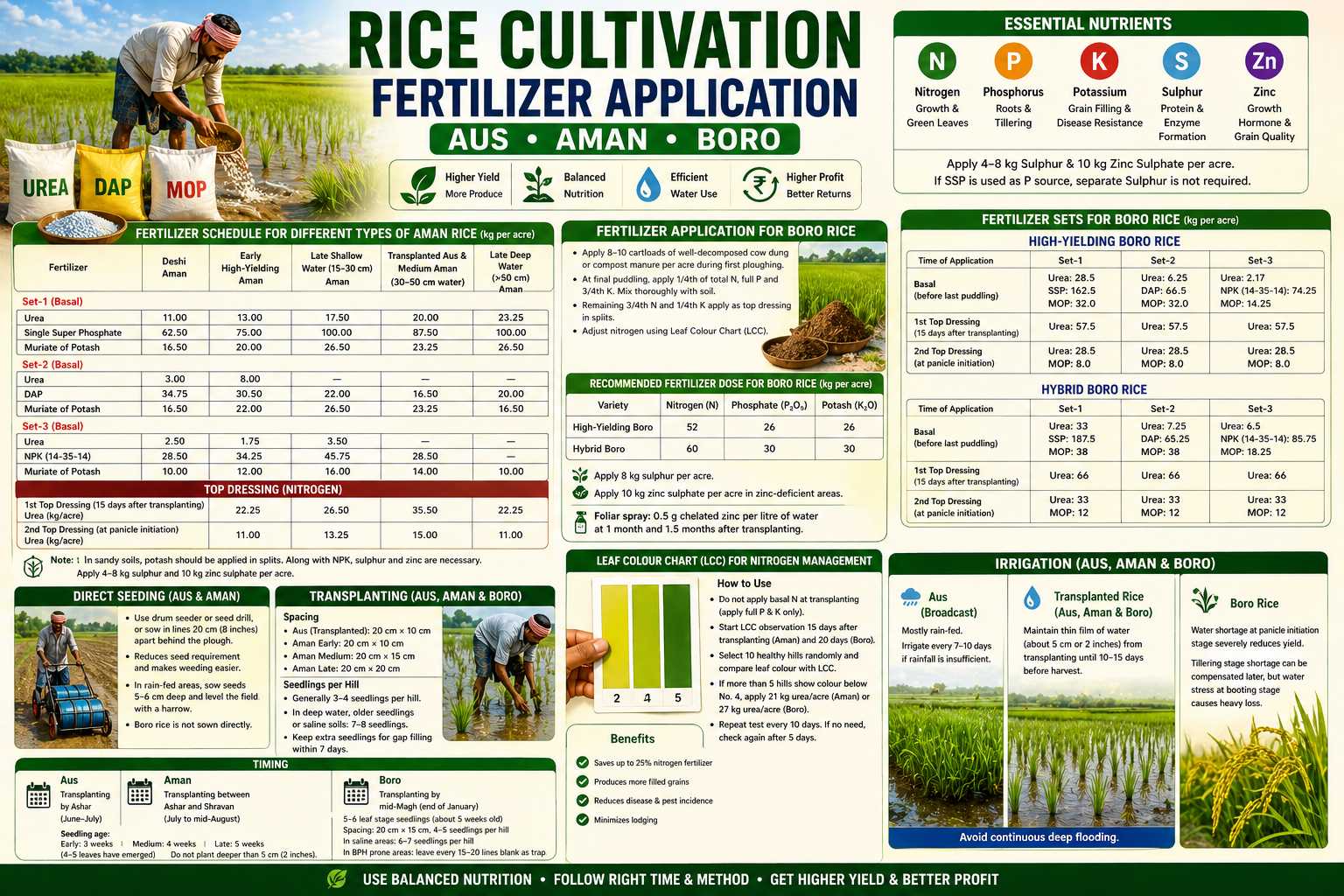
Tungro is a serious virus disease of rice transmitted primarily by the green leafhopper (Nephotettix spp.), commonly known as Shyama Poka. This disease can cause substantial yield loss by severely stunting plant growth and reducing grain formation.
Symptoms:
- Infected plants become noticeably stunted (dwarfed) compared to healthy ones.
- The number of tillers is significantly reduced.
- Leaves first turn pale yellow and later develop orange-yellow discoloration.
- Flowering is delayed, and the panicles (ears) remain very small with mostly chaffy or partially filled grains.
- In severe cases, the entire plant looks sickly and produces very poor yield.
Economic Threshold Level:
If even one hill out of every 10 randomly selected hills shows Tungro symptoms (from seedling stage up to the soft dough stage of grains) and green leafhoppers are visible in the field or surrounding areas, immediate control measures must be taken.
Control of Green Leafhopper (Vector):
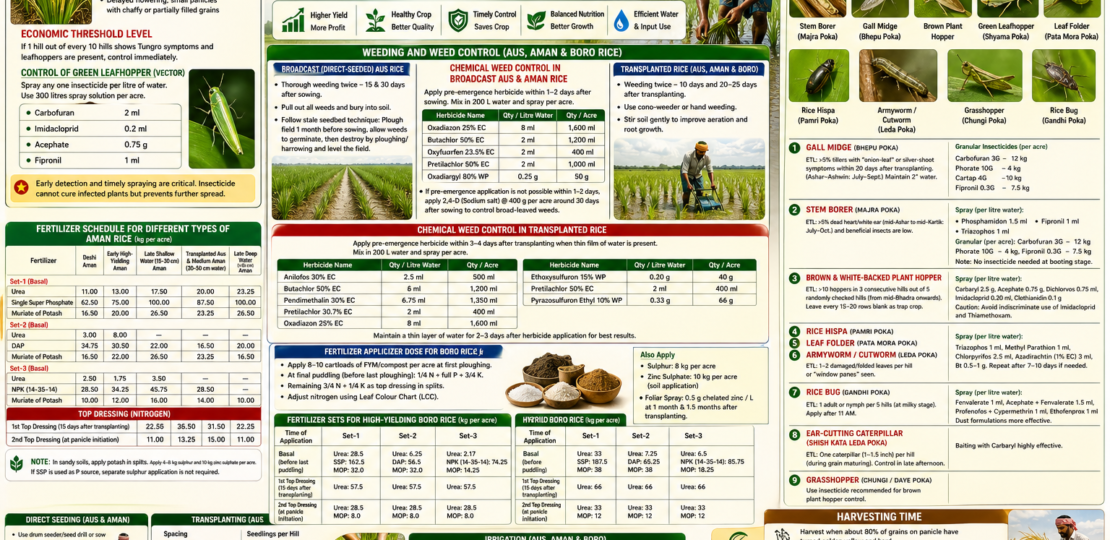
To break the disease cycle, the vector (Shyama Poka) must be controlled effectively. Spray any one of the following insecticides per litre of water:
- Carbofuran 2 ml
- Imidacloprid 0.2 ml
- Acephate 0.75 g
- Fipronil 1 ml
Use 300 litres of spray solution per acre for thorough coverage, targeting the base of the plants where the insects usually congregate.
Important Note: Early detection and timely spraying are critical. Once the virus has entered the plant, insecticide application cannot cure the infected plants, but it can prevent further spread to healthy plants.
Insect Pest Management in Rice
After transplanting, farmers should inspect the rice field at least twice a week to check for insect infestation or any visible damage symptoms. Early detection allows timely intervention and prevents heavy losses.
The major insect pests commonly observed in Aman rice fields in West Bengal are:
- Stem borer (Majra Poka)
- Gall midge (Bhepu Poka)
- Brown plant hopper and White-backed plant hopper
- Green leafhopper (Shyama Poka)
- Leaf folder (Pata Mora Poka)
- Rice hispa (Pamri Poka)
- Armyworm / Cutworm (Leda Poka)
- Grasshopper (Chungi Poka)
- Rice bug (Gandhi Poka)
1. Gall Midge (Bhepu Poka / Orseolia oryzae)
This pest is more common in late-sown nurseries and main fields.
Economic Threshold:
If more than 5% of tillers show “onion-leaf” or silver-shoot symptoms within 20 days after transplanting (especially between Ashar and Ashwin, i.e., July–September), apply granular insecticide and maintain 2 inches of standing water.
Recommended Granular Insecticides (per acre):
- Carbofuran 3G — 12 kg
- Phorate 10G — 4 kg
- Cartap 4G — 10 kg
- Fipronil 0.3G — 7.5 kg
2. Stem Borer (Majra Poka / Scirpophaga incertulas)
Stem borer damage is more critical in varieties with a duration of 110 days or less.
Economic Threshold:
If more than 5% of central leaves or panicles show “dead heart” or “white ear” symptoms between mid-Ashar and mid-Kartik (July–October), and beneficial insects (spiders, lady beetles, dragonflies, damsel flies, long-horned grasshoppers, water bugs, mirid bugs, and parasites) are present in very low numbers compared to the pest, apply control measures.
Recommended Insecticides (per litre of water):
- Phosphamidon 1.5 ml
- Fipronil 1 ml
- Triazophos 1 ml
Granular options (per acre):
- Carbofuran 3G — 12 kg
- Phorate 10G — 4 kg
- Fipronil 0.3G — 7.5 kg
Note: No insecticide is needed at the booting stage for stem borer. Use light traps to monitor adult moth population.
3. Brown Plant Hopper & White-backed Plant Hopper
These sucking pests have become increasingly problematic in recent years, especially in Kharif season.
Management Strategy:
- At transplanting, leave every 15–20 rows blank as a trap crop.
- Regularly monitor the base of the plants from mid-Bhadra (September) onwards.
- If more than 10 hoppers are found in 3 consecutive hills out of 5 randomly checked hills, and beneficial insects are insufficient, apply control measures.
Recommended Insecticides (per litre of water):
- Carbaryl 2.5 g
- Acephate 0.75 g
- Dichlorvos 0.75 ml
- Imidacloprid 0.20 ml
- Clothianidin 0.1 g
Caution: Avoid using Imidacloprid and Thiamethoxam indiscriminately to prevent resistance development.
4. Rice Hispa (Pamri Poka)
Economic Threshold:
If 1–2 damaged leaves per hill are observed between mid-Ashar and mid-Ashwin (July–September), spray recommended insecticides.
5. Leaf Folder (Pata Mora Poka)
Economic Threshold:
If 1–2 folded or damaged leaves per hill appear from Ashar to mid-Kartik (July–September) and natural enemies are low, apply control.
6. Armyworm / Cutworm (Leda Poka)
Economic Threshold:
When an average of 1–2 freshly damaged leaves or “window panes” are seen per hill, take immediate control measures.
Recommended Insecticides for Hispa, Leaf Folder, and Armyworm (per litre of water):
- Triazophos 1 ml
- Methyl Parathion 1 ml
- Chlorpyrifos 2.5 ml
- Azadirachtin (1% EC) 3 ml
- Bacillus thuringiensis (Bt) 0.5–1 g
If infestation persists even after 7–10 days, repeat the spray with the same or alternate insecticide.
7. Rice Bug (Gandhi Poka)
This pest attacks rice grains at the milky stage. Both adults and nymphs cause damage by sucking sap from developing grains.
Economic Threshold:
If one adult or nymph is found per 5 hills on average, apply control measures after 11 AM when the insects are more active.
8. Ear-cutting Caterpillar (Shish Kata Leda Poka)
Economic Threshold:
If an average of one caterpillar (1–1.5 inches long) per hill is observed when grains are maturing, apply control in the late afternoon. Baiting with Carbaryl is highly effective.
Recommended Insecticides for Rice Bug and Ear-cutting Caterpillar (per litre of water):
- Fenvalerate 1 ml
- Acephate + Fenvalerate 1.5 ml
- Profenofos + Cypermethrin 1 ml
- Ethofenprox 1 ml
Dust formulations are often more effective against these pests.
9. Grasshopper (Chungi / Daye Poka)
Use any insecticide recommended for brown plant hopper control to manage grasshoppers effectively.
Harvesting Time
Harvest the crop when approximately 80% of the grains on the panicle have turned golden yellow and hard. Timely harvesting prevents shattering, bird damage, and grain quality deterioration.
General Guidelines:
- For early and medium-duration varieties: Harvest 25–30 days after flowering.
- For late-duration varieties: Harvest 35–40 days after flowering.
Immediately after cutting, remove the crop from the field, thresh it properly, dry the grains thoroughly under the sun (until moisture content reaches 12–14%), and store in a cool, dry place to prevent fungal infestation and insect damage.
Proper drying and storage are essential to maintain grain quality, germination capacity, and market value.
continue reading
previous reading
RELATED POSTS
View all