Rice Cultivation Area, Production, and Yield in West Bengal Over the Past Years
April 27, 2026 | by anisurrahaman235f@gmail.com
Rice is the most important crop in West Bengal, serving as the staple food for the majority of the population. The state has historically been one of the leading rice-producing regions in India. Rice is grown in three distinct seasons — Aus (pre-kharif/autumn), Aman (kharif/monsoon), and Boro (rabi/summer) — each with different climatic requirements, varieties, and productivity levels.
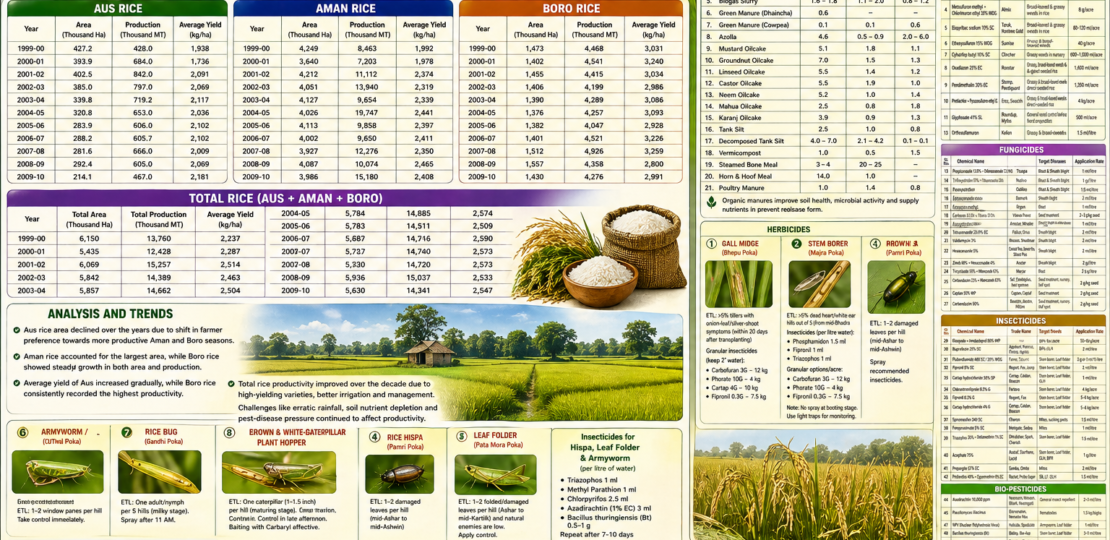
The data below presents the area under cultivation, paddy production (converted to rice/paddy equivalent as per standard reporting), and average yield for Aus, Aman, and Boro rice in West Bengal from 1999-00 to 2009-10. Figures are based on official agricultural statistics. Area is in thousand hectares, production in thousand metric tonnes, and yield in kg per hectare.
Aus Rice
| Year | Area (Thousand Ha) | Production (Thousand MT) | Average Yield (kg/ha) |
|---|---|---|---|
| 1999-00 | 427.2 | 428.0 | 1,938 |
| 2000-01 | 393.9 | 684.0 | 1,736 |
| 2001-02 | 402.5 | 842.0 | 2,091 |
| 2002-03 | 385.0 | 797.0 | 2,069 |
| 2003-04 | 339.8 | 719.2 | 2,117 |
| 2004-05 | 320.8 | 653.0 | 2,036 |
| 2005-06 | 283.9 | 606.0 | 2,102 |
| 2006-07 | 288.2 | 605.7 | 2,102 |
| 2007-08 | 281.6 | 566.0 | 2,009 |
| 2008-09 | 292.4 | 605.0 | 2,069 |
| 2009-10 | 214.1 | 467.0 | 2,181 |
Aman Rice
| Year | Area (Thousand Ha) | Production (Thousand MT) | Average Yield (kg/ha) |
|---|---|---|---|
| 1999-00 | 4,249 | 8,463 | 1,992 |
| 2000-01 | 3,640 | 7,203 | 1,978 |
| 2001-02 | 4,212 | 11,112 | 2,374 |
| 2002-03 | 4,051 | 13,940 | 2,319 |
| 2003-04 | 4,127 | 9,654 | 2,339 |
| 2004-05 | 4,026 | 19,747 | 2,441 |
| 2005-06 | 4,113 | 9,858 | 2,397 |
| 2006-07 | 4,002 | 9,650 | 2,411 |
| 2007-08 | 3,927 | 12,276 | 2,350 |
| 2008-09 | 4,087 | 10,074 | 2,465 |
| 2009-10 | 3,986 | 15,180 | 2,408 |
Boro Rice
| Year | Area (Thousand Ha) | Production (Thousand MT) | Average Yield (kg/ha) |
|---|---|---|---|
| 1999-00 | 1,473 | 4,468 | 3,031 |
| 2000-01 | 1,402 | 4,541 | 3,240 |
| 2001-02 | 1,455 | 4,415 | 3,034 |
| 2002-03 | 1,406 | 4,199 | 2,986 |
| 2003-04 | 1,390 | 4,289 | 3,086 |
| 2004-05 | 1,376 | 4,257 | 3,093 |
| 2005-06 | 1,382 | 4,047 | 2,928 |
| 2006-07 | 1,401 | 4,521 | 3,226 |
| 2007-08 | 1,512 | 4,926 | 3,259 |
| 2008-09 | 1,557 | 4,358 | 2,800 |
| 2009-10 | 1,430 | 4,276 | 2,991 |
Total Rice (Aus + Aman + Boro)
| Year | Total Area (Thousand Ha) | Total Production (Thousand MT) | Average Yield (kg/ha) |
|---|---|---|---|
| 1999-00 | 6,150 | 13,760 | 2,237 |
| 2000-01 | 5,435 | 12,428 | 2,287 |
| 2001-02 | 6,069 | 15,257 | 2,514 |
| 2002-03 | 5,842 | 14,389 | 2,463 |
| 2003-04 | 5,857 | 14,662 | 2,504 |
| 2004-05 | 5,784 | 14,885 | 2,574 |
| 2005-06 | 5,783 | 14,511 | 2,509 |
| 2006-07 | 5,687 | 14,746 | 2,590 |
| 2007-08 | 5,720 | 14,720 | 2,573 |
| 2008-09 | 5,936 | 15,037 | 2,533 |
| 2009-10 | 5,630 | 14,341 | 2,547 |
Analysis and Trends
Over the decade (1999-00 to 2009-10), the area under Aus rice showed a declining trend due to shifting farmer preferences toward more productive Boro and Aman seasons. Aman rice remained the largest in terms of area, while Boro rice demonstrated steady growth in both area and productivity thanks to expanded irrigation facilities. Overall rice productivity in West Bengal improved gradually, driven by high-yielding varieties, better irrigation, and improved management practices. However, challenges such as erratic rainfall, soil nutrient depletion, and pest-disease pressure continued to influence yields.
Nutrient Content in Some Organic Manures (% on dry weight basis)
| Name of Organic Manure | Nitrogen (%) | Phosphate (%) | Potash (%) |
|---|---|---|---|
| Rural Compost | 0.4 – 0.8 | 0.3 – 0.6 | 0.7 – 1.0 |
| Urban Compost | 1.2 – 2.0 | 1.0 | 1.5 |
| Farmyard Manure (FYM) | 0.5 – 1.0 | 0.3 – 0.5 | 0.4 – 1.0 |
| Cow Dung Manure | 0.3 – 0.4 | 0.1 – 0.2 | 0.1 – 0.3 |
| Biogas Slurry | 1.6 – 1.8 | 1.1 – 2.0 | 0.8 – 1.2 |
| Green Manure (Dhaincha) | 0.6 | — | — |
| Green Manure (Cowpea) | 0.1 | 0.1 | 0.6 |
| Azolla | 4.6 | 0.5 – 0.9 | 2.0 – 6.0 |
| Mustard Oilcake | 5.1 | 1.8 | 1.1 |
| Groundnut Oilcake | 7.0 | 1.5 | 1.3 |
| Linseed Oilcake | 5.5 | 1.4 | 1.2 |
| Castor Oilcake | 5.5 | 1.9 | 1.0 |
| Neem Oilcake | 5.2 | 1.0 | 1.4 |
| Mahua Oilcake | 2.5 | 0.8 | 1.8 |
| Karanj Oilcake | 3.9 | 0.9 | 1.3 |
| Tank Silt | 2.5 | 1.0 | 0.8 |
| Decomposed Tank Silt | 4.0 – 7.0 | 2.1 – 4.2 | 0.1 – 0.1 |
| Vermicompost | 1.0 | 0.5 | 1.5 |
| Steamed Bone Meal | 3 – 4 | 20 – 25 | — |
| Horn & Hoof Meal | 14.0 | 1.0 | — |
| Poultry Manure | 1.0 | 1.4 | 0.8 |
These organic sources play a vital role in improving soil health, enhancing microbial activity, and supplying balanced nutrients in a slow-release form. Regular use of organic manure along with judicious chemical fertilizer application is essential for sustainable rice production.
List of Some New-Generation Agrochemicals (Herbicides, Fungicides, and Insecticides) and Their Uses
Herbicides
| Sl. No. | Chemical Name | Trade Name | Target Weeds | Application Rate |
|---|---|---|---|---|
| 1 | Pendimethalin 24% SC | Granite | Broad-leaved and grassy weeds in rice | 37.5 ml/acre |
| 2 | Pyrazosulfuron ethyl 10% WP | Sathi | Broad-leaved and grassy weeds in rice | 40–60 g/acre |
| 3 | Oxyfluorfen 23.5% EC | Goal, Oxygold, Alto | Broad-leaved and grassy weeds in rice | 400 ml/acre |
| 4 | Metsulfuron methyl + Chlorimuron ethyl 20% WDG | Almix | Broad-leaved and grassy weeds in rice | 8 g/acre |
| 5 | Bispyribac sodium 10% SC | Taruk, Nominee Gold | Broad-leaved and grassy weeds in rice | 80–120 ml/acre |
| 6 | Ethoxysulfuron 15% WDG | Sunrise | Grassy and broad-leaved weeds | 40 g/acre |
| 7 | Cyhalofop butyl 10% SC | Clincher | Grassy weeds in nursery | 600–1,000 ml/acre |
| 8 | Oxadiazon 25% EC | Ronstar | Grassy, broad-leaved weeds and algae in direct-seeded rice | 1,600 ml/acre |
| 9 | Pendimethalin 30% EC | Stomp, Pendiguard | Grassy and broad-leaved weeds in direct-seeded rice | 1,350 ml/acre |
| 10 | Pretilachlor + Pyrazosulfuron ethyl G | Eroz, Swachh | Grassy and broad-leaved weeds in direct-seeded rice | 4 kg/acre |
| 11 | Glyphosate 41% SL | Roundup, Myfos | General weed control before land preparation | 500 ml/acre |
| 12 | Orthosulfamuron | Kelion | Grassy and broad-leaved weeds | 1.5 ml/litre |
Fungicides
| Sl. No. | Chemical Name | Trade Name | Target Diseases | Application Rate |
|---|---|---|---|---|
| 13 | Propiconazole 13.9% + Difenoconazole 13.9% | Truspa | Blast & Sheath blight | 1 ml/litre |
| 14 | Trifloxystrobin 50% + Tebuconazole 50% | Nativo | Blast & Sheath blight | 1 g/litre |
| 15 | Picoxystrobin | Galileo | Blast & Sheath blight | 1.5 ml/litre |
| 16 | Tetraconazole | Domark | Sheath blight | 2 ml/litre |
| 17 | Kresoxim-methyl | Ergon | Blast | 1 ml/litre |
| 18 | Carboxin 37.5% + Thiram 37.5% | Vitavax Power | Seed treatment | 2–3 g/kg seed |
| 19 | Azoxystrobin | Amistar, Mirador | Sheath blight & other fungal diseases | 1 ml/litre |
| 20 | Tebuconazole 25.9% EC | Folicur, Orius | Sheath blight | 2 ml/litre |
| 21 | Validamycin 3% | Rhizosin, Sheathmar | Sheath blight | 2 ml/litre |
| 22 | Hexaconazole 5% | Contaf Plus, Danzol Plus, Sitara Plus | Sheath blight | 2 ml/litre |
| 23 | Zineb 68% + Hexaconazole 4% | Avatar | Sheath blight | 2 g/litre |
| 24 | Tricyclazole 18% + Mancozeb 62% | Marjar | Blast | 2.5 g/litre |
| 25 | Carbendazim 25% + Mancozeb 63% | Saf, Combiplus, Companion | Seed treatment, nursery, leaf spot | 2 g/kg seed |
| 26 | Captan 50% WP | Captan, Captaf | Seed treatment | 2 g/kg seed |
| 27 | Carbendazim 50% | Bavistin, Jkestin, Hilzim | Seed treatment, nursery, leaf spot | 2 g/kg seed |
Insecticides
| Sl. No. | Chemical Name | Trade Name | Target Pests | Application Rate |
|---|---|---|---|---|
| 29 | Ethiprole + Imidacloprid 80% WP | Mamy | Brown plant hopper, Green leafhopper | 50–60 g/acre |
| 30 | Buprofezin 25% SC | Applaud, Kemriz, Flotis, Apollo | Brown plant hopper, Green leafhopper | 2 ml/litre |
| 31 | Flubendiamide 480 SC / 20% WDG | Fame, Takumi | Stem borer, Leaf folder | 8 g or 5 ml / 15 litre |
| 32 | Fipronil 5% SC | Regent, Fax, Jump | Stem borer, Leaf folder | 2 g / 15 litre |
| 33 | Cartap hydrochloride 50% SP | Cartap, Caldan, Beacon | Stem borer, Leaf folder, Green leafhopper | 1 ml/litre |
| 34 | Chlorantraniliprole 0.2% G | Fertera | Stem borer, Leaf folder | 4 kg/acre |
| 35 | Fipronil 0.3% G | Regent, Fax | Stem borer, Leaf folder | 5–6 kg/acre |
| 36 | Cartap hydrochloride 4% G | Cartap, Caldan, Beacon | Stem borer, Leaf folder | 5–6 kg/acre |
| 37 | Spiromesifen 240 SC | Oberon | Mites, Sucking pests | 1.5 ml/litre |
| 38 | Fenpyroximate 5% SC | Metigate, Sedna | Mites | 1 ml/litre |
| 39 | Triazophos 35% + Deltamethrin 1% SC | Dhrakshan, Spark, Cherish | Stem borer, Leaf folder | 1.5 ml/litre |
| 40 | Acephate 75% | Asataf, Starthene, Lucid | Stem borer, Leaf folder, Green leafhopper, Brown plant hopper | 1 g/litre |
| 41 | Propargite 57% EC | Samba, Omite | Mites | 2 ml/litre |
| 42 | Profenofos 40% + Cypermethrin 8% EC | Rocket, Profex Super | Stem borer, Leaf folder, Green leafhopper | 1.5 ml/litre |
Bio-Pesticides
| Sl. No. | Chemical / Biological Name | Trade Name | Target Pests / Diseases | Application Rate |
|---|---|---|---|---|
| 44 | Azadirachtin 10,000 ppm | Neemarin, Nimasin, Bitark, Neemgold | General insect repellent | 2–3 ml/litre |
| 45 | Paecilomyces lilacinus | Bionematon, Nematic Max | Nematodes | 1.5 kg/bigha |
| 47 | NPV (Nuclear Polyhedrosis Virus) | Helicide, Spodicide | Armyworm, Leaf folder | 1 ml/litre |
| 48 | Bacillus thuringiensis (Bt) | Biolep, Bio-Asp | Stem borer, Leaf folder | 3–5 ml/litre |
| 49 | Pseudomonas fluorescens 1.25% | Rakshak, Bioshield, Biomona | Soil-borne diseases | 2 kg/acre |
| 50 | Trichoderma viride 1% | Bioderma, Biocure | Soil-borne fungal diseases | 1–2 kg/acre |
| 51 | Trichogramma | Biograma | Stem borer (egg parasitoid) | Eggs per acre |
| 52 | Chrysoperla | Bioperla | Stem borer, sucking pests | 1,000 eggs/acre |
These new-generation agrochemicals and bio-pesticides offer targeted action with lower environmental impact when used as per recommended doses and integrated pest management (IPM) principles. Always follow label instructions, maintain safety precautions, and rotate chemicals to prevent resistance development.
Conclusion
West Bengal’s rice economy has shown resilience and gradual improvement in productivity over the years, despite fluctuations in area under Aus rice. The shift toward Boro cultivation, adoption of high-yielding and hybrid varieties, and better management practices have contributed to higher overall production. Continued emphasis on organic manure, balanced fertilizer use, integrated pest and disease management, and water-efficient methods like SRI will be key to making rice farming more sustainable and profitable in the state.
RELATED POSTS
View all


What Is an SSL Certificate and Why Does Your Website Need One?
August 2, 2026 | by anisurrahaman235f@gmail.com