Integrated Pest and Disease Management in Pulse Crops (IPM)
May 24, 2026 | by anisurrahaman235f@gmail.com

Modern agriculture has achieved remarkable success in increasing food production through the use of high-quality seeds, balanced fertilizers, irrigation, and advanced farm machinery. However, this intensive farming system has also led to increased problems of diseases and insect pests. In West Bengal, pulse production faces noticeable shortages. To boost pulse yields, farmers must adopt certified seeds, balanced nutrition, scientific cultivation practices, and — most importantly — effective and sustainable pest and disease management.
Indiscriminate use of chemical pesticides is not the solution. Excessive pesticide application is destroying many beneficial species, harming natural enemies of pests (such as predatory insects, spiders, frogs, snakes, earthworms, and fish), polluting soil and water, and disrupting the ecological balance.
To address this challenge, agricultural scientists recommend Integrated Pest Management (IPM) — a modern, eco-friendly approach to pest and disease control.
What is Integrated Pest Management (IPM)?
Integrated Pest Management (IPM) is a comprehensive and sustainable approach that combines all available methods of pest and disease control in a coordinated manner. The goal is to keep harmful pest and disease populations below the Economic Injury Level (EIL) — the point at which the damage caused by pests becomes economically significant — while minimizing risks to human health and the environment.
Objectives of IPM:
- Maintain pest and disease populations at levels where they do not cause economic damage by using natural ecological processes and biological agents.
- Reduce unnecessary and excessive use of chemical pesticides to prevent environmental pollution.
- Protect beneficial organisms and maintain ecological balance.
Goals:
- It is neither possible nor economically desirable to completely eradicate pests and diseases from nature.
- The main objective is to protect crops with the least possible cost while ensuring maximum safety and productivity.
Components of Integrated Pest Management in Pulse Crops
(a) Cultural Control Methods
These preventive practices make the crop environment less favourable for pests and diseases:
- Selection of disease-resistant and high-yielding varieties.
- Proper land selection, crop rotation, removal and burning of crop residues, cleaning of bunds, and summer ploughing to expose soil to sunlight.
- Seed treatment with recommended fungicides.
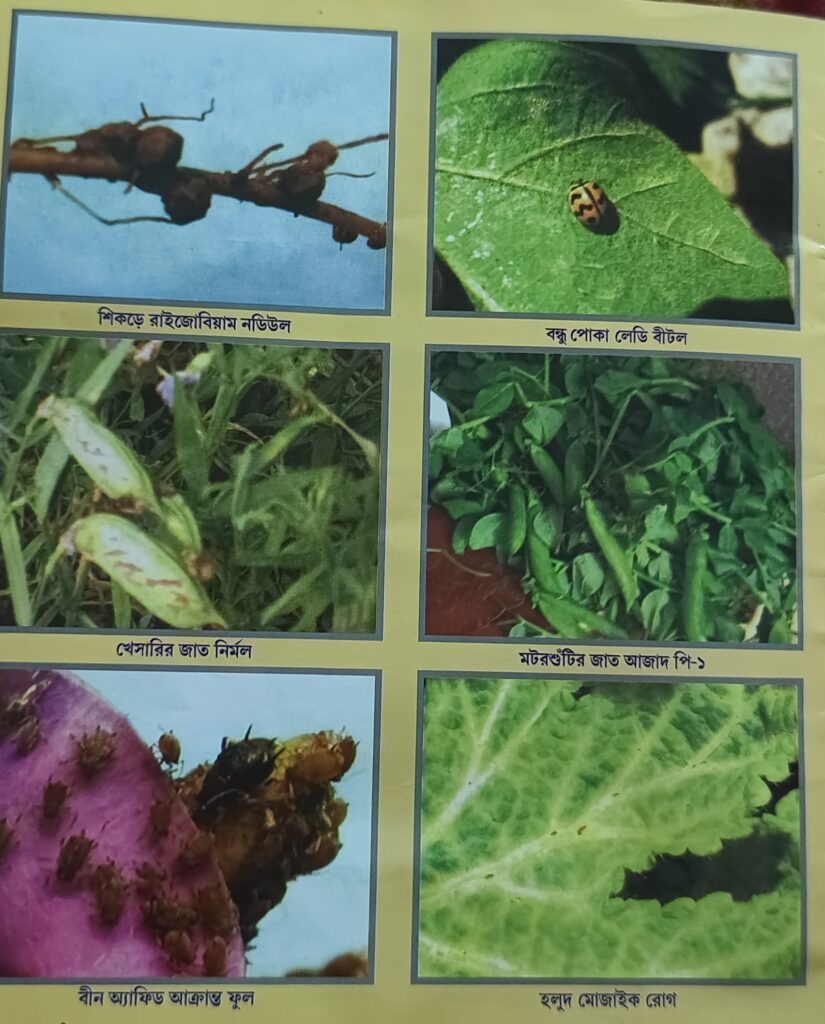
- Seed inoculation with appropriate Rhizobium culture in legumes.
- Use of green manuring and organic fertilizers.
- Timely sowing at recommended seed rates and spacing.
- Balanced fertilizer application based on soil testing, including boron and other micronutrients. Apply lime in acidic soils.
- Increased use of sulphur through Single Super Phosphate.
- Thinning of overcrowded plants to maintain optimum plant population.
- Regular weeding, proper irrigation, and effective drainage.
(b) Mechanical Control Methods
These involve direct physical removal or destruction of pests:
- Hand-picking and destruction of egg masses, larvae, and infested plant parts at the early stage of infestation.
- Collection and burning of infested leaves, pods, or stems.
- Installing bird perches (T-shaped poles) on field bunds to encourage predatory birds.
- Collecting parasitized pest larvae and placing them in specially designed bamboo cages (bird perches) so that adult parasites can emerge and continue their work in the field.
- Lighting bonfires or using light traps with burning tyres or kerosene lamps in the evening to attract and destroy adult moths.
(c) Biological Control Methods
Nature has provided many natural enemies of crop pests. These are called beneficial organisms or bio-agents. They are divided into three categories:
Table: Beneficial Organisms Used in Biological Control
| Category | Examples | Target Pests/Diseases |
|---|---|---|
| Predators | Syrphid flies, Ladybird beetles (Coccinellids), Spiders, Carabid beetles, Praying mantis | Aphids, Jassids, small larvae |
| Parasitoids | Trichogramma chilonis, Telenomus remus, Apanteles spp., Trioxys indicus | Egg and larval stages of pod borers, leaf folders |
| Pathogens (Microbes) | Bt (Bacillus thuringiensis var. kurstaki), Bacillus popilliae, NPV (Nuclear Polyhedrosis Virus), GV (Granulosis Virus), Metarhizium anisopliae, Trichoderma viride/harzianum, Beauveria bassiana | Caterpillars, grubs, soil-borne diseases |
Biological agents are safe for the environment and do not harm beneficial insects.
(d) Chemical Control Methods
Chemical pesticides should be used only as a last resort when pest populations cross the Economic Threshold Level (ETL). Examples of ETL for pulses:
- If 40–50 aphids are found on 10 cm tender shoot or 33% plants are infested, chemical intervention becomes necessary.
Guidelines for Chemical Use:
- Apply pesticides only when absolutely needed.
- Use the right pesticide in the correct dose at the right time.
- Prefer less toxic, selective, and biopesticides in the early stage of infestation.
- Use neem-based products and microbial pesticides as the first choice.
Monitoring and Scouting — The Foundation of IPM
Regular field monitoring is the most important component of successful IPM. By regularly observing the crop, farmers can:
- Assess pest and disease incidence accurately.
- Predict potential damage.
- Decide which control measures are needed and when.
- Avoid unnecessary pesticide sprays.
Conclusion
Integrated Pest Management (IPM) is a scientific, sustainable, and environmentally responsible approach to controlling pests and diseases in pulse crops. It reduces the cost of cultivation, protects natural enemies, preserves soil and environmental health, and ensures higher and safer yields. By combining cultural, mechanical, biological, and need-based chemical methods along with regular monitoring, farmers can successfully manage pests and diseases while maintaining ecological balance.
Adoption of IPM practices in pulse cultivation will not only increase production but also contribute to safer food, healthier soil, and a cleaner environment for future generations.
Integrated Pest and Disease Management (IPM) in Pulse Crops
Pulse crops are highly vulnerable to a wide range of insect pests and diseases. In intensive farming systems, the indiscriminate use of chemical pesticides has created serious problems — including the destruction of beneficial organisms, environmental pollution, and the development of pesticide resistance. To overcome these challenges while increasing productivity, Integrated Pest Management (IPM) has emerged as the most sustainable and scientific approach.
IPM combines multiple control methods in a coordinated manner to keep pest and disease populations below the Economic Injury Level, ensuring maximum crop protection with minimum cost and environmental harm.
What is IPM?
Integrated Pest Management (IPM) is an ecosystem-based strategy that uses all suitable techniques — cultural, mechanical, biological, and chemical — in a harmonious way. The aim is to manage pests and diseases effectively while safeguarding the environment, human health, and beneficial organisms.
Objectives of IPM:
- Keep pest and disease levels below the economic threshold so they do not cause significant financial loss.
- Reduce unnecessary pesticide application and prevent environmental pollution.
- Protect natural enemies of pests and maintain ecological balance.
Core Principle:
Complete eradication of pests is neither possible nor desirable. The goal is to manage them at tolerable levels through the least harmful methods.
Crop Ecosystem Monitoring Format
Regular field scouting is the foundation of successful IPM. Farmers should maintain the following observation record:
| Date | Time | Crop | Weather Condition | Rainfall | Relative Humidity | Fertilizer Applied | Soil Moisture | Weed Infestation | Crop Age | Special Observations |
|---|---|---|---|---|---|---|---|---|---|---|
Pest and Beneficial Insect Count (Example):
- Pest Insects: Leaf folder – 8, Green leafhopper – 6, Whitefly – 5
- Beneficial Insects: Ladybird beetle – 6, Spider – 6, Damselfly – 4, Parasitoid wasps – 12
- Total Pests: 35
- Total Beneficials: 15
- Ratio (Pest : Beneficial): 1 : 2.33
Such regular monitoring helps decide when and what control measures are truly needed.
Major Pests and Diseases of Mung and Black Gram
Insect Pests:
- Leaf folder
- Tobacco caterpillar (Spodoptera)
- Pod borer (Helicoverpa)
- Aphids
- Stem fly
- Red spider mite
- Thrips
Diseases:
- Powdery mildew
- Rust
- Leaf spot and blight
- Yellow mosaic virus
- Root rot and collar rot
- Bacterial leaf spot
Integrated Pest Management for Mung and Black Gram
Cultural Practices:
- Select high land with good drainage and disease-resistant varieties (e.g., Samrat, Basanti).
- Seed treatment with Trichoderma viride or Metalaxyl 2 g per kg seed is essential.
- Maintain proper spacing for better sunlight and air circulation.
- Remove and destroy infested plant parts, egg masses, and larvae.
- After harvest, burn crop residues and perform deep ploughing to expose soil to sunlight.
- Use balanced fertilizers based on soil testing.
Biological Control:
- Apply Bt or NPV (S or H) @ 1 ml per litre of water, 2–3 sprays at 15-day intervals for pod borers and caterpillars.
Chemical Control (as per need):
- Red spider mite: Dicofol, Propargite, or Milbemectin.
- Aphids: Oxydemeton methyl or Dimethoate.
- Thrips and stem fly: Imidacloprid or Clothianidin.
- Pod borer: Indoxacarb, Chlorpyrifos + Cypermethrin, or Triazophos + Deltamethrin.
Integrated Disease Management for Mung and Black Gram
- Choose well-drained soil and apply lime to correct acidity.
- Use resistant varieties and balanced fertilizers.
- Ensure proper plant spacing for good aeration.
- Regular scouting and removal of infected parts.
- Apply Trichoderma viride @ 1–2 kg mixed with 50 kg FYM or vermicompost per acre to control soil-borne diseases.
Chemical Control:
- Powdery mildew: Carbendazim 1 g or Tridemorph 0.5 ml or Myclobutanil 0.5 g per litre.
- Rust, leaf spot & blight: Propiconazole 0.75 ml or (Metalaxyl + Mancozeb) 2.5 g or Thiophanate methyl 0.75 ml per litre.
- Yellow mosaic: Use resistant varieties + control whitefly with Acetamiprid 0.20 g or Imidacloprid 0.20 ml per litre.
IPM for Other Pulse Crops (Summary Table)
| Pulse Crop | Major Pests | Major Diseases |
|---|---|---|
| Khesari | Pod borer | Leaf blight |
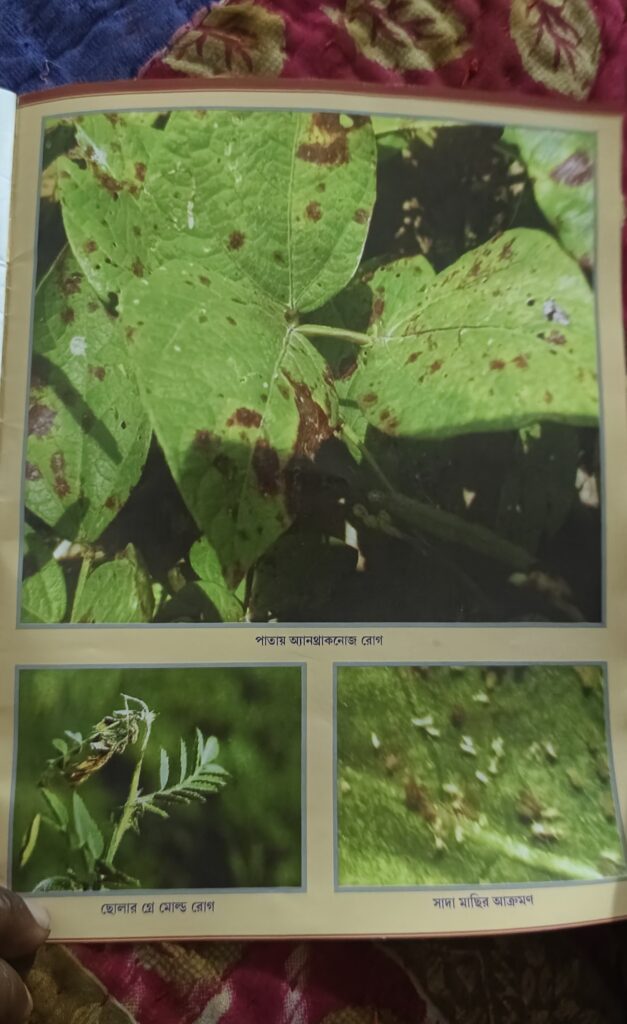
| Lentil | Aphids | Collar rot, Grey mould |
| Chickpea | Pod borer, Cutworm | Wilt, Blight, Rust |
| Soybean | Leaf eating caterpillar, Pod borer | Root rot, Leaf spot, Rust |
| Pigeon pea | Pod borer, Plume moth | Wilt, Rust |
General IPM Recommendations for All Pulses:
- Always select resistant varieties.
- Mandatory seed treatment with fungicides and Trichoderma.
- Maintain optimum plant population and spacing.
- Regular field scouting and destruction of infested parts.
- Destroy crop residues after harvest and deep plough the field.
- Use biopesticides (Bt, NPV, Beauveria, Metarhizium) as the first choice.
- Apply chemical pesticides only when pest populations cross the economic threshold level, and prefer selective, low-toxicity options.
Conclusion
Integrated Pest Management is the future of pulse cultivation. It reduces production costs, protects the environment, conserves beneficial organisms, and ensures sustainable higher yields. By combining cultural practices, biological agents, regular monitoring, and need-based chemical use, farmers can effectively manage pests and diseases while maintaining soil and ecosystem health.
Adopting IPM in pulse crops will not only increase production and farmer income but also contribute to safer food, cleaner environment, and long-term agricultural sustainability in West Bengal.
Production Statistics of Pulse Crops in West Bengal
Pulse crops play a crucial role in nutritional security and soil health improvement. Despite their importance, pulse production in West Bengal has shown fluctuations over the years due to various climatic and agronomic factors. The following table presents the area, production, and productivity of total pulse crops in the state over the past decade:
Table: Area, Production and Productivity of Pulse Crops in West Bengal
| Year | Area (Thousand Hectares) | Production (Thousand Metric Tonnes) | Average Yield (kg/ha) |
|---|---|---|---|
| 2001-02 | 249.129 | 175.144 | 703 |
| 2002-03 | 241.767 | 167.887 | 694 |
| 2003-04 | 251.886 | 211.642 | 840 |
| 2004-05 | 226.381 | 167.302 | 739 |
| 2005-06 | 222.591 | 174.532 | 784 |
| 2006-07 | — | — | — |
| 2007-08 | 219.606 | 154.606 | 703 |
| 2008-09 | 200.943 | 158.021 | 786 |
| 2009-10 | 184.014 | 129.730 | 705 |
| 2010-11 | 182.395 | 150.434 | 825 |
| 2011-12 | 197.060 | 176.522 | 896 |
| 2012-13 | 199.003 | 153.979 | 774 |
| 2013-14 | 218.001 | 201.648 | 925 |
| 2014-15 | 233.432 | 215.227 | 922 |
The data indicates that while the area under pulses has remained relatively stable, there is scope for significant improvement in productivity through better varieties, scientific management, and effective pest-disease control.
Appendix: List of Some Insecticides and Fungicides with Trade Names and Doses
Table 1: Some Important Insecticides
| Chemical Name | Trade Name | Dose per Litre of Water |
|---|---|---|
| Lindane 6.5% WP | Lindane, Termahit | 5 g |
| Methyl Parathion 50% EC | Metacid, Suthacid | 1 ml |
| Endosulfan 35% EC | Thiodon, Speed | 2 ml |
| Carbofuran 25% EC | Marshal | 2 ml |
| Chlorpyrifos 20% EC | Dermet, Classic | 2.5 ml |
| Carbaryl 50% WP | Sevin, Carbaryl | 2.5 g |
| Methomyl 40% SP | Lannate, Dunet | 1 g |
| Profenofos 50% EC | Carina, Curacron | 1.5 ml |
| Emamectin Benzoate 5% SG | Proclaim | 0.5 g |
| Difenthiuron 50% WP | Pegasus | 1 g |
| Dimethoate 30% EC | Rogor, Tara-909 | 2 ml |
| Methyl Demeton 25% EC | Metasystox, Hymox | 2 ml |
| Fipronil 5% SC | Regent | 1 ml |
| Imidacloprid 17.8% SL | Confidor, Media | 0.2 ml |
| Acetamiprid 20% SP | Pride | 0.2 g |
| Thiamethoxam 25% WG | Aktara, Anant | 0.33 g |
| Clothianidin 50% WDG | Dantop | 0.1 g |
| Acephate 75% SP | Asataf, Starthene | 0.75 g |
| Cartap Hydrochloride 50% SP | Padan, Kelden | 1 g |
| Chlorfenapyr 10% SC | Intrepid | 1.5 ml |
| Flubendiamide 20% WDG | Fame | 0.5 g |
| Thiacloprid 24% SC | Calypso | 1 ml |
| Novaluron 10% EC | Rimon, Nova | 1 ml |
| Lufenuron 10% EC | Sigma, Match | 1 ml |
| Spinosad 45% SC | Tracer, Spintor | 0.15 ml |
| Buprofezin 25% SC | Hamla, Anaconda | 0.5 ml |
| Chlorpyrifos 50% + Cypermethrin 5% EC | Rocket, Polytrin | 1.5 ml |
| Endosulfan 29.75% + Deltamethrin 0.75% EC | Civet, Hitsel | 2 ml |
| Profenofos 40% + Cypermethrin 4% EC | Coranda, Miranda | 1.5 ml |
| Acephate 25% + Fenvalerate 3% EC | — | 1.5 ml |
| Deltamethrin 5.76% + Buprofezin 0.67% EC | — | 1.5 ml |
| Acephate 50% + Imidacloprid 1.8% SC | Lancer Gold | 1.5 ml |
| Dicofol 18.5% EC | Kelthane, Colonel | 2 ml |
| Propargite 57% EC | Simba, Omite | 2 ml |
| Abamectin 1.9% EC | Vertimec | 1 ml |
| Methyl Parathion 2% Dust | Folidol, Methatox | 10 kg/acre |
| Chlorpyrifos 1.5% Dust | Radar, Force | 10 kg/acre |
| Lindane 1.3% Dust | Hexa, Debilin | 10 kg/acre |
| Phorate 10G | Furadan, Furatox | 4 kg/acre |
| Chlorpyrifos 10G | Thimet, Foratox | 12 kg/acre |
| Cartap 4G | Padan, Critap | 10 kg/acre |
| Fipronil 0.3G | Regent, Tempo | 7.5 kg/acre |
Table 2: Some Important Fungicides
| Chemical Name | Trade Name | Dose per Litre of Water |
|---|---|---|
| Mancozeb 75% WP | Dithane M-45, Spara | 2.5 g |
| Zineb 75% WP | Indofil Z-78, Dithane Z-78 | 2.5 g |
| Copper Oxychloride 50% WP | Blitox, Blue Copper | 4 g |
| Copper Hydroxide 77% WP | Kocide | 2 g |
| Carbendazim 50% WP | Bavistin, Derosal | 1 g |
| Benomyl 50% WP | Benlate, Benomyl | 0.5 g |
| Metalaxyl 35% WS | Apron, Ridomil | 2 g |
| Thiophanate Methyl 70% WP | Roko, Topsin-M | 0.75 g |
| Dodine 65% WP | Syllit, Click | 0.5 g |
| Chlorothalonil 75% WP | Kavach, Daconil | 2 g |
| Sulphur 80% WP | Sulfex, Insaf | 3 g |
| Propineb 70% WP | Antracol | 3 g |
| Metiram 70% WP | Polyram, Sanit | 3 g |
| Dimethomorph 50% WP | Acrobat | 1 g |
| Hexaconazole 5% EC | Contaf, Sudden | 1 ml |
| Propiconazole 25% EC | Tilt, Pinnacle | 0.75 ml |
| Difénoconazole 25% EC | Score | 1 ml |
| Myclobutanil 10% WP | Systhane | 0.5 g |
| Validamycin / Kasugamycin | Kasu-B | 2 ml |
| (Carbendazim 12% + Mancozeb 64%) WP | Companion | 2 g |
| (Captan 70% + Hexaconazole 5%) WP | — | 2 g |
| (Iprodione 25% + Carbendazim 25%) WP | Quintal | 1 g |
| (Mancozeb 64% + Cymoxanil 8%) WP | — | 2.5 g |
Important Note on Pesticide Use:
- Always follow the recommended dose and safety precautions.
- Use protective clothing, gloves, and masks while spraying.
- Avoid spraying during flowering to protect pollinators.
- Follow the waiting period before harvest.
- Prefer biopesticides and IPM practices over chemical pesticides whenever possible.
This appendix provides a ready reference for farmers and extension workers for effective and safe pest and disease management in pulse crops. Combined with cultural and biological methods, these chemicals should be used only as a last resort under Integrated Pest Management (IPM) principles.
Conclusion of the Pulse Crops Cultivation Guide
RELATED POSTS
View all